MCQ
product ($C$) is
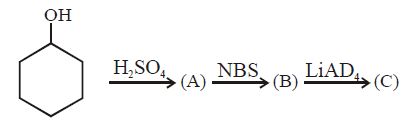
- A

- B

- C

- ✓

Generate a complete, print-ready paper with questions like this in minutes — across 16+ boards, with answer keys.
The above reaction is an example of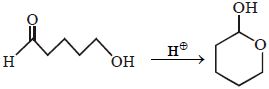
$\mathop {(A)}\limits_{{C_{11}}{H_8}O} \to $ does not under go self aldol condensation
$\mathop {(A)}\limits_{{C_{11}}{H_8}O} \xrightarrow{{{O_3}}}ph\, - \,CHO\, + \,2B\,\xrightarrow{{A{g^ + }}}$ Oxalic acid
$A$. All group $16$ elements form oxides of general formula $\mathrm{EO}_2$ and $\mathrm{EO}_3$ where $\mathrm{E}=\mathrm{S}, \mathrm{Se}, \mathrm{Te}$ and Po. Both the types of oxides are acidic in nature.
$B$. $\mathrm{TeO}_2$ is an oxidising agent while $\mathrm{SO}_2$ is reducing in nature.
$C$. The reducing property decreases from $\mathrm{H}_2 \mathrm{~S}$ to $\mathrm{H}_2 \mathrm{Te}$ down the group.
$D$. The ozone molecule contains five lone pairs of electrons.
Choose the correct answer from the options given below: