MCQ
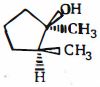
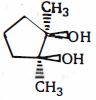
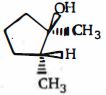
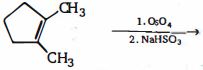
Product of the reaction is
  • A


  • C

  • D

Answer

Correct option: B.

b
$(b)$ cis-diol will form

Need a full question paper?

Generate a complete, print-ready paper with questions like this in minutes — across 16+ boards, with answer keys.

Start Generating Free

Similar questions

The species having no $p \pi - p \pi$ bond but has bond order equal to that of $O_2$ 
When $KMn{O_4}$ acts as an oxidising agent and ultimately forms ${[\,Mn{O_4}]^{ - 2}},\,\,Mn{O_2},\,\,\,M{n_2}{O_3},\,\,M{n^{ + 2}}$ then the number of electrons transferred in each case respectively is
The tendency of electron to loose electron is a measure of which of the following :
The fragrance of flowers is due to the presence of some steam volatile organic compounds called essential oils. These are generally insoluble in water at room temperature but are miscible with water vapour in vapour phase. A suitable method for the extraction of these oils from the flowers is:
In Carius tube, an organic compound ' $X$ ' is treated with sodium peroxide to form a mineral acid ' $Y$ '. The solution of $BaCl _2$ is added to ' $Y$ ' to form a precipitate ' $Z$ '. ' $Z$ ' is used for the quantitative estimation of an extra element. ' $X$ ' could be:
A mixture of $H_2$ and sufficient quantity of air at $25\,^oC$ aild $1\ atm$ pressure undergoes complete combustion in a closed rigid adiabatic container leaving behind $H_2O(g)$ and $N_2(g)$. If air is a mixture of $80\% N_2$ and $20\%O_2$ by volume and $C_{P(N_2 )}$ and $C_{P(H_2O)g}$ are $7.0$ and $8.0\  cal-deg^{- 1}\  mol^{-1}$ respectively. What will be max imum temperature attained ?

( Given that : ${\left( {\Delta {H^o}_f} \right)_{{H_2}O(g)}} =  - 56.0\,\,kcal/mol$ and it is independnet of temperature).......$ K$ 
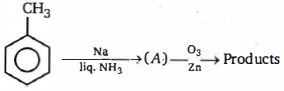
Which of the following product cannot be obtained in above reaction ?
$K_{SP}$ of $AgCl$ at $18\,^oC$ is $1.8 \times 10^{-10}$. If concentration of $Ag^+$ is $4 \times 10^{-3}\, mol/litre$ the concentration of $Cl^-$ that is required for $AgCl$ precipitation
Which is not example of Bronsted Lowry theory
The ionisation of weak base MOH can be represented by equation,
$\text{MOH}(\text{aq})\rightleftharpoons\text{M}^+(\text{aq})+\text{OH}^-(\text{aq});$
$\text{K}_{\text{b}}=\frac{[\text{M}^+][\text{OH}^-]}{[\text{MOH}]}$
where, Kb is represented as: