MCQ
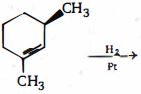
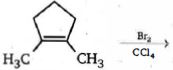
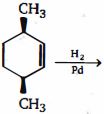
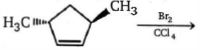
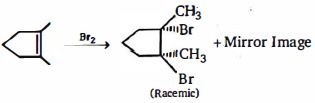
Product of which of the following reactions, is racemic mixture ?
  • A


  • C

  • D

Answer

Correct option: B.

b

Need a full question paper?

Generate a complete, print-ready paper with questions like this in minutes — across 16+ boards, with answer keys.

Start Generating Free

Similar questions

Conside the following reactions:

$\mathrm{NaCl}+\mathrm{K}_{2} \mathrm{Cr}_{2} \mathrm{O}_{7}+\mathrm{H}_{2} \mathrm{SO}_{4}(\mathrm{Conc} .) \rightarrow(\mathrm{A})+$ Side products

$(\mathrm{A})+\mathrm{NaOH} \rightarrow(\mathrm{B})+$ side product

$(\mathrm{B})+\mathrm{H}_{2} \mathrm{SO}_{4}(\mathrm{dilute})+\mathrm{H}_{2} \mathrm{O}_{2} \rightarrow(\mathrm{C})+$ Side product

The sum of the total number of atoms in one molecule each of $(A), (B)$ and $(C)$ is
At $300\, K$ and $1\, atm,\, 15\, mL$ of a gaseous hydrocarbon requires $375\, mL$ air containing $20\%\,\, O_2$ by volume for complete combustion. After combustion the gases occupy $330\, mL.$ Assuming that the water formed is in liquid form and the volumes were measured at the same temperature and pressure, the formula of the hydrocarbon is :
What is the $pH$ of a solution in which $10.0\, mL$ of $0.010\, M$ $Sr(OH)_2$ is added to $10.0\, mL$ of $0.010\, M\, HCl$ ?
The standard heats of formation in $kcal$ $mo{l^{ - 1}}$ of $N{O_2}(g)$ and ${N_2}{O_4}(g)$ are $8.0$  and $2.0 $ respectively. The heat of dimerization of $N{O_2}$ in $kcal$ is $2N{O_2}(g) = {N_2}{O_4}(g)$
How many moles of ${K_2}C{r_2}{O_7}$ can be reduced by $1\, mole$ of $S{n^{2 + }}$
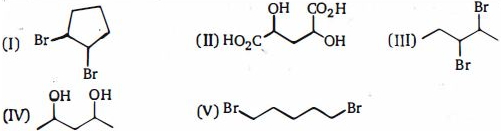
A compound was synthesized by a student, but its structure was not identified.  However, his wonderfully helpful instructor told him that it was a meso compound with $5$ carbons and $2$ stereogenic centers. Which of the following structures  should the student consider as possibilities for his compound ?
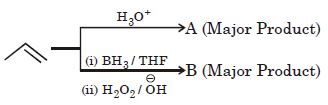
Relation between products $A$ and $B$ is ?
Which among the following represents the reaction of formation of the product ?
Decreasing$(-I)$ power of given groups is

$(A) -CN$ $(B) -NO_2$ $(C) -NH_2$ $(D) -F$

Which of the following carbide gives alkane on hydrolysis :