MCQ
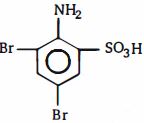
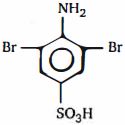
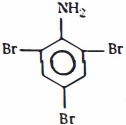
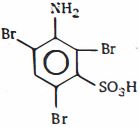
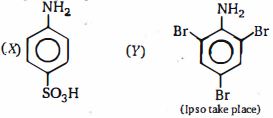
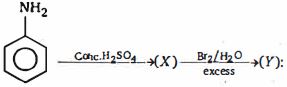
Product $(Y)$ of this reaction is
  • A

  • B


  • D

Answer

Correct option: C.

c

Need a full question paper?

Generate a complete, print-ready paper with questions like this in minutes — across 16+ boards, with answer keys.

Start Generating Free

Similar questions

$4-$ carbohydrate glucose, lactose , sucrose, starch are present. Different test is carried out with $4-$ carbohydratcs separately. Following observation takes place. 

$(a)$ Heated : it is charred

$(b)$ $I_2$ solution : no violet colour

$(c)$ Fehling solution : reddish brown ppt. is observed

$(d)$ It does not reduce copper$(II)$ acetate to $Cu_2O$ . No red precipiated is observed in $5/ min$ 

The carboxylate which satisfy all the above observation 

$ClCH_2CH_2OH$ is stronger acid than $CH_3CH_2OH$ because of
Paraldehyde is used as a______________.
In the following sequence of reactions, what is $D$

image $\xrightarrow{{[O]}}A\xrightarrow{{SOC{l_2}}}B\xrightarrow{{Na{N_3}}}C\xrightarrow{{{\text{Heat}}}}D$

Isopropyl alcohol heated at ${300\,^o}C$ with copper catalyst to form
A reaction takes place in three steps with individual rate constant and activation energy as follows 

     Rate constant     Activation energy
 Step $1$        $k_1$ $E_{a1} = 180\ kJ/mol$
 Step $2$        $k_2$ $E_{a2} = 80\ kJ/mol$
 Step $3$        $k_3$ $E_{a3} = 50\ kJ/mol$

If overall rate constant, $k = {\left( {\frac{{{k_1}{k_2}}}{{{k_3}}}} \right)^{2/3}}$  ,then overall activation energy of the reaction will be  .......... $ kJ/mol$

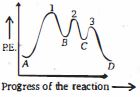
Energy profile diagram for an exothermic reaction, $A\xrightarrow{1}B\xrightarrow{2}C\xrightarrow{3}D,$ is given below.

The rate determining step of the reaction is
Which metal is used to make alloy steel for armour plates, safes and helmets
Arrange the following bonds according to their average bond energies in descending order 

$\mathrm{C}-\mathrm{Cl}, \mathrm{C}-\mathrm{Br}, \mathrm{C}-\mathrm{F}, \mathrm{C}-\mathrm{I}$

Consider the following complex $[Co(NH_3)_5CO_3]ClO_4$. The coordination number, oxidation number, number of $d-$ electrons and number of unpaired $d-$ electrons on the metal are respectively