Question
Projection of vector $\vec A$ on $\vec B$ is

Answer

The projection of $\vec{A}$ on $\vec{B}$ is a vector with length $P Q$ which begins at $P$ in the same direction as $\vec{B}$.

The projection of $\vec{A}$ on $\vec{B}$ is defined as $\frac{\vec{A} \cdot \vec{B}}{|\vec{B}|}=\vec{A} \cdot \hat{B}$

Need a full question paper?

Generate a complete, print-ready paper with questions like this in minutes — across 16+ boards, with answer keys.

Start Generating Free

Similar questions

What is the change in temperature on Fahrenheit scale and Kelvin scale, if an iron piece is heated from $30\ ^oC$ to $90\ ^oC$?
A body is imparted motion from rest to move in a straight line. If it is then obstructed by an opposite force, then
In an orchestra, the musical sounds of different instruments are distinguished from one another by which of the following characteristics
A circular coil of radius $10\, cm$ is placed in a uniform magnetic field of $3.0 \times 10^{-5}\, T$ with its plane perpendicular to the field initially. It is rotated at constant angular speed about an axis along the diameter of coil and perpendicular to magnetic field so that it undergoes half of rotation in $0.2\,s.$ The maximum value of $EMF$ induced (in $\mu V$ ) in the coil will be close to the integer$....\mu V$
A bullet of mass $5\, g$, travelling with a speed of $210$ $m / s ,$ strikes a fixed wooden target. One half of its kinetic energy is converted into heat in the bullet while the other half is converted into heat in the wood. The rise of temperature of the bullet if the specific heat of its material is $0.030\, cal /\left( g -{ }^{\circ} C \right)$ $\left(1\, cal =4.2 \times 10^{7}\, ergs \right)$ close to$.......^oC$
The magnetic flux linked with a coil (in $Wb$) is given by the equation $\phi=5 t^{2}+3 t+16$ The magnitude of induced emf in the coil at the fourth second will be (In $V$)
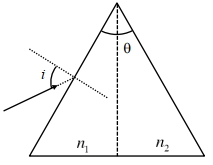
For a prism of prism angle $\theta=60^{\circ}$, the refractive indices of the left half and the right half are, respectively, $n_1$ and $n_2\left(n_2 \geq n_1\right)$ as shown in the figure. The angle of incidence $i$ is chosen such that the incident light rays will have minimum deviation if $n_1=n_2=n=1.5$. For the case of unequal refractive indices, $n_1=n$ and $n_2=n+\Delta n$ (where $\Delta n \ll n$ ), the angle of emergence $e=i+\Delta e$.

Which of the following statement($s$) is (are) correct?

$(A)$ The value of $\Delta e$ (in radians) is greater than that of $\Delta n$

$(B)$ $\Delta e$ is proportional to $\Delta n$

$(C)$ $\Delta e$ lies between 2.0 and 3.0 milliradians, if $\Delta n=2.8 \times 10^{-3}$

$(D)$ $\Delta e$ lies between 1.0 and 1.6 milliradians, if $\Delta n=2.8 \times 10^{-3}$
The centre of mass of a body
If the velocity of light $c$, universal gravitational constant $G$ and planck's constant $h$ are chosen as fundamental quantities. The dimensions of mass in the new system is
The radius of a soap bubble whose potential is $16\,V$ is doubled. The new potential of the bubble will be.....$V$