The radius of a soap bubble whose potential is $16\,V$ is doubled. The new potential of the bubble will be.....$V$
Easy


Download our appand get started for free
Experience the future of education. Simply download our apps or reach out to us for more information. Let's shape the future of learning together!No signup needed.*
Similar Questions
- 1Two electrons are moving towards each other, each with a velocity of $10^6 \,m / s$. What will be closest distance of approach between them is ......... $m$View Solution
- 2$X $ and $Y$ are large, parallel conducting plates closed to each other. Each face has an area $A$. $X$ is given a charge $Q$. $Y$ is without any charge. Points $A, B$ and $C$ are as shown in figure.View Solution

- 3View SolutionConsidering a group of positive charges, which of the following statements is correct?
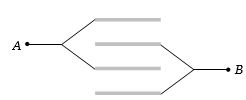
- 4Four plates of the same area of cross-section are joined as shown in the figure. The distance between each plate is $d$. The equivalent capacity across $A$ and $B$ will beView Solution
- 5$0.2\, F$ capacitor is charged to $600\, V$ by a battery. On removing the battery. It is connected with another parallel plate condenser of $1\, F$. The potential decreases to....$V$View Solution
- 6An electric dipole of moment $\vec p$ is kept in a uniform electric field $\vec E$. Angle between $\vec p$ and $\vec E$ is $30^o$. Calculate work done by field when angle is increased to $60^o.$View Solution
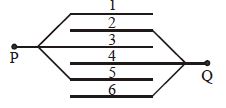
- 7Six metallic plates each with a surface area of one side $A$, are placed at a distance $d$ from each other. The alternate plates are connected to points $P$ and $Q$ as shown in figure. The capacitance of the system isView Solution
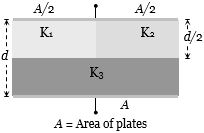
- 8A parallel plate capacitor of area $A$, plate separation $d$ and capacitance $C$ is filled with three different dielectric materials having dielectric constants ${k_1},{k_2}$ and ${k_3}$ as shown. If a single dielectric material is to be used to have the same capacitance $C$ in this capacitor, then its dielectric constant $k$ is given byView Solution
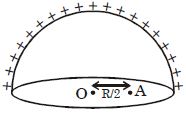
- 9A hemispherical bowl of mass $m$ is uniformly charged with charge density $'\sigma '$ . Electric potential due to charge distribution at a point $'A'$ is (which lies at centre of radius as shown).View Solution
- 10Two capacitors connected in parallel having the capacities ${C_1}$ and ${C_2}$ are given $'q'$ charge, which is distributed among them. The ratio of the charge on ${C_1}$ and ${C_2}$ will beView Solution