MCQ
Projection of vector $\vec A$ on $\vec B$ is
  • A
    $\vec A.\vec B$
  • $\vec A.\hat B$
  • C
    $\vec B \times \vec A$
  • D
    $\hat B.\hat A$

Answer

Correct option: B.
$\vec A.\hat B$
b
$A\,\cos \,\theta  = \frac{{\vec A.\vec B}}{{\left| {\vec B} \right|}} = \vec A.\hat B$

Need a full question paper?

Generate a complete, print-ready paper with questions like this in minutes — across 16+ boards, with answer keys.

Start Generating Free

Similar questions

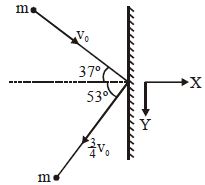
A ball of mass $m$ moving with velocity $v_0$ collides a wall as shown in figure. After impact it rebounds with a velocity $\frac {3}{4}v_0$. The impulse acting on ball during impact is
A charged $30\,\mu F$ capacitor is connected to a $27\,mH$ inductor. The angular frequency of free oscillations of the circuit is
Two charges $q$ and $-3q$ are placed fixed on $x-axis$ separated by distance $'d'$. Where should a third charge $2q$ be placed such that it will not experience any force ?
The nucleus $_{48}^{115}Cd$ after two successive ${\beta ^ - }$ decays will give
Two rigid boxes containing different ideal gases are placed on a table. Box A contains one mole of nitrogen at temperature $T_0$, while Box contains one mole of helium at temperature $(7/3)$ $T_0$ The boxes are then put into thermal contact with each other, and heat flows between them until the gases reach a common final temperature (ignore the heat capacity of boxes). Then, the final temperature of the gases,$T_f$  in terms of $T_0$ is
A constant voltage is applied between the two ends of a uniform metallic wire. Some heat is developed in it. The heat developed is double if
Resistivity of a semiconductor depends on
A bar magnet of magnetic moment $10^4\,J/T$ is free to rotate in a horizontal plane. The work done in rotating the magnet slowly from a direction parallel to a horizontal magnetic field of $4×10^{-5}\, T$ to a direction $ 60° $ from the field will be.....$ J$
An iron ball and a wooden ball of the same radius are released from the same height in vacuum. They take the same time to reach the ground. The reason for this is
Given that $\vec A\, + \,\vec B\, = \,\vec C\,.$  If  $\left| {\vec A} \right|\, = \,4,\,\,\left| {\vec B} \right|\, = \,5\,\,$ and $\left| {\vec C} \right|\, =\,\sqrt {61}$ the angle between $\vec A\,\,$ and $\vec B$ is ....... $^o$