Question
Propanal and pentan-3-one are the ozonolysis products of an alkene? What is the structural formula of the alkene?
Answer


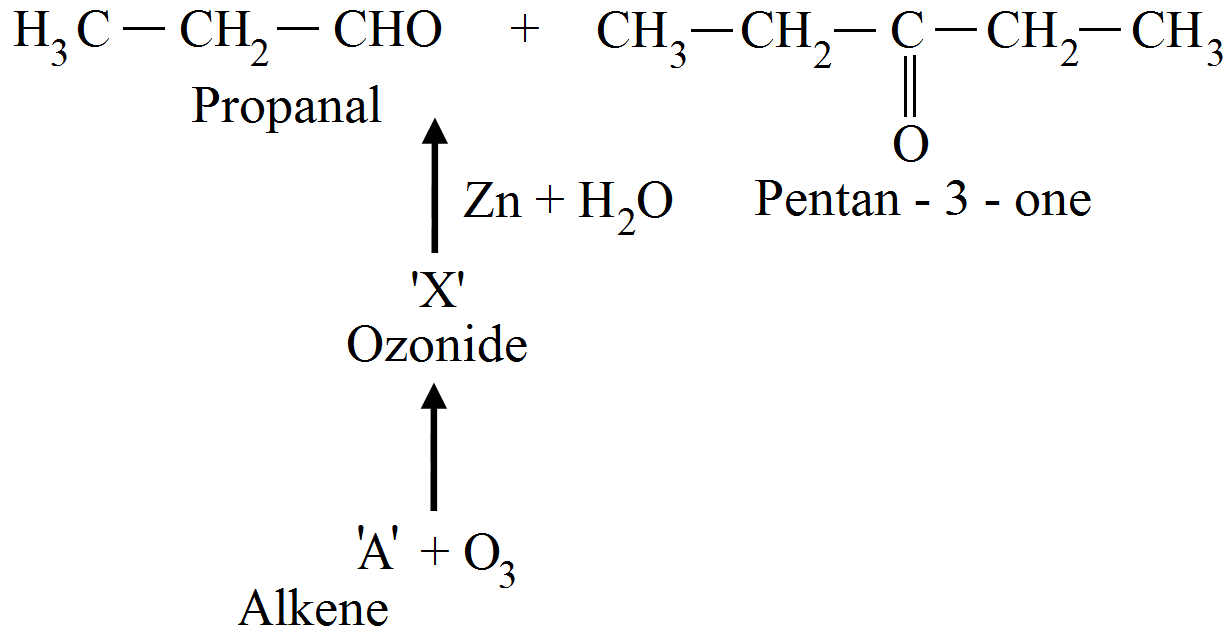
As per the given information, propanal and pentan-3-one are the ozonolysis products of an alkene. Let the given alkene be 'A'. Writing the reverse of the ozonolysis reaction, we get:

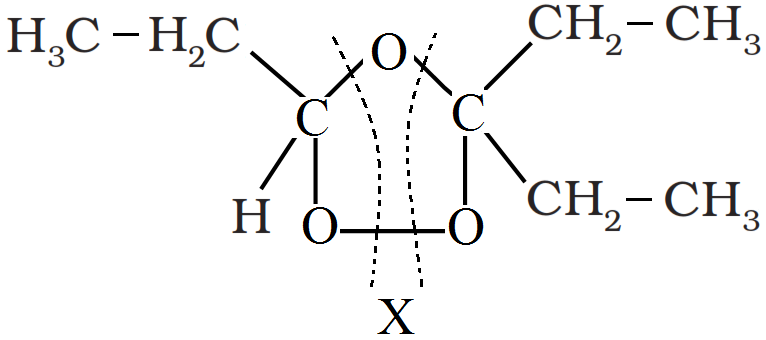
The products are obtained on the cleavage of ozonide 'X'. Hence, 'X' contains both products in the cyclic form. The possible structure of ozonide can be represented as:

Now, 'X' is an addition product of alkene ‘A’ with ozone. Therefore, the possible structure of alkene 'A' is:
$\text{H}_3\text{C}-\text{CH}_2-\text{CH}=\text{C}-\text{CH}_2-\text{CH}_3\\\ \ \ \ \ \ \ \ \ \ \ \ \ \ \ \ \ \ \ \ \ \ \ \ \ \ \ \ \ \ \ \ \ \ \ \ \ |\\\ \ \ \ \ \ \ \ \ \ \ \ \ \ \ \ \ \ \ \ \ \ \ \ \ \ \ \ \ \ \ \ \ \ \ \ \text{CH}_2\text{CH}_3$

Need a full question paper?

Generate a complete, print-ready paper with questions like this in minutes — across 16+ boards, with answer keys.

Start Generating Free

Similar questions

Write the favourable factors for the formation of ionic bond.
  1. For the reaction:
$\text{N}_2(\text{g})+3\text{H}_2(\text{g})\rightleftharpoons2\text{NH}_3(\text{g}),$
The value of $K_p$ is $3.6 \times 10^{-2}$ at $500K$.
Colculate the value of $K_c$ for the reaction at the same temperature R = 0.083L bar $K^{-1}mol^{-1}$​​​​​​​.
  1. What is the effect of increasing pressure in the reactions? Give reason.
$\text{PCl}_5(\text{g})\rightleftharpoons\text{PCl}_3(\text{g})+\text{Cl}_2\text{(g)}$
$\text{N}_2(\text{g})+\text{O}_2(\text{g})\rightleftharpoons2\text{NO(g)}$
Balance the following equations in basic medium by ion-electron method and oxidation number methods and identify the oxidising agent and the reducing agent.$\text{P}_4(\text{s})+\text{OH}^{-}(\text{aq})\rightarrow\text{PH}_3(\text{g})+\text{HPO}_2^-(\text{aq})$
Ethyl acetate is formed by the reaction of ethanol and acetic acid and the equilibrium is represented as:
$
CH_3 COOH(l)+C_5 H_5 OH(l) \rightleftharpoons CH_3 COOC_2 H_5(l)+H_2 O(l)
$
a. Write the concentration ratio (reaction quotient), $Q _{ C }$, for this reaction (note: water is not in excess and is not a solvent in this reaction)
b. At 293 K , if one starts with 1.00 mol of acetic acid and 0.18 mol of ethanol, there is 0.171 mol of ethyl acetate in the final equilibrium mixture. Calculate the equilibrium constant.
c. Starting with 0.5 mol of ethanol and 1.0 mol of acetic acid and maintaining it at $293 K, 0.214$ mol of ethyl acetate is found after some time. Has equilibrium been reached?
  1. Commercially available concentrated hydrochloric acid contains $45\%$ HCl by mass.
  1. What is the molarity of this solution? The density is $1.19g$ mL.
  2. What volume of cone. HCl is required to make $1.00L$ of $0.24M$ HCl?
  1. Write the balanced chemical equations for the following:
  1. $KMnO_4 + NH3 \rightarrow MnO_2 +KOH+ H_2O + N_2$
  2. $HNO_3 + P_4\rightarrow NO_2 + H_3PO_4 + H_2O$
Write the expression for the equilibrium constant, $K _{ C }$ for each of the following reactions:
a. $2 NOCl ( g ) \rightleftharpoons 2 NO ( g )+ Cl _2(g)$
b. $2 Cu \left( NO _3\right)_2(s) \rightleftharpoons 2 CuO ( s )+4 NO _2(g)+ O _2(g)$
c. $CH _3 COOC _2 H _5( aq )+ H _2 O ( l ) \rightleftharpoons CH _3 COOH ( aq )+ C _2 H _5 OH ( aq )$
d. $Fe ^{3+}( aq )+3 OH ^{-}( aq ) \rightleftharpoons Fe ( OH )_3(s)$
e. $I _2(s)+5 F_2 \rightleftharpoons 2 IF _5$
The first ionization enthalpy values (in $\mathrm{kJ} \mathrm{~mol}^{-1}$) of group 13 elements are:
B Al Ga In Tl
801 577 579 558 589
How would you explain this deviation from the general trend?
How the electrons was discovered? Explain
Write the electronic configurations of the following ions:
Explain why the following compounds behave as Lewis acids?
  1. $BCl_3$.
  2. $AlCl_3$.