Question
Explain why the following compounds behave as Lewis acids?
  1. $BCl_3$.
  2. $AlCl_3$.

Answer


Lewis acids are basically electron deficient species. They can readily accept electron from Lewis bases, which are electron rich and can donate electrons.
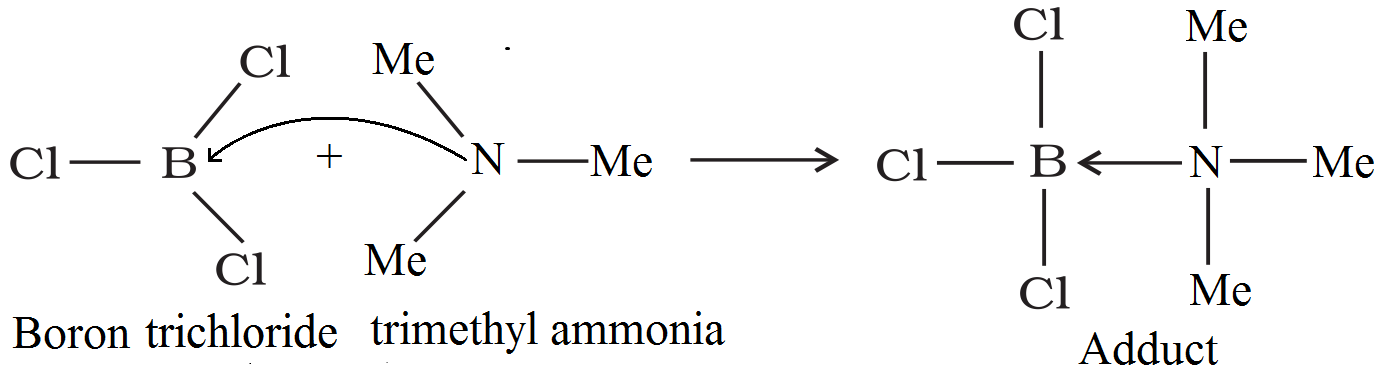
In $BCl_3$, the central atom boron is electron deficient and has only six electrons. Hence it is termed as Lewis acid. It can readily accept electron from ammonia or its derivatives.
Reaction:
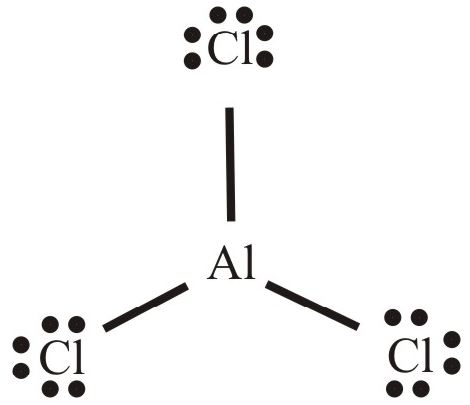
In $AlCl_3$, Al has empty p orbitals to accept the electrons to complete its octet, so it acts as a lewis acid.Structure of $AlCl _3$ :

Need a full question paper?

Generate a complete, print-ready paper with questions like this in minutes — across 16+ boards, with answer keys.

Start Generating Free

Similar questions

Consider the reaction of water with $F_2$ and suggest, in terms of oxidation and reduction, which species are oxidised/ reduced.
Attempt any five of the following:
(a) What happens when benzene is treated with acetyl chloride in presence of $AlCl _3$ ?
Image
(c) Classify the hydrocarbons according to the carbon-carbon bond.
(d) Arrange the following: $HCl , HBr , Hl , HF$ in order of decreasing reactivity towards alkenes.
(e) Why is $CH _2= CH - CH _2- Cl$ more easily hydrolysed than $CH _3- CH _2- CH _2- Cl$ ?
(f) Which of the two trans-but-2-ene or trans-pent-2-ene is non-polar?
(g) What are benzenoids?
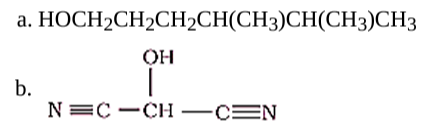
1. For each of the following compounds, write a condensed formula and also their bond-line formula.
Image
2. How does
i. an electron withdrawing group (EWG) and
ii. an electron donating group (EDG) influence the acid strength of carboxylic end?
What is the pH of 0.001 M aniline solution? The ionisation constant of aniline is $4.27 \times 10^{-10}$. Calculate the degree of ionisation of aniline in the solution. Also calculate the ionisation constant of the conjugate acid of aniline.
Balance the following equations in basic medium by ion-electron method and oxidation number methods and identify the oxidising agent and the reducing agent. $Cl_2O_7(g) + H_2O_2(aq) \rightarrow ClO_2^-(aq) + O_2(g) + H^+$
Present a comparative account of the alkali and alkaline earth metals with respect to the following characteristics:
  1. Tendency to form ionic/ covalent compounds.
  2. Nature of oxides and their solubility in water.
  3. Formation of oxosalts.
  4. Solubility of oxosalts.
  5. Thermal stability of oxosalts.
How are different series formed in the linear spectrum of hydrogen? Explain.
$\mathrm{BCl}_3$ exists as monomer whereas $\mathrm{AlCl}_3$ is dimerised through halogen bridging. Give reason. Explain the structure of the dimer of $\mathrm{AlCl}_3$ also.
Starting with sodium chloride how would you proceed to prepare.
  1. Sodium metal
  2. Sodium hydroxide
  3. Sodium peroxide
  4. Sodium carbonate?
Justify giving reactions that among halogens, fluorine is the best oxidant and among hydrohalic compounds, hydroiodic acid is the best reductant.