Question
Prove : $\left(1+\cot ^2 \theta\right)(1+\cos \theta)(1-\cos \theta)=1$

Answer

self

Need a full question paper?

Generate a complete, print-ready paper with questions like this in minutes — across 16+ boards, with answer keys.
Start Generating Free

Similar questions

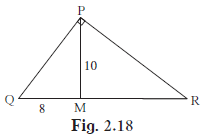
In figure 2.18, ∠QPR = 90°, seg PM ⊥ seg QR and Q – M – R,PM = 10, QM = 8, find QR.
Find the sum of first $51$ terms of an A.P. whose second and third terms are $14$ and $18 $respectively.
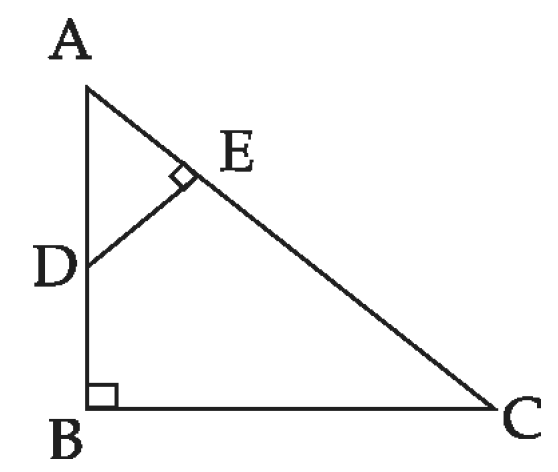
In $\triangle A B C, \angle B=90^{\circ}$, seg $DE \perp$ side AC . $A D=6, A B=12$, $A C=18$, then find $A E$.
Image
A cone of radius 4cm is divided into two parts by drawing a plane through the mid point of its axis and parallel to its base. Compare the volumes of two parts.
The largest sphere is carved out of a cube of side 10.5cm. Find the volume of the sphere.
The first term of an A.P. is p and its common difference is q. Find its $10^{th}$​​​​​​​ term.
Write an equation of a line passing through the point representing solution of the pair of linear equations $x + y = 2$ and $2x - y = 1$. How many such lines can we find?
Find the sum of natural numbers between 1 to 140, which are divisible by 4.
Activity :- Natural numbers between 1 to 140 divisible by 4 are,
4,8,12,16,......136
Here d=4, therefore this sequence is an A.P.
a=4, d=4,$t _{ n }=136, \quad S _{ n }=?$
$t_n=a+(n-1) d$
_____= 4+(n-1)×4
_____= (n-1)×4
n =_____
Now,
$S _{ n }=\frac{ n }{2}+\left[ a + t _{ n }\right]$
$S_n=17 \times$____
$S _{ n }=$____
Therefore, the sum of natural numbers between 1 to 140, which are divisible by 4 is _____
If $\alpha$ and $\beta$ are the zeroes of the quadratic polynomial such that $\alpha+\beta=24$ and $\alpha-\beta=8,$ find a quadratic polynomial have $\alpha$ and $\beta$ as its zeroes.