Question
Prove that $3+2\sqrt { 5 }$ is irrational.

Answer

Let us assume, to the contrary, that is $3 + 2 \sqrt { 5 }$ rational.
That is, we can find coprime integers a and b $( b \neq 0 )$ such that
$3 + 2 \sqrt { 5 } = \frac { a } { b } \text { Therefore, } \frac { a } { b } - 3 = 2 \sqrt { 5 }$
$\Rightarrow \frac { a - 3 b } { b } = 2 \sqrt { 5 }$
$\Rightarrow \frac { a - 3 b } { 2 b } = \sqrt { 5 } \Rightarrow \frac { a } { 2 b } - \frac { 3 } { 2 }$
Since a and b are integers,
We get $\frac { a } { 2 b } - \frac { 3 } { 2 }$ is rational, also so $\sqrt { 5 }$ is rational.
But this contradicts the fact that $\sqrt { 5 }$ is irrational.
This contradiction arose because of our incorrect
assumption that $3 + 2 \sqrt { 5 }$ is rational.
So, we conclude that $3 + 2 \sqrt { 5 }$ is irrational.

Need a full question paper?

Generate a complete, print-ready paper with questions like this in minutes — across 16+ boards, with answer keys.
Start Generating Free

Similar questions

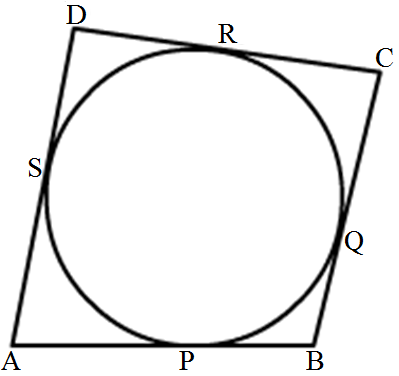
In the given figure, a circle touches all the four sides of a quadrilateral ABCD with AB = 6cm, BC = 7cm and CD = 4cm. Find AD.
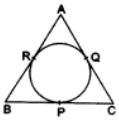
In the given figure, the incircle $-$ of $\triangle A B C$ touches the sides $BC, CA$ and $AB $ at $P, Q$ and $R$ respectively. Prove that $(AR + BP + CQ) = (AQ + BR + CP) =\frac{1}{2}($ perimeter of $\triangle A B C)$.
Image
Find the indicated terms in the following sequences whose $n^{th}$ terms are:$a_n = (n - 1)(2 - n)(3 + n); a_1, a_2, a_3.$
Find the value(s) of p in (i) to (iv) and p and q in (v) for the following pair of equations:
$-3x + 5y = 7$ and $2px - 3y = 1,$
if the lines represented by these equations are intersecting at a unique point.
Which of the following sequences are arithmetic progressions. For those which are arithmetic progressions, find out the common difference.
$a + b, (a + 1) + b, (a + 1) + (b + 1), (a + 2) + (b + 1), (a + 2) + (b + 2), .....$
Find the HCF and LCM of 26, 65 and 117, using prime factorisation.
If from an external point B of a circle with centre O, two tangents BC and BD are drawn such that $\angle\text{DBC}=120^\circ,$ prove that BC + BD = BO, i.e., BO = 2BC.
A cubical block of side $10 \ cm$ is surmounted by a hemisphere. What is the largest diameter that the hemisphere can have? Find the cost of painting the total surface area of the solid so formed, at the rate of $Rs. 5$ per $100 sq. cm. [$Use $\pi=3.14]$
A mason has to fit a bathroom with square marble tiles of the largest possible size. The size of the bathroom is $10 ft.$ by $8 ft.$ What would be the size $($in inches$)$ of the tile required that has to be cut and how many such tiles are required?
Do the points $(3, 2), (–2, –3)$ and $(2, 3)$ form a triangle? If so, name the type of triangle formed.