Questions

3 Marks Question

Take a timed test

9 questions · self-marked practice — reveal the answer and mark yourself.

Question 13 Marks
Find the LCM and HCF of 336 and 54 pairs of integers and verify that LCM $\times$ HCF = product of the two numbers.
Answer
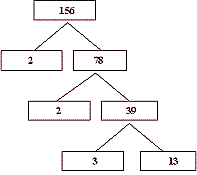

So, the factors of 156 are 2 $\times$ 2 $\times$ 3 $\times$ 13
View full question & answer
Question 23 Marks
Prove that $6+\sqrt { 2 }$ is irrational.
Answer
Let us assume that 6 + √2 is a rational number.
So we can write this number as
6 + √2 = a/b
Here a and b are two co-prime numbers and b is not equal to 0
Subtract 6 both side we get
√2 = a/b – 6
√2 = (a-6b)/b
Here a and b are integers so (a-6b)/b is a rational number. So √2 should be a rational number. But √2 is an irrational number. It is a contradiction.
Hence result is 6 + √2 is a irrational number
View full question & answer
Question 33 Marks
Prove that $7 \sqrt { 5 }$ is irrational.
Answer
We can prove $7 \sqrt { 5 }$ irrational by contradiction.
Let us suppose that $7 \sqrt { 5 }$ is rational.
It means we have some co-prime integers a and b (b≠ 0)

such that
$7 \sqrt { 5 } = \frac { a } { b }$
$\Rightarrow \sqrt { 5 } = \frac { a } { 7 b }$ .......(1)
R.H.S of (1) is rational but we know that $\sqrt { 5 }$ is irrational.
It is not possible which means our supposition is wrong.
Therefore, $7 \sqrt { 5 }$ cannot be rational.
Hence, it is irrational.

View full question & answer
Question 43 Marks
Prove that $\frac{1}{{\sqrt 2 }}$ is irrational.
Answer
We can prove $\frac{1}{{\sqrt 2 }}$ irrational by contradiction.
Let us suppose that $\frac{1}{{\sqrt 2 }}$is rational.
It means we have some co-prime integers a and b (b ≠ 0)
Such that
$\frac{1}{{\sqrt 2 }}$= $\frac ab$
$\Rightarrow $ $\sqrt 2 = \frac{b}{a}$..........(1)
R.H.S of (1) is rational but we know that is$\sqrt 2 $ irrational.
It is not possible which means our supposition is wrong.
Therefore,$\frac{1}{{\sqrt 2 }}$can not be rational.
Hence, it is irrational.
View full question & answer
Question 53 Marks
Prove that $3+2\sqrt { 5 }$ is irrational.
Answer
Let us assume, to the contrary, that is $3 + 2 \sqrt { 5 }$ rational.
That is, we can find coprime integers a and b $( b \neq 0 )$ such that
$3 + 2 \sqrt { 5 } = \frac { a } { b } \text { Therefore, } \frac { a } { b } - 3 = 2 \sqrt { 5 }$
$\Rightarrow \frac { a - 3 b } { b } = 2 \sqrt { 5 }$
$\Rightarrow \frac { a - 3 b } { 2 b } = \sqrt { 5 } \Rightarrow \frac { a } { 2 b } - \frac { 3 } { 2 }$
Since a and b are integers,
We get $\frac { a } { 2 b } - \frac { 3 } { 2 }$ is rational, also so $\sqrt { 5 }$ is rational.
But this contradicts the fact that $\sqrt { 5 }$ is irrational.
This contradiction arose because of our incorrect
assumption that $3 + 2 \sqrt { 5 }$ is rational.
So, we conclude that $3 + 2 \sqrt { 5 }$ is irrational.
View full question & answer
Question 63 Marks
Show that $5-\sqrt{3}$ is irrational.
Answer
Let us assume, to the contrary, that $5-\sqrt{3}$ is rational.
That is, we can find coprime numbers a and b (b ≠ 0) such that $5-\sqrt{3}=\frac{a}{b}$
Therefore, $5-\frac{a}{b}=\sqrt{3}$
Rearranging this equation, we get $\sqrt{3}=5-\frac{a}{b}=\frac{5 b-a}{b}$
Since a and b are integers, we get $5-\frac{a}{b}$ is rational, and so $\sqrt{3}$ is rational.
But this contradicts the fact that $\sqrt{3}$ is irrational
This contradiction has arisen because of our incorrect assumption that $5-\sqrt{3}$ is rational.
So, we conclude that $5-\sqrt{3}$ is irrational.
View full question & answer
Question 73 Marks
Prove that $\sqrt { 3 }$ is irrational.
Answer
Let us assume $\sqrt{ } 3$ be a rational, then as every rational can be represented in the form $p / q$ where $q \neq 0$ Let $\sqrt{ } 3=p / q$ where $p, q$ have no common factor.
Now squaring on both sides we get $3=p^2 / q^2$
$\Longrightarrow 3 \times q^2=p^2$
Which means 3 divides $p ^2$ which implies 3 divides p
Hence we can write $p=3 \times k$, where $k$ is some constant.
This gives $3 \times q^2=9 \times k^2$
$q^2=3 \times k^2$
Which means 3 divides $q^2$ which implies 3 divides $q$.
3 divides $p$ and $q$ which means 3 is a common factor for $p$ and $q$.
And this is a contradiction for our assumption that $p$ and $q$ have no common factor...
Hence we can say our assumption that $\sqrt{ } 3$ is rational is wrong...
And therefore $\sqrt{ } 3$ is an irrational...
View full question & answer
Question 83 Marks
$\sqrt{2}$ is irrational.
Answer
Let us assume, to the contrary, that $\sqrt{2}$ is rational.
So, we can find integers $r$ and $s(\neq 0)$ such that $\sqrt{2}=\frac{r}{s}$.
Suppose $r$ and $s$ have a common factor other than 1 . Then, we divide by the common factor to get $\sqrt{2}=\frac{a}{b}$, where $a$ and $b$ are coprime.
So, $b \sqrt{2}=a$.
Squaring on both sides and rearranging, we get $2 b^2=a^2$. Therefore, 2 divides $a^2$.
Now, by Theorem 1.3, it follows that 2 divides $a$.
So, we can write $a=2 c$ for some integer $c$.
Substituting for $a$, we get $2 b^2=4 c^2$, that is, $b^2=2 c^2$.
This means that 2 divides $b^2$, and so 2 divides $b$ (again using Theorem 1.3 with $p=2$ ).
Therefore, $a$ and $b$ have at least 2 as a common factor.
But this contradicts the fact that $a$ and $b$ have no common factors other than 1 .
This contradiction has arisen because of our incorrect assumption that $\sqrt{2}$ is rational.
So, we conclude that $\sqrt{2}$ is irrational.
View full question & answer
Question 93 Marks
Let $p$ be a prime number. If $p$ divides $a^2$, then $p$ divides $a$, where $a$ is a positive integer.
Answer
Let the prime factorisation of $a$ be as follows :
$a=p_1 p_2 \ldots p_n$, where $p_1, p_2, \ldots, p_n$ are primes, not necessarily distinct.
Therefore, $a^2=\left(p_1 p_2 \ldots p_n\right)\left(p_1 p_2 \ldots p_n\right)=p_1^2 p_2^2 \ldots p_n^2$.
Now, we are given that $p$ divides $a^2$. Therefore, from the Fundamental Theorem of Arithmetic, it follows that $p$ is one of the prime factors of $a^2$. However, using the uniqueness part of the Fundamental Theorem of Arithmetic, we realise that the only prime factors of $a^2$ are $p_1, p_2, \ldots, p_n$. So $p$ is one of $p_1, p_2, \ldots, p_n$.
Now, since $a=p_1 p_2 \ldots p_n, p$ divides $a$.
We are now ready to give a proof that $\sqrt{2}$ is irrational.
The proof is based on a technique called 'proof by contradiction'. (This technique is discussed in some detail in Appendix 1).
View full question & answer