Question
Prove that a closed equipotential surface with no charge within itself must enclose an equipotential volume.

Answer

Let us assume that in a closed equipotential surface with no charge the potential is changing from position to position. Let the potential just inside the surface is different to that of the surface causing in a potential gradient $\Big(\frac{\text{dV}}{\text{dr}}\Big)$ It means $\text{E}\neq0$ electric field comes into existence, which is given by as $\text{E}=-\frac{\text{dV}}{\text{dr}}$ It means there will be field lines pointing inwards or outwards from the surface. These lines cannot be again on the surface, as the surface is equipotential. It is possible only when the other end of the field lines are originated from the charges inside. This contradicts the original assumption. Hence, the entire volume inside must be equipotential.

Need a full question paper?

Generate a complete, print-ready paper with questions like this in minutes — across 16+ boards, with answer keys.
Start Generating Free

Similar questions

In a Geiger-Marsden experiment, what is the distance of closest approach to the nucleus of a $7.7 MeV \alpha$-particle before it comes momentarily to rest and reverse its direction?
When charcoal is prepared from a living tree, it shows a disintegration rate of 15.3 disintegrations of 14C per gram per minute. A sample from an ancient piece of charcoal shows 14C activity to be 12.3 disintegrations per gram per minute. How old is this sample? Half-life of 14C is 5730y.
A number of identical cells, n, each of emf E, internal resistance r connected in series are charged by a d.c. source of emf E', using a resistor R.
  1. Draw the circuit arrangement.
  2. Deduce the expressions for (a) the charging current and (b) the potential difference across the combination of the cells.
Draw a labelled diagram of Hertz’s experimental set-up to produce electromagnetics waves. Explain the generation of electromagnetic waves using this set-up.
Answer the following questions:
If χ-stands for the magnetic susceptibility of a given material, identity the class of materials for which $(\text{i})-1 \geq\text{X} < 0 (\text{ii}) 0< \text{X} < \varepsilon 0 (\varepsilon$ is a small positive number).
  1. Write the range of relative magnetic permeability of these materials.
  2. Draw the pattern of the magnetic field lines when these materials are placed on an strong magnetic field.
The sunlight reaching Earth has maximum electric field of 810Vm-1. What is the maximum magnetic field in this light?
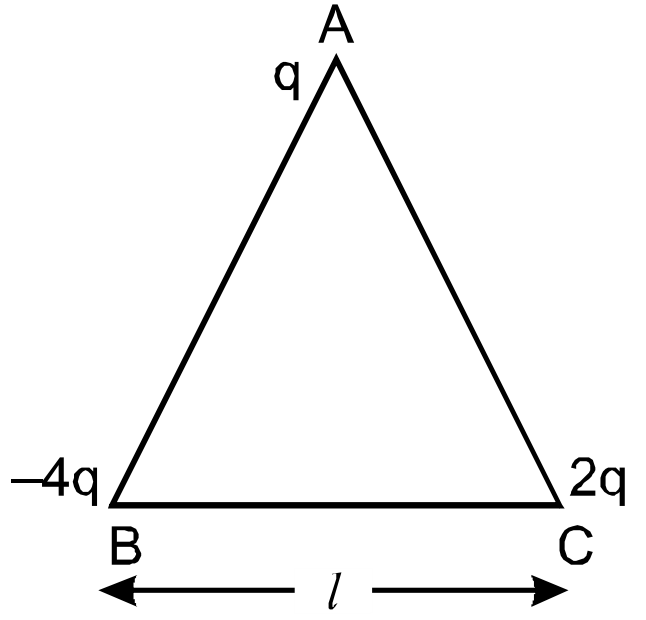
  1. Three point charges q, -4q and 2q are placed at the vertices of an equilateral triangle ABC of side ‘l’ as shown in the figure. Obtain the expression for the magnitude of the resultant electric force acting on the charge q.

  1. Find out the amount of the work done to separate the charges at infinite distance.
A metre scale made of steel is calibrated at 20°C to give correct reading. Find the distance between the 50cm mark and the 51cm mark if the scale is used at 10°C. Coefficient of linear expansion of steel is 1.1 × 10⁻⁵ °C-1.
A bulb rated 60W at 220V is connected across a household supply of alternating voltage of 220V. Calculate the maximum instantaneous current through the filament.
Find the acceleration of the moon with respect to the earth from the following data:
Distance between the earth and the moon = 3.85 × 105km and the time taken by the moon to complete one revolution around the earth = 27.3 days.