Question
Prove that $\big(2\sqrt3-1\big)$ is an irrational number.

Answer

Let $\text{x}=2\sqrt3-1$ be a rational number.
$\text{x}=2\sqrt3-1$
$\Rightarrow\text{x}^2=\big(2\sqrt3-1\big)^2$
$\Rightarrow\text{x}^2=\big(2\sqrt3\big)^2+1^2-2\big(2\sqrt3\big)(1)$
$\Rightarrow\text{x}^2=12+1-4\sqrt3$
$\Rightarrow\text{x}^2-13=-4\sqrt3$
$\Rightarrow\frac{13-\text{x}^2}{4}=\sqrt3$
Since x is a rational number, $x^2$ is also a rational number.
$\Rightarrow 13 − x^2$is a rational number
$\Rightarrow\frac{13-\text{x}^2}{4}$ is a rational number
$\Rightarrow\sqrt3$ is a rational number
But $\sqrt3$ is an irrational number, which is a contradiction.
Hence, our assumption is wrong.
Thus, $\big(2\sqrt3-1\big)$ is an irrational number.

Need a full question paper?

Generate a complete, print-ready paper with questions like this in minutes — across 16+ boards, with answer keys.

Start Generating Free

Similar questions

Solve each of the following given systems of equations graphically and find the vertices and area of the triangle formed by these lines and the y-axis:
2x - 5y + 4 = 0, 2x + y - 8 = 0
An equilateral triangle has two vertices at the points (3, 4) and (-2, 3), find the coordinates of the third vertex.
The mean of the following data is 42, find the missing frequencies x and y if the sum of the frequencies is 100.
Class interval 0-10 10-20 20-30 30-40 40-50 50-60 60-70 70-80
Frequency 7 10 x 13 y 10 14 9
In two concentric circles, a chord of length 8cm of the larger circle touches the smaller circle. If the radius of the larger circle is 5cm then Find the radius of the smaller circle.
An iron pillar has some part in the form of a right circular cylinder and remaining in the form of a right circular cone.The radius of the base of each of cone and cylinder is $8 \ cm.$ The cylindrical part is $240 \ cm$ high and the conical part is $36 \ cm$ high. Find the weight of the pillar if one cubic $\ cm$ of iron weighs $7.8$ grams.
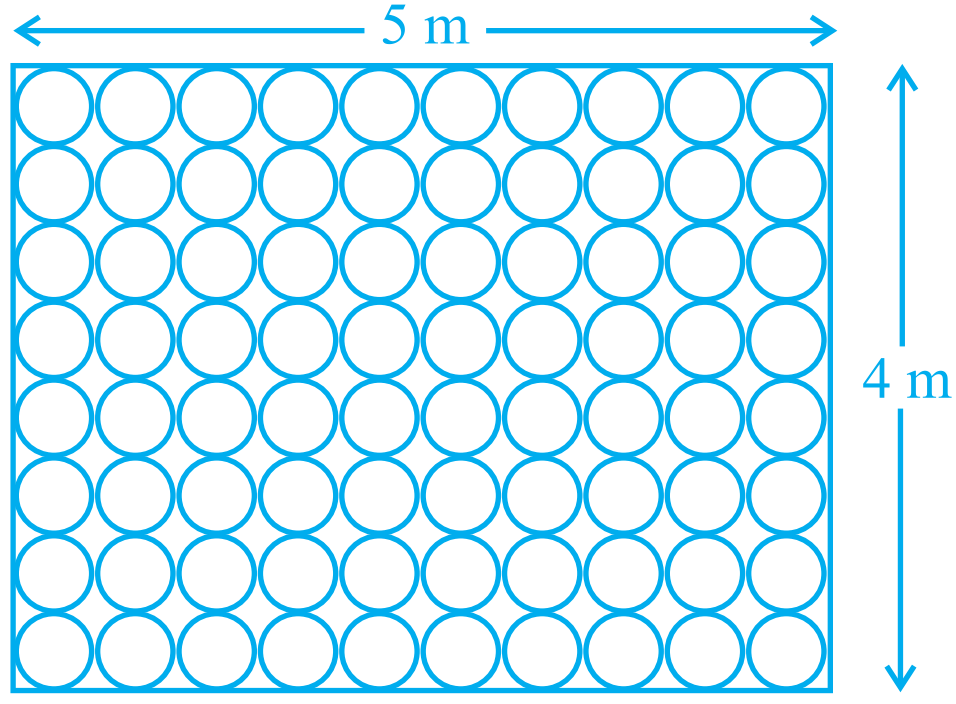
Floor of a room is of dimensions $5\ m \times 4\ m$ and it is covered with circular tiles of diameters $50\ cm$ each as shown in Fig. Find the area of floor that remains uncovered with tiles. $(\text{Use }\pi=3.14)$
Prove the following identities:
$\sin^2\theta+\cos^4\theta=\cos^2\theta+\sin^4\theta$
A well, whose diameter is $7 m ,$ has been dug $22.5 m$ deep and the earth dugout is used to form an embankment around it. If the height of the embankment is $1.5 m$ , find the width of the embankment.
Draw a line segment AB of length 6.5cm and divide it in the ratio 4 : 7. Measure each of the two parts.
Find the common difference of an A.P. whose first term is 5 and the sum of its first four terms is half the sum of the next four terms.