CBSE BoardEnglish MediumSTD 10MathsCo-ordinate Geometry5 Marks
Question
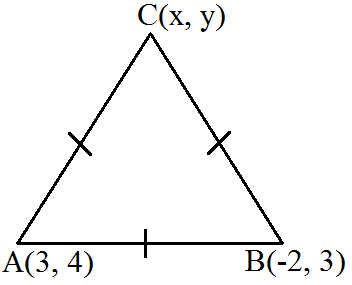
An equilateral triangle has two vertices at the points (3, 4) and (-2, 3), find the coordinates of the third vertex.
✓
Answer
Let two vertices of an equilateral triangle are A(3, 4), and B(-2, 3) and let the third vertex be C(x, y).
Now, $\text{AB}=\sqrt{(\text{x}_2-\text{x}_1)^2+(\text{y}_2-\text{y}_1)^2}$ $=\sqrt{(-2-3)^2+(3-4)^2}=\sqrt{(-5)^2+(-1)^2}$$\sqrt{25+1}=\sqrt{26}$
$\text{BC}=\sqrt{(\text{x}+2)^2+(\text{y}-3)^2}$
and, $\text{CA}=\sqrt{({3}-\text{x})^2+({4}-\text{y})^2}$
$\because$ The triangle is an equilateral triangle.
$\therefore$ AB = BC = CA$\because$ BC = AB
$\therefore\sqrt{(\text{x}+2)^2+(\text{y}-3)^2}=\sqrt{26}$
$\Rightarrow(x+2)^2+(y-3)^2=26 \text { (Squaring) } \Rightarrow x^2+4 x+4+y^2-6 y+9=26 $
$\Rightarrow x^2+y^2+4 x-6 y+13=26 $
$\Rightarrow x^2+y^2+4 x-6 y=26-13=13 \ldots \ldots \text {. (i) Again } C A=A B .$
$ \therefore \sqrt{(3-x)^2+(4-y)^2}=\sqrt{26}$
$\text { Squaring, }(3-x)^2+(4-y)^2=26 $
$\Rightarrow 9+x^2-6 x+16+y^2-8 y=26 $
$\Rightarrow x^2+y^2-6 x-8 y+25=26$
$\Rightarrow x^2+y^2-6 x-8 y=26-25=1 \ldots \ldots \text {.(ii) Subtracting (ii) from (i) } 10 x+2 y=12$
$\Rightarrow 5 x+y=6 \ldots . . \text { (iii) } y=6-5 x$
$\text { Subtracting in (i) } x^2+(6-5 x)^2+4 x-6(6-5 x)=13$
$\Rightarrow x^2+36+25 x^2-60 x+4 x-36+30 x-13=0 $
$\Rightarrow 26 x^2-26 x-13=0 $
$\Rightarrow 2 x^2-2 x-1=0 \text { Here } a=2, b=-2, C=-1$
$=\frac{-(-2)\pm\sqrt{(-2)^2-4\times2\times(-1)}}{2\times2}$
$=\frac{2\pm\sqrt{4+8}}{4}$
$=\frac{2\pm\sqrt{12}}{4}$
$=\frac{2\pm\sqrt{4\times3}}{4}$
$=\frac{2\pm2\sqrt{3}}{4}=\frac{1\pm\sqrt{3}}{2}$
$\text{x}=\frac{1+\sqrt{3}}{2}$ and $\frac{1-\sqrt{3}}{2}$
If $\text{x}=\frac{1+\sqrt{3}}{2},$ then $\text{y}=6-5\text{x}$ $=6-\frac{5(1+\sqrt{3})}{2}$ $=\frac{12-5-5\sqrt{3}}{2}=\frac{7-5\sqrt{3}}{2}$ and if $\text{x}=\frac{1-\sqrt{3}}{2},$ then $\text{y}=6-5\text{x}$ $=6-\frac{5(1-\sqrt{3})}{2}$ $=\frac{12-5+5\sqrt{3}}{2}=\frac{7+5\sqrt{3}}{2}$ Hence co-ordinates of the point will be $\Big(\frac{1+\sqrt{3}}{2},\frac{7-5\sqrt{3}}{2}\Big)$ or $\Big(\frac{1-\sqrt{3}}{2},\frac{7+5\sqrt{3}}{2}\Big).$
Need a full question paper?
Generate a complete, print-ready paper with questions like this in minutes — across 16+ boards, with answer keys.