Questions

3 Marks Question

🎯

Test yourself on this topic

18 questions · timed · auto-graded

Question 13 Marks
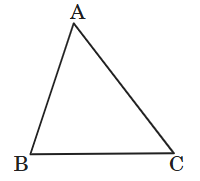
If $\text{A, B, C}$ are interior angles of a $\triangle \text{A B C}$, then Show that : $\sin \left(\frac{B+C}{2}\right)=\cos \frac{A}{2}$
Answer
In $\triangle \text{A B C}$,
Image

Sum of interior angles of triangles $=180^{\circ} ($Angle sum property of triangle$)$
$A+B+C=180^{\circ}$
$\Rightarrow B+C=180^{\circ}-A$
Dividing both the sides by $2$
$\Rightarrow \frac{B+C}{2}=\frac{180^{\circ}-A}{2}$
$\Rightarrow \frac{B+C}{2}=90^{\circ}-\frac{A}{2} \ldots \ldots(i)$
Now taking $\text{L.H.S}$ of the given expression,
$\sin \left(\frac{B+C}{2}\right)$
$=\sin \left(90^{\circ}-\frac{A}{2}\right)$
$=\cos \left(\frac{A}{2}\right)\left[\sin \left(90^{\circ}-\theta\right)=\cos \theta\right]$
$=\text { R.H.S }$
View full question & answer
Question 23 Marks
Prove that: $\frac{\sin \theta-\cos \theta+1}{\sin \theta+\cos \theta-1}=\frac{1}{\sec \theta-\tan \theta}$
Answer
Taking $\text{LHS,} \frac{\sin \theta-\cos \theta+1}{\sin \theta+\cos \theta-1}$
Dividing both numerator and denominator by $\cos \theta$, we get
$= \frac{\frac{\sin \theta}{\cos \theta}-\frac{\cos \theta}{\cos \theta}+\frac{1}{\cos \theta}}{\frac{\sin \theta}{\cos \theta}+\frac{\cos \theta}{\cos \theta}-\frac{1}{\cos \theta}}=\frac{\tan \theta-1+\sec \theta}{\tan \theta+1-\sec \theta}$
$= \frac{(\tan \theta+\sec \theta)-1}{(\tan \theta-\sec \theta)+1}$
Multiplying both numerator and denominator by
$(\tan \theta+\sec \theta)$
$=\frac{\{(\tan \theta+\sec \theta)-1\}}{\{(\tan \theta-\sec \theta)+1\}} \frac{(\tan \theta-\sec \theta)}{(\tan \theta-\sec \theta)}$
$\frac{\left(\tan ^2 \theta-\sec ^2 \theta\right)-(\tan \theta-\sec \theta)}{(\tan \theta-\sec \theta+1)(\tan \theta-\sec \theta)}$
$=\frac{\left[\operatorname{As} a^2-b^2\right.}{(\tan \theta-\sec \theta+1)(\tan \theta-\sec \theta)}$
$=\frac{(-1-\tan \theta+\sec \theta)}{\tan \theta-\sec \theta}$
$=\frac{1}{\sec \theta-\tan \theta}$
Hence, $\text{LHS }=\text { RHS},$ Proved
 
View full question & answer
Question 33 Marks
Prove the identity: $\frac{1}{\operatorname{cosec} \theta+\cot \theta}-\frac{1}{\sin \theta}=\frac{1}{\sin \theta}-\frac{1}{\operatorname{cosec} \theta-\cot \theta}$
Answer
Taking $\text{LHS},$
$\frac{1}{\operatorname{cosec} \theta+\cot \theta}-\frac{1}{\sin \theta}$
Using the identity,
$\operatorname{cosec}^2 \theta-\cot ^2 \theta=1$
Putting $ 1=\operatorname{cosec}^2 \theta-\cot ^2 \theta$
$\frac{\operatorname{cosec}{ }^2 \theta-\cot ^2 \theta}{\operatorname{cosec} \theta+\cot \theta}-\frac{1}{\sin \theta}$
$\frac{(\operatorname{cosec} \theta-\cot \theta)(\operatorname{cosec} \theta+\cot \theta)}{(\operatorname{cosec} \theta+\cot \theta)}-\operatorname{cosec} \theta$
$(\operatorname{cosec} \theta-\cot \theta)-\operatorname{cosec} \theta$
$-\cot \theta$
Taking $\text{RHS}, \frac{1}{\sin \theta}-\frac{1}{\operatorname{cosec} \theta-\cot \theta}$
$\operatorname{cosec} \theta-\frac{1}{\operatorname{cosec} \theta-\cot \theta}$
Putting, $1=\operatorname{cosec}^2 \theta-\cot ^2 \theta$
$\operatorname{cosec} \theta-\frac{\left(\operatorname{cosec}^2 \theta-\cot ^2 \theta\right)}{\operatorname{cosec} \theta-\cot \theta}$
$\operatorname{cosec} \theta-\frac{(\operatorname{cosec} \theta-\cot \theta)(\operatorname{cosec} \theta+\cot \theta)}{\operatorname{cosec} \theta-\cot \theta}$
$=\operatorname{cosec} \theta-(\operatorname{cosec} \theta+\cot \theta) -\cot \theta$
Thus $\text{LHS} = \text{RHS}.$
View full question & answer
Question 43 Marks
If $3 \tan A=4$ then prove that:
(i) $\sqrt{\frac{\sec A-\operatorname{Cosec} A}{\sec A+\operatorname{Cosec} A}}=\frac{1}{\sqrt{3}}$
(ii) $\sqrt{\frac{1-\sin A}{1+\operatorname{Cos} A}}=\frac{1}{2 \sqrt{2}}$
Answer
$3 \tan A=4$
$\Rightarrow \tan A=\frac{4}{3}$ and $\cot A=\frac{1}{\tan A}$
$\Rightarrow \cot A=\frac{3}{4}$
$\Rightarrow \tan ^2 A=\frac{16}{9}$
And also,
$\sec ^2 A=1+\tan ^2 A$
$\sec ^2 A=1+\frac{16}{9}=\frac{25}{9}$
Taking square root,
$\sec A=\frac{5}{3}$
And,
$\operatorname{cosec}^2 A=1+\cot ^2 A$
$\operatorname{cosec}^2 A=1+\frac{9}{16}=\frac{25}{16}$
(Using(i))
Taking square root,
$
\operatorname{cosec} A=\frac{5}{4}
$
(i) Taking LHS
$\sqrt{\frac{\sec A-\operatorname{Cosec} A}{\sec A+\operatorname{Cosec} A}}=\sqrt{\frac{\frac{5}{3}-\frac{5}{4}}{\frac{5}{3}+\frac{5}{4}}}=\sqrt{\frac{\frac{5}{\frac{12}{35}}}{\frac{12}{12}}}$
$=\sqrt{\frac{5}{35}}=\sqrt{\frac{1}{7}}=\frac{1}{\sqrt{7}}$
Hence, LHS=RHS
(ii) $\sqrt{\frac{1-\sin A}{1+\cos A}}=\frac{1}{2 \sqrt{2}}$
$\sin A=\frac{1}{\operatorname{cosec} A}=\frac{4}{5}$
And, $\cos A=\frac{1}{\sec A}=\frac{3}{5}$
Taking LHS,
$
\sqrt{\frac{1-\sin A}{1+\cos A}}=\sqrt{\frac{1-\frac{4}{5}}{1+\frac{3}{5}}}=\sqrt{\frac{\frac{1}{5}}{\frac{8}{5}}}=\sqrt{\frac{1}{8}}=\frac{1}{2 \sqrt{2}}
$
Hence, LHS=RHS.
View full question & answer
Question 53 Marks
Prove that: $(1+\cos \theta-\operatorname{cosec} \theta) \cdot(1+\tan \theta+\sec \theta)=2$
Answer
To prove:
$(1+\cot \theta-\operatorname{cosec} \theta) \cdot(1+\tan \theta+\sec \theta)=2$
Solving the left hand side of the equation
$(1+\cot \theta-\operatorname{cosec} \theta) \cdot(1+\tan \theta+\sec \theta)$
$\Rightarrow\left(1+\frac{\cos \theta}{\sin \theta}-\frac{1}{\sin \theta}\right) \cdot\left(1+\frac{\sin \theta}{\cos \theta}+\frac{1}{\cos \theta}\right)$
$\Rightarrow\left(\frac{\sin \theta+\cos \theta-1}{\sin \theta}\right) \cdot\left(\frac{\cos \theta+\sin \theta+1}{\cos \theta}\right)$
$\Rightarrow\left(\frac{(\sin \theta+\cos \theta)^2-1^2}{\sin \theta \cdot \cos \theta}\right)$
$\Rightarrow\left(\frac{\sin ^2 \theta+\cos ^2 \theta+2 \sin \theta \cdot \cos \theta-1}{\sin \theta \cdot \cos \theta}\right)$
$\Rightarrow\left(\frac{1+2 \sin \theta \cdot \cos \theta-1}{\sin \theta \cdot \cos \theta}\right)$
$\Rightarrow\left(\frac{2 \sin \theta \cdot \cos \theta}{\sin \theta \cdot \cos \theta}\right)$
$\Rightarrow 2$
Since $\ce{LHS = RHS},$
Hence proved.
View full question & answer
Question 63 Marks
If $\sin \theta=\frac{3}{5}$, evaluate $\frac{\operatorname{cosec} \theta-\cot \theta}{2 \cot \theta}$
Answer
$\sin \theta=\frac{3}{5}$
$\cos ^2 \theta=1-\sin ^2 \theta$
$\cos ^2 \theta=1-\frac{9}{25}=\frac{16}{25}$
$\cos \theta=\frac{4}{5}$
$\cot \theta=\frac{\cos \theta}{\sin \theta}=\frac{\frac{4}{5}}{\frac{3}{5}}=\frac{4}{3}$
$\operatorname{cosec} \theta=\frac{1}{\sin \theta}=\frac{5}{3}$
Now substituting these values in the given equation,
$\frac{\operatorname{cosec} \theta-\cot \theta}{2 \cot \theta}=\frac{\frac{5}{3}-\frac{4}{3}}{2 \cdot \frac{4}{3}}$
$\Rightarrow \frac{\frac{5}{3}-\frac{4}{3}}{2 \cdot \frac{4}{3}}=\frac{1}{3} \cdot \frac{3}{8}=\frac{1}{8}$
Hence, $\frac{\operatorname{cosec} \theta-\cot \theta}{2 \cot \theta}=\frac{1}{8}$
View full question & answer
Question 73 Marks
Prove that:
$
\frac{\sin \theta-\cos \theta}{\sin \theta+\cos \theta}+\frac{\sin \theta+\cos \theta}{\sin \theta-\cos \theta}=\frac{2}{2 \sin ^2 \theta-1}
$
Answer
Using the left hand side of the equation,
$
\begin{aligned}
= & \frac{(\sin \theta-\cos \theta)^2+(\sin \theta+\cos \theta)^2}{\sin ^2 \theta-\cos ^2 \theta} \\
& \frac{\sin ^2 \theta+\cos ^2 \theta-2 \sin \theta \cos \theta+\sin ^2 \theta+\cos ^2 \theta}{\left(\sin ^2 \theta-\cos ^2 \theta\right)} \\
= & \frac{1+1}{\sin ^2 \theta-\left(1-\sin ^2 \theta\right)}\quad\quad{\left(\therefore \sin ^2 \theta+\cos ^2 \theta=1\right)} \\
= & \frac{2}{2 \sin ^2 \theta-1}
\end{aligned}
$
Hence Proved.
View full question & answer
Question 83 Marks
If $\tan \theta+\frac{1}{\tan \theta}=\sqrt{2}$, find the value of $\tan ^2 \theta+\frac{1}{\tan ^2 \theta}$
Answer
$\tan \theta+\frac{1}{\tan \theta}=\sqrt{2}$
Squaring both sides we get,
$\left(\tan \theta+\frac{1}{\tan \theta}\right)^2=2$
$\tan ^2 \theta+\cot ^2 \theta+2 \tan \theta \frac{1}{\tan \theta}=2 \left(\therefore \frac{1}{\tan \theta}=\cot \theta\right)$
$\tan ^2 \theta+\cot ^2 \theta+2=2$
$\tan ^2 \theta+\cot ^2 \theta=0$
The value of $\tan ^2 \theta+\cot ^2 \theta=0$
View full question & answer
Question 93 Marks
Prove that: $\frac{\left(1+\tan ^2 A\right) \cot A}{\operatorname{cosec}^2 A}=\tan A$
Answer
Using the left hand side of the equation
$\Rightarrow \frac{\left(1+\tan ^2 A\right) \cot A}{\operatorname{cosec}^2 A}$
We know $1+\tan ^2 A=\sec ^2 A$
$\frac{\left(\sec ^2 A\right) \cot A}{\operatorname{cosec}^2 A}$
$\frac{\frac{1}{\cos ^2 A}(\cot A)}{\frac{1}{\sin ^2 A}}$
$=\frac{\sin ^2 A}{\cos ^2 A}(\cot A)$
$=\tan ^2 A \times \cot A$
$=\tan ^2 A \times \frac{1}{\tan A}$
$=\tan A$
Hence, proved.
View full question & answer
Question 103 Marks
Prove that: $\frac{1+\sec A}{\sec A}=\frac{\sin ^2 A}{1-\cos A}$
Answer
Using the Left hand side of the equation
$\Rightarrow \frac{1+\sec A}{\sec A}$
Putting sec $A=\frac{1}{\cos A}$
$\frac{1+\frac{1}{\cos A}}{\frac{1}{\cos A}}$
$=\frac{\frac{\cos A+1}{\cos A}}{\frac{1}{\cos A}}$
$=\cos A+1$
Using the Right hand side of the equation
$\Rightarrow \frac{\sin ^2 A}{1-\cos A}$
We know $\sin 2 A=1-\cos ^2 A$
$\Rightarrow \frac{1-\cos ^2 A}{1-\cos A}$
$\frac{(\cos A+1)(1-\cos A)}{1-\cos A}$
$\Rightarrow 1+\cos A$
Hence, proved.
View full question & answer
Question 113 Marks
Prove that $(\operatorname{cosec} \theta-\cot \theta)^2=\frac{1-\cos \theta}{1+\cos \theta}$.
Answer
Proceeding with the left hand side of the given equation and using
$\operatorname{cosec} \theta=\frac{1}{\sin \theta}$ and $\cot \theta=\frac{\cos \theta}{\sin \theta}$,
$(\operatorname{cosec} \theta-\cot \theta)^2=\left(\frac{1}{\sin \theta}-\frac{\cos \theta}{\sin \theta}\right)^2$
$\Rightarrow(\operatorname{cosec} \theta-\cot \theta)^2=\frac{(1-\cos \theta)^2}{\sin ^2 \theta}$
Apply $\sin ^2 \theta=1-\cos ^2 \theta$
$\Rightarrow(\operatorname{cosec} \theta-\cot \theta)^2=\frac{(1-\cos \theta)(1-\cos \theta)}{1-\cos ^2 \theta}$
$\Rightarrow(\operatorname{cosec} \theta-\cot \theta)^2=\frac{(1-\cos \theta)(1-\cos \theta)}{(1-\cos \theta)(1+\cos \theta)}$
$\left(\right.$ As $\left.a^2-b^2=(a-b)(a+b)\right)$
$\Rightarrow(\operatorname{cosec} \theta-\cot \theta)^2=\frac{1-\cos \theta}{1+\cos \theta}$,
Which is same as the Right hand side.
Hence proved.
View full question & answer
Question 123 Marks
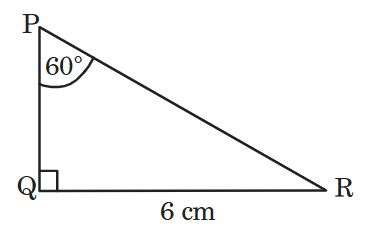
In fig, $\triangle \text{PQR}$ is, right angled at $\text{Q , QR }=6 \ cm$, $\angle \text{QPR}=60^{\circ}$. Find the length of $PQ$ and $PR .$
Image
Answer
In $\triangle \text{PQR}$,
The value of $\sin 60^{\circ}=\frac{\sqrt{3}}{2}$,
So, $\Rightarrow \frac{Q R}{P R}=\frac{\sqrt{3}}{2}$
Substitute $Q R=6 \ cm$,
we get $\Rightarrow \frac{6}{P R}=\frac{\sqrt{3}}{2}$
$\Rightarrow P R=\frac{12}{\sqrt{3}} \ cm$
$=\frac{12 \times \sqrt{3}}{\sqrt{3} \times \sqrt{3}}=4 \sqrt{3} \ cm$
In right angled $\triangle \text{PQR}$,
$\ce{PR^2=PQ^2 + QR^2}$
$\Rightarrow(4 \sqrt{3})^2=P Q^2+6^2$
$\Rightarrow 48=P Q^2+36$
$\Rightarrow PQ^2=12$
$\Rightarrow PQ=\sqrt{12}$
$=\sqrt{4 \times 3}$
$=2 \sqrt{3} \ cm$
Hence, $PQ=2 \sqrt{3} \ cm$ and $P R=4 \sqrt{3} \ cm$.
View full question & answer
Question 133 Marks
Prove that $\frac{1+\sec A}{\sec A}=\frac{\sin ^2 A}{1-\cos A}$.
Answer

$
\begin{aligned}
LHS\quad\frac{1+\sec A}{\sec A} & =\frac{1+\frac{1}{\cos A}}{\frac{1}{\cos A}} \\
& =\frac{\frac{\cos A+1}{\cos A}}{\frac{1}{\cos A}} \\
& =\frac{\cos A+1}{\cos A} \times \frac{\cos A}{1} \\
& =1+\cos A \\
& =1+\cos A \times\left(\frac{1-\cos A}{1-\cos A}\right) \\
& =\frac{(1)^2-(\cos A)^2}{1-\cos A} \\
& =\frac{1-\cos { }^2 A}{1-\cos A} \\
& =\frac{\sin ^2 A}{1-\cos A}=R H S
\end{aligned}
$
View full question & answer
Question 143 Marks
Show that: $\frac{\cos ^2\left(45^{\circ}+\theta\right)+\cos ^2\left(45^{\circ}-\theta\right)}{\tan \left(60^{\circ}+\theta\right) \tan \left(30^{\circ}-\theta\right)}=1$
Answer
We will take,
$\Rightarrow \text { L.H.S }=\frac{\cos ^2\left(45^{\circ}+\theta\right)+\cos ^2\left(45^{\circ}-\theta\right)}{\tan \left(60^{\circ}+\theta\right) \cdot \tan \left(30^{\circ}-\theta\right)}$
$\Rightarrow \frac{\cos ^2\left(45^{\circ}+\theta\right)+\left[\sin \left(\sin \left(90^{\circ}-\left(45^{\circ}-\theta\right)\right)\right]\right.}{\tan \left(45^{\circ}+\theta\right) \cdot \cot \left(90^{\circ}-\left(30^{\circ}-\theta\right)\right)}$
$\because \sin \left(90^{\circ}-\theta\right)=\cos \theta $ and  $\cot (90^{\circ}-\theta)=\tan \theta$
$\text { [11/2] }$
$\Rightarrow \frac{\cos ^2\left(45^{\circ}+\theta\right)+\sin ^2\left(45^{\circ}+\theta\right)}{\tan \left(60^{\circ}+\theta\right) \cdot \cot \left(60^{\circ}+\theta\right)}$
${\left[\because \sin ^2 \theta+\cos ^2 \theta=1\right]}$
$\Rightarrow \frac{1}{\tan \left(60^{\circ}+\theta\right) \cdot \frac{1}{\tan \left(60^{\circ}+\theta\right)}}=1$
$\Rightarrow 1=1$
$\Rightarrow \text { L.H.S = R.H.S},$
Hence proved
View full question & answer
Question 153 Marks
Prove that $\frac{1+\tan ^2 A}{1+\cot ^2 A}=\sec ^2 A-1$
Answer
We know, trigonometric identities
$
1+\tan ^2 A=\sec ^2 A \text { and } 1+\cot ^2 A=\operatorname{cosec}^2 A
$
Therefore, the given L.H.S. becomes
$
\begin{aligned}
\frac{\sec ^2 A}{\operatorname{cosec}^2 A} & =\frac{\sin ^2 A}{\cos ^2 A} \\
& =\tan ^2 A \\
& =1-\sec ^2 A
\end{aligned}
$
Hence proved.
View full question & answer
Question 163 Marks
Prove that: $(\operatorname{cosec} A-\sin A)(\sec A-\cos A) =\frac{1}{\tan A+\cos A}$
Answer
$(\operatorname{cosec} A -\sin A )(\sec A -\cos A )$
$=\frac{1}{\tan A+\cot A}$
$\text { LHS, }\left(\frac{1}{\sin A}-\sin A\right)\left(\frac{1}{\cos A}-\cos A\right)$
$\Rightarrow\left[\frac{1-\sin ^2 A}{\sin A}\right]\left[\frac{1-\cos ^2 A}{\cos A}\right]$
$\Rightarrow \frac{\cos ^2 A \times \sin ^2 A}{\sin A \times \cos A }$
$\Rightarrow \cos A \sin A$
$\text { RHS }, \frac{1}{\frac{\sin A}{\cos A}+\frac{\cos A}{\sin A}}$
$\Rightarrow \frac{1}{\frac{\cos ^2 A+\sin ^2 A}{\cos A \sin A}}$
$\Rightarrow \frac{\cos A \sin A}{\sin ^2 A+\cos ^2 A}$
$\Rightarrow \cos A \sin A$
$\Rightarrow \text { LHS = RHS }$
View full question & answer
Question 173 Marks
$\sqrt{\frac{\sec \theta-1}{\sec \theta+1}}+\sqrt{\frac{\text { sec } \theta+1}{\sec \theta-1}}=2 \operatorname{cosec} \theta$
Answer
$\text{L.H.S.} : \sqrt{\frac{\sec \theta-1}{\sec \theta+1}}+\sqrt{\frac{\sec \theta+1}{\sec \theta-1}}$
$=\sqrt{\frac{(\sec \theta-1)}{(\sec \theta+1)} \times \frac{(\sec \theta-1)}{(\sec \theta-1)}}+\sqrt{\frac{(\sec \theta+1)}{(\sec \theta-1)} \times \frac{(\sec \theta+1)}{(\sec \theta+1)}}$
$=\sqrt{\frac{(\sec \theta-1)^2}{\tan ^2 \theta}}+\sqrt{\frac{(\sec \theta+1)^2}{\tan ^2 \theta}}\left[\because \sec ^2 \theta+\tan ^2 \theta=1\right]$
$=\frac{(\sec \theta-1)}{\tan \theta}+\frac{(\sec \theta+1)}{\tan \theta}$
$=\frac{\sec \theta-1+\sec \theta+1}{\tan \theta}$
$=\frac{2 \sec \theta}{\tan \theta}$
$=\frac{2 \times \cos \theta}{\sin \theta \times \cos \theta}$
$=2$
$=2 \operatorname{cosec} \theta$
$=\text { R.H.S }$
View full question & answer
Question 183 Marks
Prove that : $(\sin \theta+1+\cos \theta)(\sin \theta-1+\cos \theta)$. $\sec \theta \operatorname{cosec} \theta=2$
Answer
$\text { L.H.S. : }(\sin \theta+\cos \theta)(\sin \theta-1+\cos \theta) . \sec \theta \operatorname{cosec} \theta$
$=\{(\sin \theta+\cos \theta)+1(\sin \theta+\cos \theta)-1\} . \sec \theta \operatorname{cosec} \theta$
$=\left\{(\sin \theta+\cos \theta)^2-(1)^2\right\} \sec \theta \operatorname{cosec} \theta \left[\because(a-b)(a+b)=a^2-b^2\right]$
$=\left\{\sin ^2 \theta+\cos ^2 \theta+2 \sin \theta \cos \theta-1\right\} \frac{1}{\cos \theta} \frac{1}{\sin \theta}$
$=\left[\because \operatorname{cosec} \theta=\frac{1}{\sin \theta} \text { and } \because \sec \theta=\frac{1}{\cos \theta}\right]$
$=\frac{\{1+2 \sin \theta \cos \theta-1\}}{\sin \theta \cos \theta} \left[\because \sin ^2 \theta+\cos ^2 \theta=1\right]$
$=\frac{2 \sin \theta \cos \theta}{\sin \theta \cos \theta}=2=\text { R.H.S }$
 
View full question & answer
3 Marks Question - Maths STD 10 Questions - Vidyadip