Question
Prove that from the surface of earth :
(i) accleration due to the gravity at a height $h$$
g_h=g\left(1-\frac{2 h}{ R }\right)
$(ii) Acceleration due to gravity at depth $h ^{\prime}$$
g_h^{\prime}=g\left(1-\frac{h^{\prime}}{ R }\right)
$
Where g is the gravitational acceleration on earth's surface and $R$ is the radius of the Earth. (Here assume $\rho$ and $h \ll R)$
Answer

self

Need a full question paper?

Generate a complete, print-ready paper with questions like this in minutes — across 16+ boards, with answer keys.

Start Generating Free

Similar questions

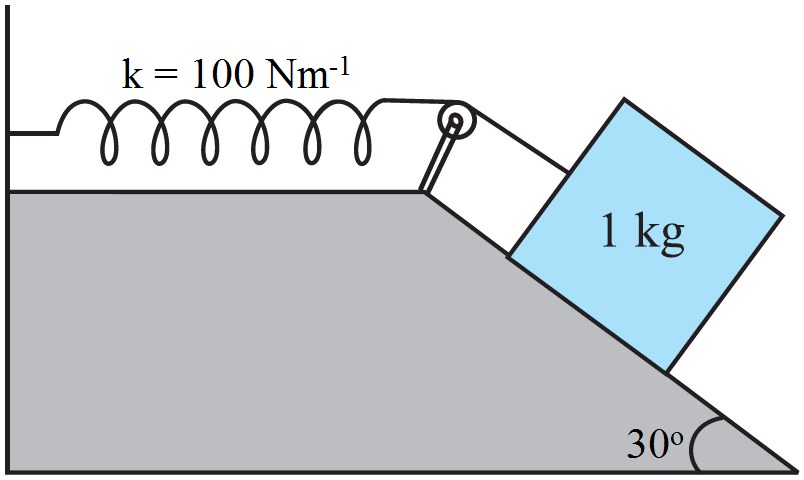
A 1kg block situated on a rough incline is connected to a spring of spring constant 100Nm as shown below. The block is released from rest with the spring in the unstretched position. The block moves 10cm down the incline before coming to rest. Find the coefficient of friction between the block and the incline. Assume that the spring has a negligible mass and the pulley is frictionless.
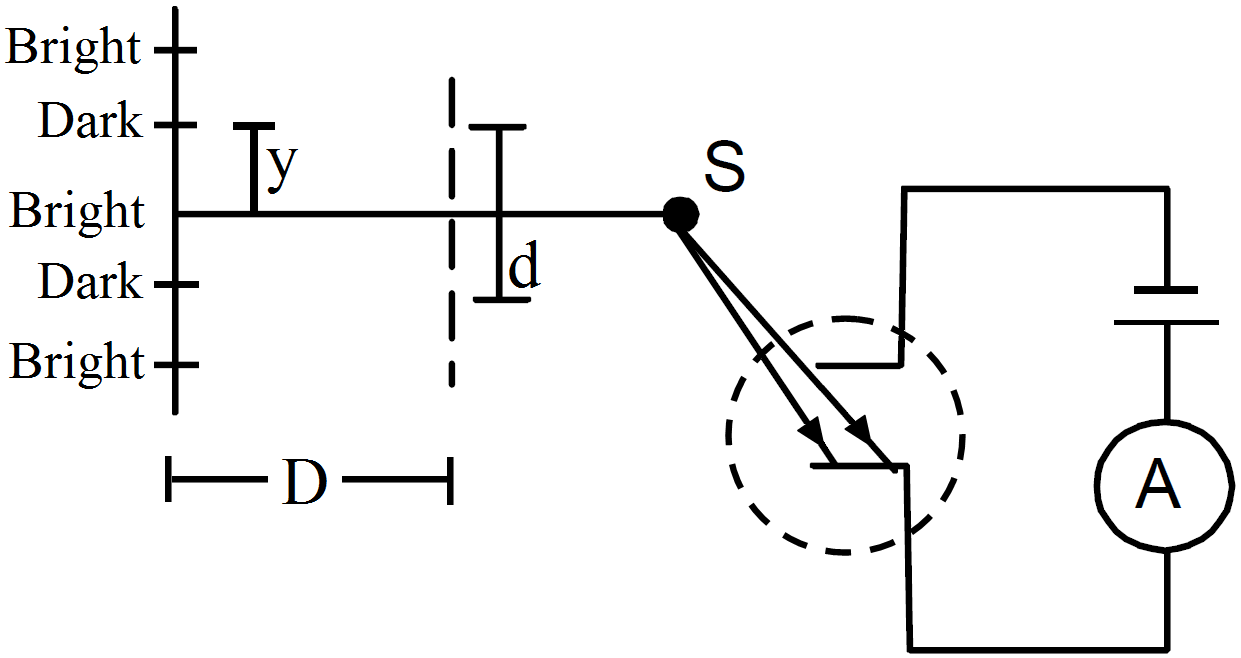
In the arrangement shown in figure $y = 1.0mm. d = 0.24mm$ end $D = 1.2m$. The work function of the materiel of the emitter is $2.2eV$. Find the stopping potential V needed to stop the photocurrent.
(i) What is oscillatory or vibratory motion? Explain this with explanation. Write difference between oscillatory and harmonic motion.
(ii) Write the definition of period and frequency and establish the relationship between them.
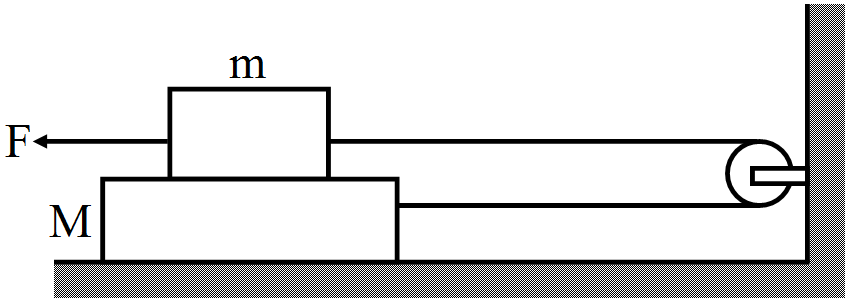
The friction coefficient between the two blocks shown in figure is $\mu$ but the floor is smooth.
  1. What maximum horizontal force F can be applied without disturbing the equilibrium of the system?
  2. Suppose the horizontal force applied is double of that found in part (a). Find the accelerations of the two masses.
A body is projected with some initial velocity making an angle $\theta$ with the horizontal. Show that its path is a parabola. Find the maximum height attained, time for maximum height, horizontal range, maximum horizontal range and the time of flight.
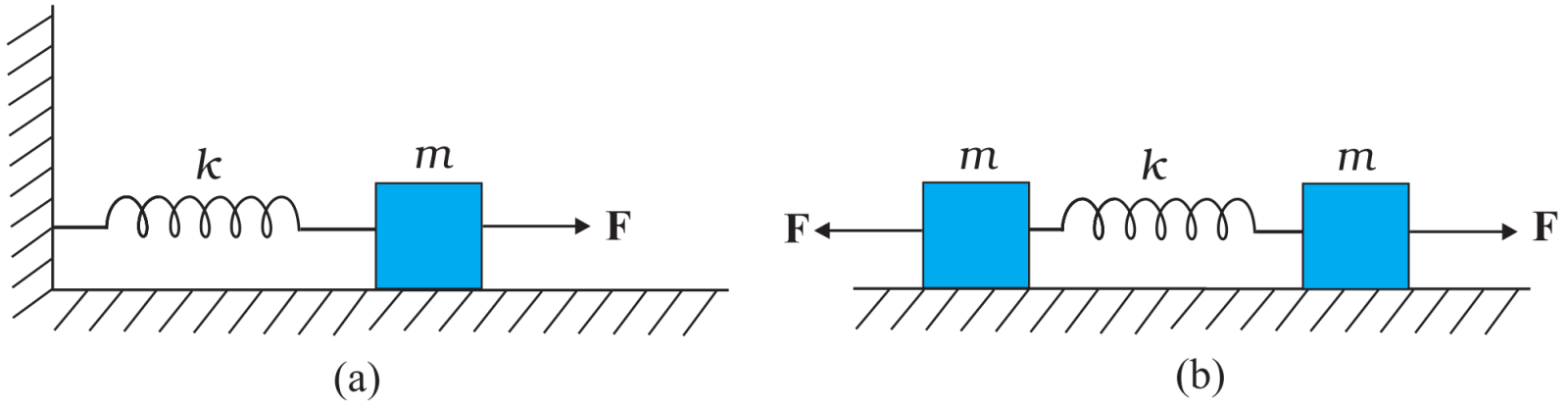
Figure (a) shows a spring of force constant k clamped rigidly at one end and a mass m attached to its free end. A force F applied at the free end stretches the spring. Figure (b) shows the same spring with both ends free and attached to a mass m at either end. Each end of the spring in Fig. (b) is stretched by the same force F.
If the mass in Fig. (a) and the two masses in Fig. (b) are released, what is the period of oscillation in each case?
A vector has both magnitude and direction. Does it mean that anything that has magnitude and direction is necessarily a vector? The rotation of a body can be specified by the direction of the axis of rotation, and the angle of rotation about the axis. Does that make any rotation a vector?
Define conservative and non$-$conservative forces. Give example and properties of conservative forces. A $5\ kg$ rifle fires a $58$ bullet with a speed of $500ms^{-1}$. What kinetic energy is acquired.
  1. By the bullet and.
  2. By the rifle?
  3. Find the the ratio of the distance which the rifle moves backward while the bullet is in the barrel to the distance the bullet moves forward.
Establish the following vector inequalities geometrically or otherwise: $|\text{a}-\text{b}|\ge||\text{a}|-|\text{b}||$When does the equality sign above apply?
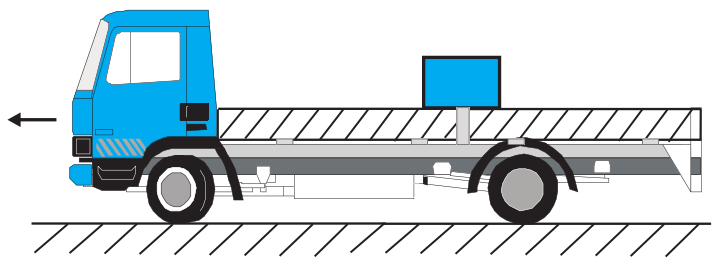
The rear side of a truck is open and a box of $40kg$ mass is placed $5m$ away from the open end as shown in Fig. The coefficient of friction between the box and the surface below it is $0.15$. On a straight road, the truck starts from rest and accelerates with $2ms^{-2}$. At what distance from the starting point does the box fall off the truck? (Ignore the size of the box).