Question
Prove that if a, and a, are the amplitudes of two interfering waves $\phi$ and is their phase difference, the amplitude of the resultant wave is given by,
$\text{a}^2=\text{a}^2_1+\text{a}^2_2+2\text{a}_1\text{a}_2\cos\phi$
Answer

Let $\text{y}_1=\text{a}_1\cos\ \omega\text{t},$
$\text{y}_2=\text{a}_52\cos\ (\omega\text{t}+\phi)$
be the two displacements.
On superposition,
$\text{y}=\text{y}_1+\text{y}_2$
$=\text{a}_1\cos\ \omega\text{t}+\text{a}_2\cos(\omega\text{t}+\phi)$
$=\text{a}_1\cos\omega\text{t}+\text{a}_2\cos\ \omega\text{t}\cos\phi$
$=-\text{a}_2\sin\omega\text{t}\sin\phi$
$=-(\text{a}_2\sin \phi)\sin\omega\text{t}\dots(1)$
$\text{put}\text{ a}_1+\text{a}_2\cos\phi=\text{a}\cos\theta\dots(2)$
$\text{a}_2\sin\phi=\text{a}\sin\theta\dots(3)$
Squaring and adding (2) and (3), we have
$\text{y}=\text{a}\cos\theta\cos\omega\text{t}-\text{a}\sin\theta\sin\omega\text{t}$
$=\text{a}\cos(\omega\text{t}+\theta)$
$\therefore\text{y}=\Big(\text{a}^2_1+\text{a}^2_2+2\text{a}_1\text{a}_2\cos\phi\Big)^{\frac{1}{2}}\cos(\omega\text{t}+\theta)$
where $\theta=\tan^{-1}\Big(\frac{\text{a}_2\sin\phi}{\text{a}_1+\text{a}_2\cos\phi}\Big)$

Need a full question paper?

Generate a complete, print-ready paper with questions like this in minutes — across 16+ boards, with answer keys.

Start Generating Free

Similar questions

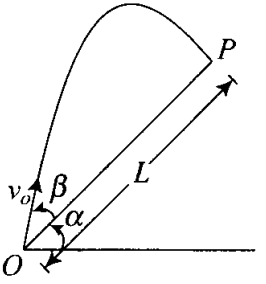
A particle is projected in air at an angle $\beta$ to a surface which itself is inclined at an angle $\alpha$ to the horizontal (Fig.).
  1. Time of flight.
(Hint: This problem can be solved in two different ways:
  1. Point P at which particle hits the plane can be seen as intersection of its trajectory (parobola) and straight line. Remember particle is projected at an angle $(\alpha+\beta)$ w.r.t. horizontal.
  2. We can take x-direction along the plane and y-direction perpendicular to the plane. In that case resolve g (acceleration due to gravity) in two differrent components, $g_x$ along the plane and $g_y$ perpendicular to the plane. Now the problem can be solved as two independent motions in x and y directions respectively with time as a common parameter.)
The motion of a particle executing simple harmonic motion is described by the displacement function, $x ( t )= A$ $\cos \left(\omega_t+\omega\right)$.
If the initial $(t=0)$ position of the particle is 1 cm and its initial velocity is $\omega cm / s$, what are its amplitude and initial phase angle? The angular frequency of the particle is $\pi s ^{-1}$. If instead of the cosine function, we choose the sine function to describe the $SHM : x = B \sin (\omega t+a)$, what are the amplitude and initial phase of the particle with the above initial conditions.
A ball is whirled in a circle by attaching it to a fixed point with a string. Is there an angular rotation of the ball about its centre? If yes, is this angular velocity equal to the angular velocity of the ball about the fixed point?
A uniform wheel of radius R is set into rotation about its axis at an angular speed $\omega.$ This rotating wheel is now placed on a rough horizontal surface with its axis horizontal. Because of friction at the contact, the wheel accelerates forward and its rotation decelerates till the wheel starts pure rolling on the surface. Find the linear speed of the wheel after it starts pure rolling.
A fighter plane is flying horizontally at an altitude of 1.5km with speed 720km/ h. At what angle of sight (w.r.t. horizontal) when the target is seen, should the pilot drop the bomb in order to attack the target?
Differentiate between progressive and non- progressive waves.
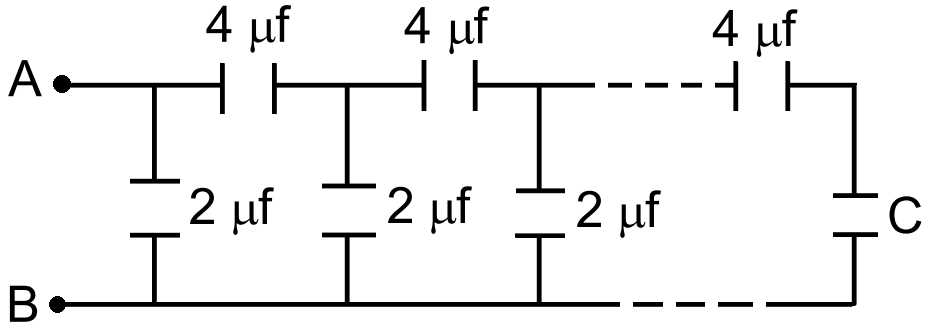
A finite ladder is constructed by connecting several sections of $2\mu\text{F},\ 4\mu\text{F}$ capacitor combinations as shown in figure. It is terminated by a capacitor of capacitance C. What value should be chosen for C, such that the equivalent capacitance of the ladder between the points A and B becomes independent of the number of sections in between?
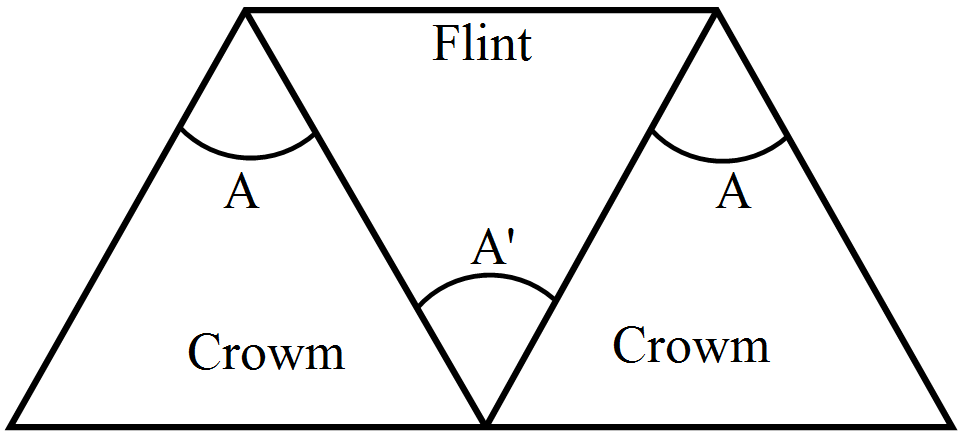
Three thin prisms are combined as shown in figure. The refractive indices of the crown glass for red, yellow and violet rays are $\mu_\text{r},\mu_\text{y}$ and $\mu_\text{v}$ respectively and those for the flint glass are $\mu'_\text{r},\mu'_\text{y}$ and $\mu'_\text{v}$ respectively. Find the ratio $\frac{\text{A}'}{\text{A}}$ for which.
  1. There is no net angular dispersion.
  2. There is no net deviation in the yellow ray.
A parallel-plate capacitor having plate area $20cm^2$ and separation between the plates 1.00mm is connected to a battery of 12.0V. The plates are pulled apart to increase the separation to 2.0mm.
  1. Calculate the charge flown through the circuit during the process.
  2. How much energy is absorbed by the battery during the process?
  3. Calculate the stored energy in the electric field before and after the process.
  4. Using the expression for the force between the plates, find the work done by the person pulling the plates apart.
  5. Show and justify that no heat is produced during this transfer of charge as the separation is increased.
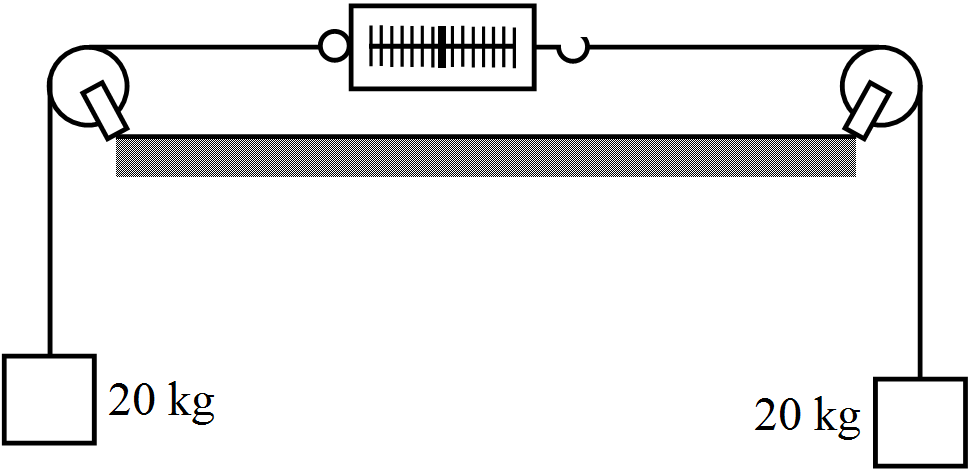
Figure shows a light spring balance connected to two blocks of mass 20kg each. The graduations in the balance measure the tension in the spring.
  1. What is the reading of the balance?
  2. Will the reading change if the balance is heavy, say 2.0kg?
  3. What will happen if the spring is light but the blocks have unequal masses?