Question
Prove that in a triangle, other than an equilateral triangle, angle opposite the longest side is greater than $\frac{2}{3}$ of a right angle.
Answer


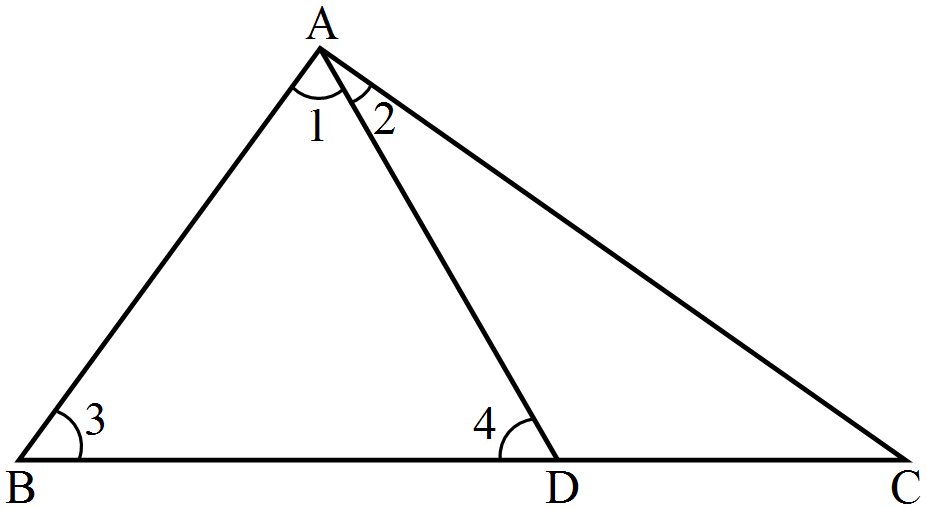
Given: In $\triangle\text{ABC, BC}$ is the longest side.
To prove: $\angle\text{BAC}>\frac{2}{3}$ of a right angle, i.e., $\angle\text{BAC}>60^{\circ}$
Construct: Mark a point D on side AC such that AD = AB = BD.
Proof:
In $\triangle\text{ABD,}$
$\because\text{AD = AB = BD}$ (By construction)
$\therefore\angle1=\angle3=\angle4=60^{\circ}$
Now,
$\angle\text{BAC}=\angle1+\angle2=60^{\circ}+\angle2$
but $60^{\circ}=\frac{2}{3}$ of a right angle
So, $\angle\text{BAC}=\frac{2}{3}$ of a right angle + $\angle2$
Hence, $\angle\text{BAC}>\frac{2}{3}$ of a right angle.

Need a full question paper?

Generate a complete, print-ready paper with questions like this in minutes — across 16+ boards, with answer keys.
Start Generating Free

Similar questions

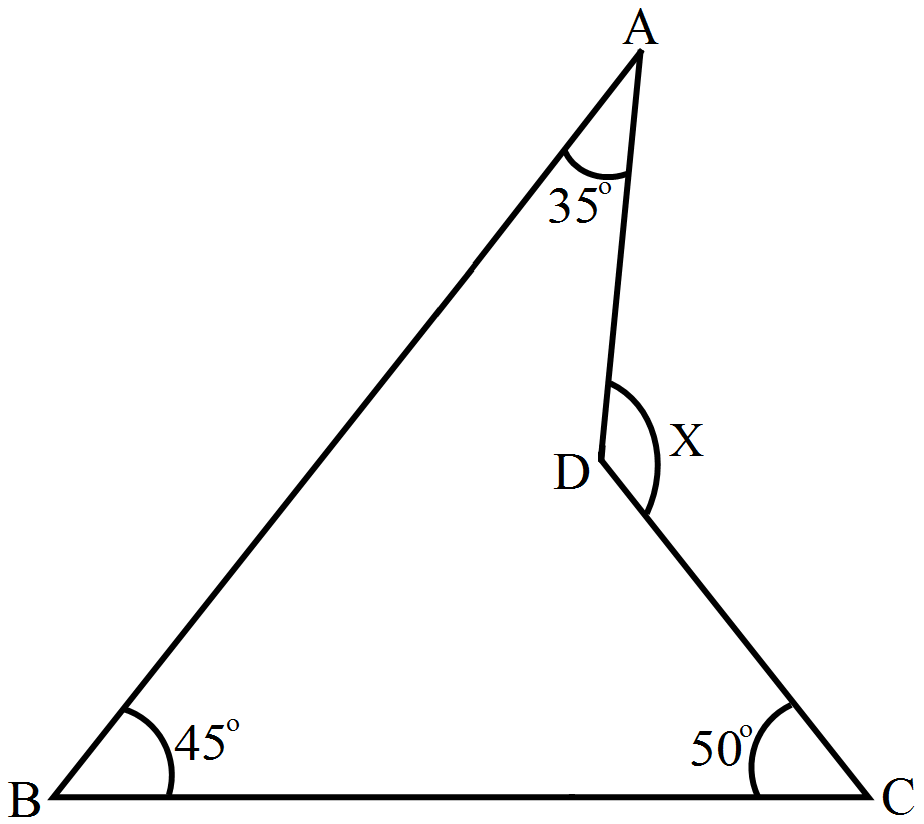
In the given figure, compute the value of x.

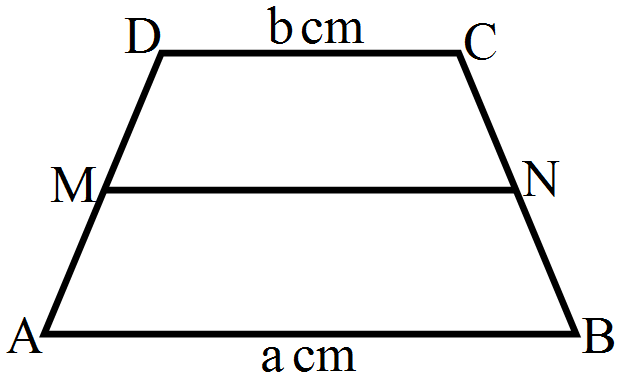
In a trapezium ABCD, AB || DC, AB = acm, and DC = bcm. If M and N are the midpoints ofthe nonparallel sides, AD and BC respectively then find the ratio of
ar(DCNM) and ar(MNBA).

The sum of the deviations of a set of n values x1, x2, x3,..., xn measured from 15 and -3 are -90 and 54 respectively. Find the value of n and mean.
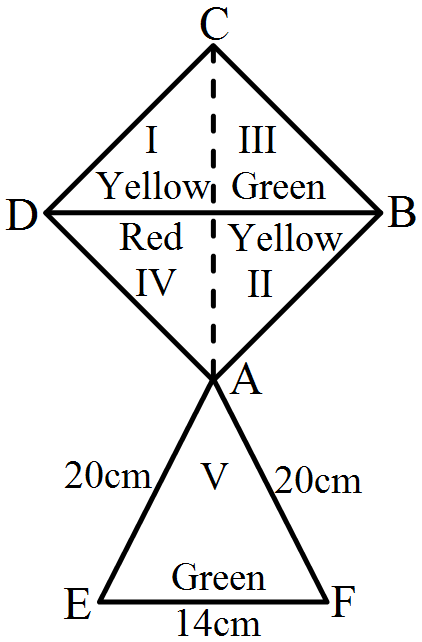
In the given figure, ABCD is a square with diagonal 44cm. How much paper of each shade is needed to make a kite given in the figure?

Draw a histogram for the frequency distribution of the following date:
Class interval
8-13
13-18
18-23
23-28
28-33
33-38
38-43
Frequency
320
780
160
540
260
100
80
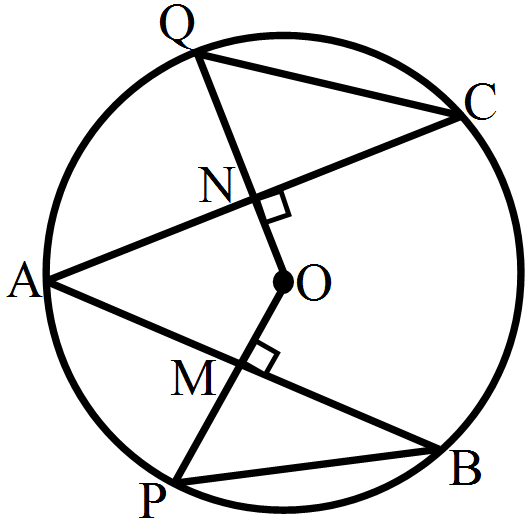
In the adjoining figure, O is the centre of a circle. If AB and AC are chords of the circle such that AB = AC, $\text{OP}\perp\text{AB}$ and $\text{OQ}\perp\text{AC},$
prove that PB = QC.

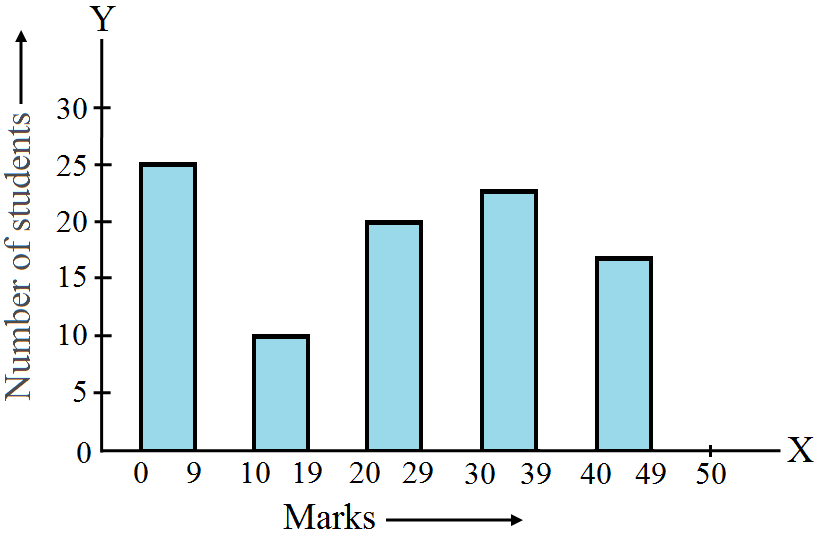
Given below is the bar graph indicating the marks obtained out of 50 in mathematics paper by 100 students. Read the bar graph and answer the following questions:

  1. It is decided to distribute workbooks on mathematics to the students obtaining less than 20 marks, giving one workbook to each of such students. If a workbook costs Rs. 5, what sum is required to buy the workbooks?
  2. Every student belonging to the highest mark group is entitled to get a prize of Rs. 10. How much amount of money is required for distributing the prize money?
  3. Every student belonging to the lowest mark-group has to solve 5 problems per day. How many problems, in all, will be solved by the students of this group per day?
  4. State whether true or false:
  1. 17% students have obtained marks ranging from 40 to 49.
  2. 59 students have obtained marks ranging from 10 to 29.
  1. What is the number of students getting less than 20 marks?
  2. What is the number of students getting more than 29 marks?
  3. What is the number of students getting marks between 9 and 40?
  4. What is the number of students belonging to the highest mark group?
  5. What is the number of students obtaining more than 19 marks?
The difference between inside and outside surfaces of a cylindrical tube 14cm long, is 88cm2. If the volume of the tube is 176cm3, find the inner and outer radii of the tube.
An organisation selected 2400 families at random and surveyed them to determine a relationship between the income level and the number of vehicles in a family. The information gathered is listed in the table below:
Monthly income(in ₹)
Number of vehicles per family
0
1
2
3 or more
Less than ₹ 25000
10
160
25
0
 ₹ 25000 - ₹ 30000
0
305
27
2
 ₹ 30000 - ₹ 35000
1
535
29
1
 ₹ 35000 - ₹ 40000
2
469
59
25
 ₹ 40000 or more
1
579
82
88
Suppose a family is chosen at random. Find the probability that the family chosen is:
  1. Earning ₹ 25000 - ₹ 30000 per month and owning exactly 2 vehicles.
  2. Earning ₹ 40000 or more per month and owning exactly 1 vehicle.
  3. Earning less than ₹ 25000 per month and not owning any vehicle.
  4. Earning ₹ 35000 - ₹ 40000 per month and owning 2 or more vehicles.
  5. Owning not more than 1 vehicle.
The total surface area of a solid cylinder is 231cm2 and its curved surface area is $\frac{2}{3}$ of the total surface area. Find the volume of the cylinder.