Question
Prove that in a triangle, other than an equilateral triangle, angle opposite the longest side is greater than $\frac{2}{3}$ of a right angle.
Answer

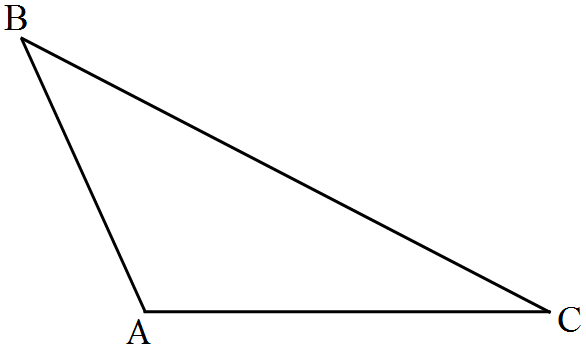
Consider $\triangle\text{ABC}$ in which $BC$ is the longest side. To prove $\angle\text{A}=\frac{2}{3}$ right angle Proof In $\triangle\text{ABC},\ \text{BC}>\text{AB}.$

$[$consider $BC$ is the largest side$]$
$\Rightarrow\ \angle\text{A}>\angle\text{C} ...(i) [$angle opposite the lngest side is greatest$]$
$\text{and}\ \text{BC}>\text{AC}$
$\Rightarrow\ \angle\text{A}>\angle\text{B}, [$angle opposite the longest side is greatest$]$
On adding Eqs. $(i)$ and $(ii),$ we get $2\angle\text{A}>\angle\text{B}+\angle\text{C}$
$\Rightarrow\ 2\angle\text{A}+\angle\text{A}>\angle\text{A}+\angle\text{C}$ [adding $\angle\text{A}$ both sides]
$\Rightarrow\ 3\angle\text{A}>\angle\text{A}+\angle\text{B}+\angle\text{C}$
$\Rightarrow\ 3\angle\text{A}>180^\circ [$sum of the angles of a triangle is $180^\circ ]$
$\Rightarrow\ \angle\text{A}>\frac{2}{3}\times90^\circ$
 i.e., $\angle\text{A}>\frac{2}{3}$ of a right angle Hence proved.

Need a full question paper?

Generate a complete, print-ready paper with questions like this in minutes — across 16+ boards, with answer keys.
Start Generating Free

Similar questions

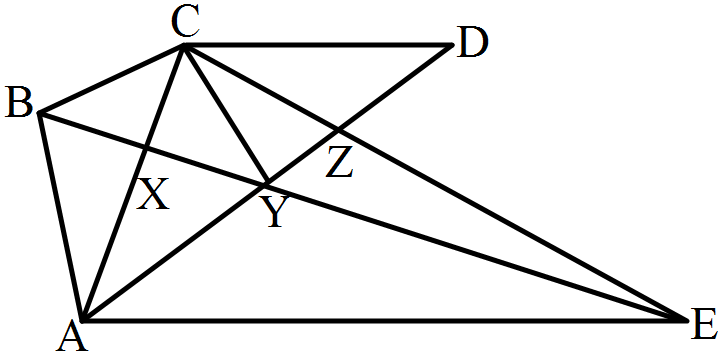
In the given figure, $CD \| AE$ and $CY \| BA$.
$i.$ Name a triangle equal in area of $\triangle\text{CBX}$
$ii.$ Prove that $\text{ar}(\triangle\text{ZDE})=\text{ar}(\triangle\text{CZA})$
$iii.$ Prove that $\text{ar}(\text{BCZY})=\text{ar}(\triangle\text{EDZ}).$
Draw the graphs of the following linear equations on the same graph paper: $2x + 3y = 12, x - y = 1$ Find the coordinates of the vertices of the triangle formed by the two straight lines and the $y$-axis. Also, find the area of the triangle.
If each side of a equilateral triangle is tripled then what is the percentage increase in the area of the triangle?
Rationalise the denominator of the following:
$\frac{1}{\sqrt{7}+\sqrt{6}-\sqrt{13}}$
The sides of a quadrilateral field, taken in order are $26\ m, 27\ m, 7\ m, 24\ m$ respectively. The angle contained by the last two sides is a right angle. Find its area.
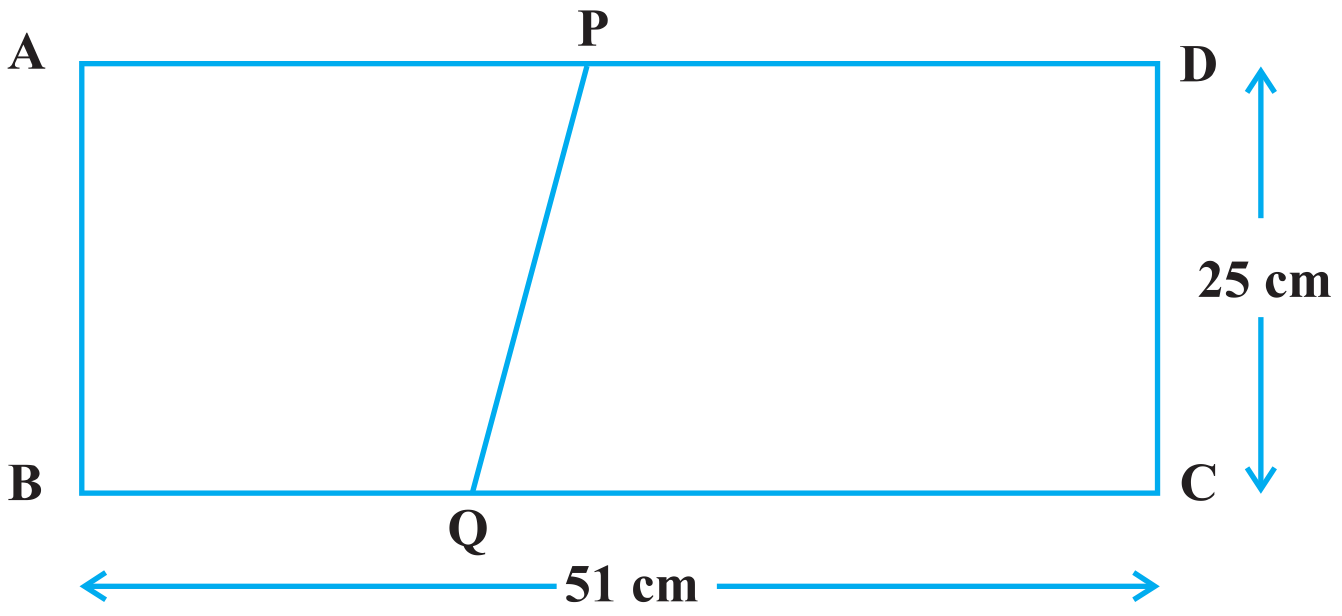
The dimensions of a rectangle $A B C D$ are $51 cm \times 25 cm$. A trapezium $PQCD$ with its parallel sides $QC$ and $PD$ in the ratio $9: 8$, is cut off from the rectangle as shown in the if the area of the trapezium $PQCD$ is $\frac{5}{6}$ th part of the area of the rectangle, find the lengths $QC$ and $PD.$​​​​​​​
The paint in a certain container is sufficient to paint an area equal to 9.375m2. How many bricks of dimensions 22.5cm × 10cm × 7.5cm can be painted out of this container?
Show that if the diagonals of a quadrilateral are equal and bisect each other at right angles, then it is a square.
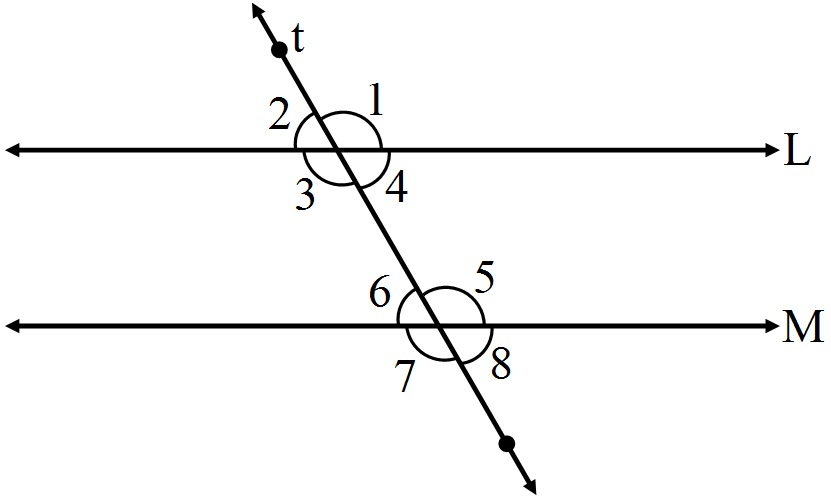
In the given figure, $l || m$ and a transversal $t$ cuts them, If $\angle1=120^\circ,$ find the measure of each of the remaining marked angles.
The breadth of a room is twice its height, one half of its length and the volume of the room is $512cu$. dm. Find its dimensions.