Question
Prove that in projectile motion, when bodies are projected at angle $\left(45^{\circ}+\phi\right)$ and $\left(45^{\circ}-\phi\right)$ from the horizontal, their horizontal range will be same.

Answer

 We know that by projecting an object at angle $\theta$,
$R=\frac{u^2 \sin 2 \theta}{g}$
But it is given that when object is projected at angle $(45+\phi)$ and $\left(45^{\circ}-\phi\right)$ from the horizontal, their ranges are same.$
\begin{aligned}
R_1 & =\frac{u^2 \sin 2\left(45^{\circ}+\phi\right)}{g} \\
R_1 & =\frac{u^2 \sin \left(90^{\circ}+2 \phi\right)}{g} \\
R_1 & =\frac{u^2 \cos 2 \phi}{g}......(1) \\
\text { Similarly, } \quad R_2 & =\frac{u^2 \sin 2\left(45^{\circ}-\phi\right)}{g} \\
R_2 & =\frac{u^2 \sin \left(90^{\circ}-2 \phi\right)}{g} \\
R_2 & =\frac{u^2 \cos 2 \phi}{g}.......(2)
\end{aligned}$
From equations (1) and (2), it is clear
$R_1=R_2$

Need a full question paper?

Generate a complete, print-ready paper with questions like this in minutes — across 16+ boards, with answer keys.
Start Generating Free

Similar questions

Find the dimensions of :
  1. Electric field $E$,
  2. Magnetic field $B$ and
  3. Magnetic permeability $\mu_0.$
The relevant equations are$\text{F = qE, F = qvB,}$ and $\text{B}=\frac{\mu_0\text{I}}{2\pi\alpha};$
where $F$ is force, $q$ is charge, $v$ is speed, $I$ is current, and $a$ is distance.
What is the dimension of coefficient of viscosity?
Find the area bounded under the curve $y = 3x^2 + 6x + 7$ and the X-axis with the ordinates at $x = 5$ and $x = 10$.
What are the conditions under which a rocket fired from the earth, launches an artificial satellite of earth?
A block of mass $2.00kg$ moving at a speed of $10.0m/s$ accelerates at $3.00m/s^2$ for $5.00s$. Compute its final kinetic energy.
What is called stream line flow?
Find the ratio of the mean speed of hydrogen molecules to the mean speed of nitrogen molecules in a sample contammg a mixture of the two gases.
Why do we see the flash of lightning first and hear the thunder later?
One end of a long string of linear mass density $8.0 \times 10 kg . m ^{-1}$ is connected to an electrically operated tunning fork of frequency 256 Hz . The other end of the string is passed over a stationary pulley and tied to the scale of a balance on which 90 kg weight are hanging. The pulley end absorb all the incoming energy due 90 which the amplitude of the waves reflected from this end is negligible. At $t=0$ the transverse displacement at the left end of the string at $x=0$ is zero $(y=0)$ and it is moving along the positive direction. The amplitude of the wave is 5.0 cm write the transverse displacement $y$ describe this wave on the string as a function of $X$ and $t$.
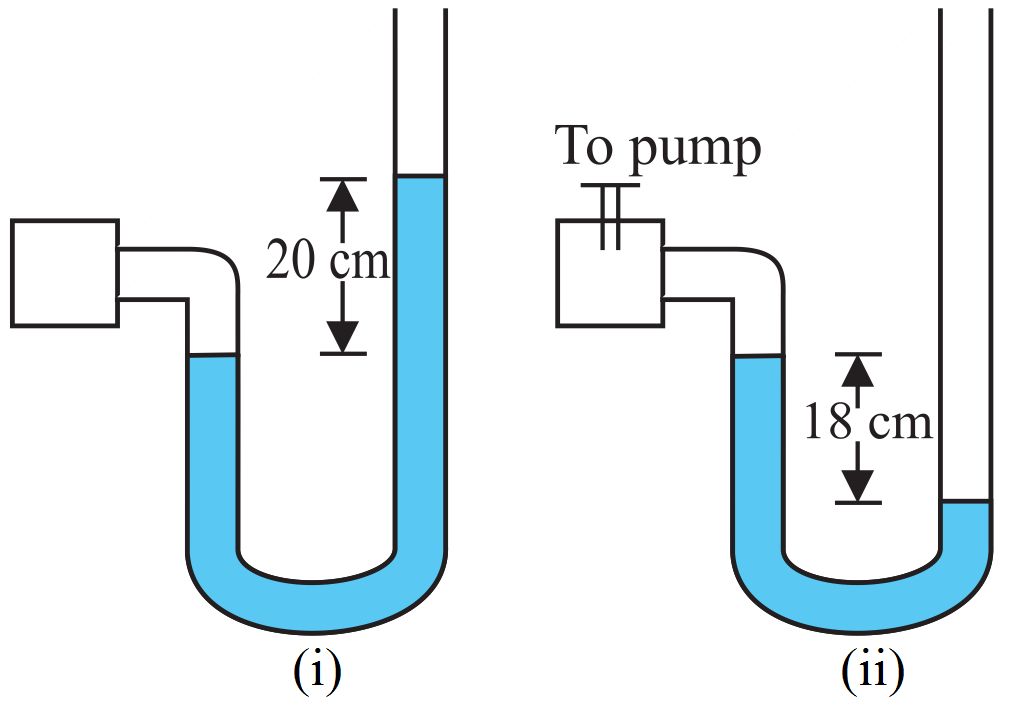
A manometer reads the pressure of a gas in an enclosure as shown in Fig.$(a)$ When a pump removes some of the gas, the manometer reads as in Fig. $(b)$ The liquid used in the manometers is mercury and the atmospheric pressure is $76\ cm$ of mercury. Give the absolute and gauge pressure of the gas in the enclosure for cases $(i)$ and $(ii)$ in units of cm of mercury. How would the levels change in case $(i)$ if $13.6\ cm$ of water $($immiscible with mercury$)$ are poured into the right limb of the manometer? $($Ignore the small change in volume of the gas.$)$