Question
Prove that $n_{12}=\frac{1}{\sin i_C}$ where $I_c$ is the critical angle.

Answer

The angle of incidence whose corresponding angle of refraction is $90^{\circ}$. It is called the critical angle $i_c$ for a given pair of mediums. From Snell's law $n_{21}=\frac{\sin i}{\sin r}$ we see that if the relative refractive index is less than one, then the maximum value of $\sin r$ is one. Therefore, there is an upper limit to the value of $\sin i$ up to which this rule can be applied.
This is $i=i_{ C }$, thus $\sin i_{ C }=n_{21}$
Snell's law of refraction cannot be applied to values of $i_c$ greater than $i$. Hence no refraction is possible. The refractive index of denser medium 2 will be relative to rarer medium 1.
$
n_{12}=\frac{1}{\sin i_C}
$

Need a full question paper?

Generate a complete, print-ready paper with questions like this in minutes — across 16+ boards, with answer keys.
Start Generating Free

Similar questions

Radioactive isotopes are produced in a nuclear physics experiment at a constant rate $\frac{\text{dN}}{\text{dt}}=\text{R}.$ An inductor of inductance 100mH, a resistor of resistance $100\Omega$ and a battery are connected to form a series circuit. The circuit is switched on at the instant the production of radioactive isotope starts. It is found that $\frac{\text{i}}{\text{N}}$ remains constant in time where i is the current in the circuit at time t and N is the number of active nuclei at time t. Find the half-life of the isotope.
Write any four characteristics of electromagnetic waves. Give two uses each of (i) Radio-waves (ii) Micro-waves.
A charge of 3.14 × 10⁻⁶C is distributed uniformly over a circular ring of radius 20.0cm. The ring rotates about its axis with an angular velocity of 60.0 rad/s. Find the ratio of the electric field to the magnetic field at a point on the axis at a distance of 5.00cm from the centre.
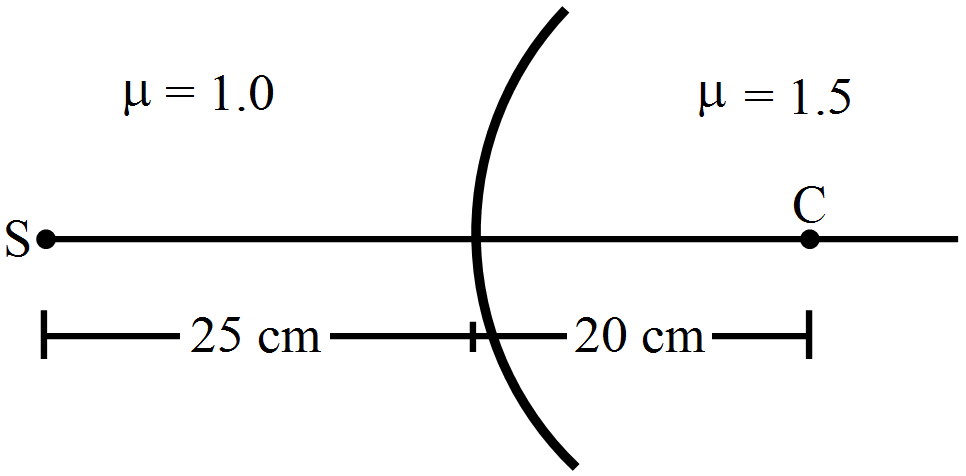
Locate the image formed by refraction in the situation shown in figure.

Two waves, travelling in the same direction through the same region, have equal frequencies, wavelengths and amplitudes. If the amplitude of each wave is 4mm and the phase difference between the waves is 90°, what is the resultant amplitude?
The current through a wire depends on time as $\text{i}=\text{i}_0+\alpha\text{t},$
Where $\text{i}_0=10\text{A}$ and $\alpha=4\text{A/ s}.$ Find the charge that crosses through a section of the wire in 10 seconds.
Draw diagrams to depict the behaviour of magnetic field lines near a ‘bar’ of: (i) Copper (ii) Aluminium (iii) Mercury, cooled to a very low temperature (4.2K)
  1. Using the phenomenon of polarisation, show how transverse nature of light can be demonstrated.
  2. Two polaroids P1 and P2 are placed with their pass axes perpendicular to each other. Unpolarised light of intensity Io is incident on P1. A third polaroid P3 is kept in between P1 and P2 such that its pass axis makes an angle of 300 with that of P1. Determine the intensity of light transmitted through P1, P2 and P3.
  1. Draw a plot showing the variation of photoelectric current with collector potential for different frequencies but same intensity of incident radiation.
  2. Use Einstein’s photoelectric equation to explain the observations from this graph.
  3. What change will you observe if intensity of incident radiation is changed but the frequency remains the same?
In Young’s double slit experiment, the two slits 0.15 mm apart are illuminated by monochromatic light of wavelength 450 nm. The screen is 1.0 m away from the slits.
  1. Find the distance of the second (i) bright fringe, (ii) dark fringe from the central maximum.
  2. How will the fringe pattern change if the screen is moved away from the slits?