Question
Prove that parallelogram circumscribing a circle is a rhombus.
Answer


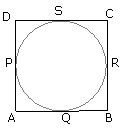
Given ABCD is a parallelogram in which all the sides touch a given circle
To prove:- ABCD is a rhombus
Proof:-
$\because$ ABCD is a parallelogram
$\therefore$ AB = DC and AD = BC
Again AP, AQ are tangents to the circle from the point A
$\therefore$ AP = AQ
Similarly, BR = BQ
CR = CS
DP = DS
$\therefore$(AP + DP) + (BR + CR) = AQ + DS + BQ + CS = (AQ + BQ) + (CS + DS)
$\Rightarrow$ AD + BC = AB + DC
$\Rightarrow$ BC + BC = AB + AB [$\because$ AB = DC, AD = BC]
$\Rightarrow$ 2BC = 2AB
$\Rightarrow$ BC = AB
Hence, parallelogram ABCD is a rhombus

Need a full question paper?

Generate a complete, print-ready paper with questions like this in minutes — across 16+ boards, with answer keys.

Start Generating Free

Similar questions

Side of a triangular field are 15m, 16m and 17m. With the three corners of the field a cow, a buffalo and tied separately with ropes of length 7m each to graze in field. Find the area of the field which cannot be grazed by three animals.
A die has its six faces marked 0, 1, 1, 1, 6, 6. Two such dice are thrown together and the total score is recorded.
  1. How many different scores are possible?
  2. What is the probability of getting a total of 7?
Solve for $x$ & $y.$
$\frac{1}{3 x+y}+\frac{1}{3 x-y}=\frac{3}{4} \text { and } \frac{1}{2(3 x+y)}-\frac{1}{(3 x-y)}=\frac{-1}{8}$
Compute the mode from the following data:
Age (in years)
0-5
5-10
10-15
15-20
20-25
25-30
30-35
Number of patients
6
11
18
24
17
13
5
Find a cubic polynomial whose zeroes are 2, -3 and 4
In the centre of a rectangular lawn of dimensions 50m x 40m, a rectangular pond has to be constructed so that the area of the grass surrounding the pond would be $1184m^2$. Find the length and breadth of the pond.
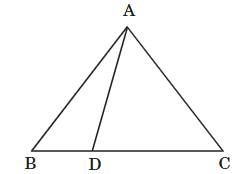
In the given figure $\triangle A B C$ is an equilateral. D is a point on $B C$ such that $B D=\frac{1}{3} B C$ Prove that $9 A D^2=7 A B^2$
Image
Solve the following quadratic equation:
$\frac{\text{x}-4}{\text{x}-5}+\frac{\text{x}-6}{\text{x}-7}=3\frac{1}{3},$ $\text{x}\neq5,7$
A shopkeeper buys a number of books for $₹ 1,800$ . If he had bought $15$ more books for the same amount, then each book would have cost him $₹ 20$ less. Find how many books he bought initially.
A train covered a certain distance at a uniform speed. If it were $6 \ km/h$ faster, it would have taken $4$ hours less than the scheduled time. And, if the train were slower by $6 \ km/h,$ it would have taken $6$ hours more than the scheduled time. Find the length of the journey.