Question
Prove that $\sin ^6 A+\cos ^6 A=1-3 \sin ^2 A \cdot \cos ^2 A$

Answer

$ \text { L.H.S }=\sin ^6 A+\cos ^6 A$
$ =\left(\sin ^2 A\right)^3+\left(\cos ^2 A\right)^3$
$=\left(1-\cos ^2 A\right)^3+\left(\cos ^2 A\right)^3 \ldots \ldots\left[\begin{array}{l}\because \sin ^2 A+\cos ^2 A=1 \\ \therefore 1-\cos ^2 A=\sin ^2 A\end{array}\right]$
$ =1-3 \cos ^2 A+3\left(\cos ^2 A\right)^2-\left(\cos ^2 A\right)^3+\cos ^6 A \ldots \ldots\left[\because(a-b)^3=a^3-3 a^2 b+3 a b^2-b^3\right]$
$ =1-3 \cos ^2 A\left(1-\cos ^2 A\right)-\cos ^6 A+\cos ^6 A$
$ =1-3 \cos ^2 A \sin ^2 A$
$ =\text { R.H.S }$
$ \therefore \sin ^6 A+\cos ^6 A=1-3 \sin ^2 A \cdot \cos ^2 A$

Need a full question paper?

Generate a complete, print-ready paper with questions like this in minutes — across 16+ boards, with answer keys.

Start Generating Free

Similar questions

Solve graphically the following system of linear equation. Also find the coordinates of the points where the lines meet axis of y.
$2x - y - 5 = 0,$
$x - y - 3 = 0.$
A takes $10$ days less than the time taken by $B$ to finish a piece of work. If both $A$ and $B$ together can finish the work in $12$ days, find the time taken by $B$ to finish the work.
Find the roots of the following quadratic equation (if they exist) by the method of completing the square.
$\text{x}^2-(\sqrt{2}+1)\text{x}+\sqrt{2}=0$
The following table shows the marks of 180 students in Mathematics. Find the value of '$x$' and draw histogram.
MarksNo. of Students
0 - 1025
10 - 20$x$
20 - 3030
30 - 40$2x$
40 - 5065
Find the value of ‘$x$’ and draw histogram.
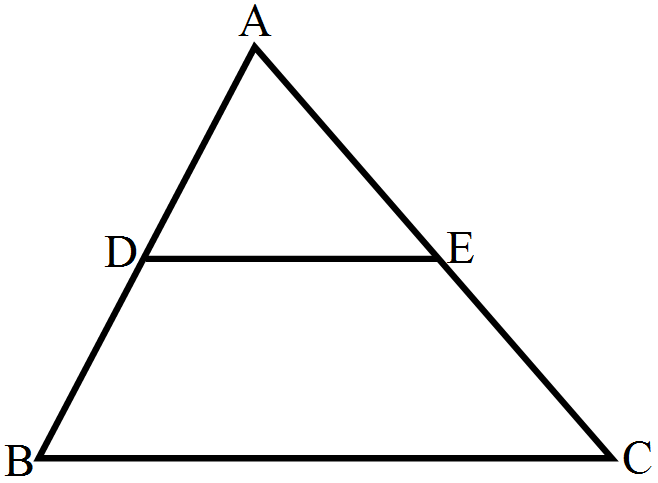
In $\triangle\text{ABC},\text{D}$ and $\text{E}$ are the midpoint of AB and AC respectively. Find the ratio of the areas of $\triangle\text{ADE}$ and $\triangle\text{ABC}.$
The sum of two numbers is $16$. The sum of their reciprocals is $\frac{1}{3}.$ Find the numbers.
Represent the following pair of equations graphically and write the coordinates of points where the lines intersects y-axis.
x + 3y = 6,
2x - 3y = 12.
Find the ratio in which the point $P(x, 2)$ divides the join of $A(12, 5)$ and $B(4, -3).$
The sum of the digits of a two-digit number is 9. Also, nine times this number is twice the number obtained by reversing the order of the digits. Find the number.
The following table gives the distribution of the life time of 400 neon lamps:
Life time (in hours)
Number of lamps
1500-2000
2000-2500
2500-3000
3000-3500
3500-4000
4000-4500
4500-5000
14
56
60
86
74
62
48
Find the median life.