Question
Prove that $\sqrt{3}+\sqrt{5}$ is irrational.

Answer

Let us suppose $\sqrt{3}+\sqrt{5}$ is rational Let $\sqrt{3}+\sqrt{5}=\text{a},$ where a is rational. $\therefore\ \sqrt{3}=\text{a}-\sqrt{5}$ On squaring both sides, we get $(\sqrt{3})^2+(\text{a}-\sqrt{5})^2$ $\Rightarrow\ 3=\text{a}^2+5-2\text{a}\sqrt{5}\ \ \big[\because(\text{a}-\text{b})^2=\text{a}^2 +\text{b}^2-2\text{ab}\big]$ $\Rightarrow\ 2\text{a}\sqrt{5}=\text{a}^2+2$ $\therefore\ \sqrt{5}=\frac{\text{a}^2+2}{2\text{a}}$ which is contradiction.As the right hand side is rational number while V5 is irrational. Since, 3 and 5 are prime number. Hence, $\sqrt{3}+\sqrt{5}$ is irrational.

Need a full question paper?

Generate a complete, print-ready paper with questions like this in minutes — across 16+ boards, with answer keys.
Start Generating Free

Similar questions

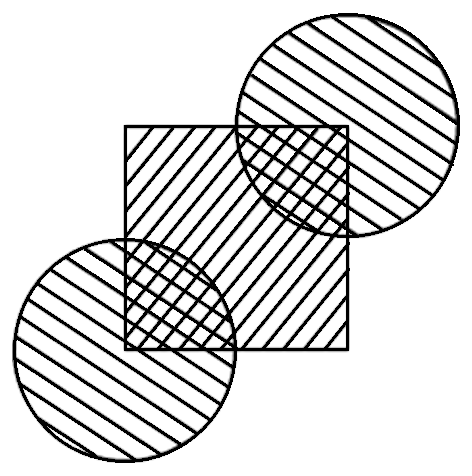
In the given figure, the side of square is $28\ cm$ and radius of each circle is half of the length of the side of the square where $O$ and $O$' are centres of the circles. Find the area of shaded region.
$P (-2,5)$ and $Q (3,2)$ are two points. Find the coordinates of the point $R$ on line segment $PQ$ such that $PR=2QR$.
Given the linear equation $2x + 3y - 8 = 0$, write another linear equation in two variables such that the geometrical representation of the pair so formed is:
  1. Intersecting lines.
  2. Parallel lines.
  3. Coincident lines.
For any positive integer n, prove that $n^3 - n$ is divisible by $6.$
Line 4x + y = 4 divides the line segment joining the points (−2, −1) and (3,5)in a certain ratio. Find the ratio.
Five coins were simultaneously tossed $1000$ times and at each toss the number of heads were observed. The number of tosses during which $0,1,2,3,4$ and $5$ heads were obtained are shown in the table below. Find the mean number of heads per toss.
No. of heads per toss No. of tosses
$0$ $38$
$1$ $144$
$2$ $342$
$3$ $287$
$4$ $164$
$5$ $25$
$\text{Total}$ $1000$
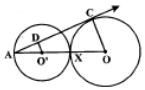
Equal circles with centres $O$ and $O\ '$ touch each other at $X. OO\ '$ produced to meet a circle with centre $O\ ', $ at $A. AC$ is a tangent to the circle whose centre is $O. O\ ' \ D$ is perpendicular to $AC$. Find the value of $\frac{ DO ^{\prime}}{ CO }$
Image
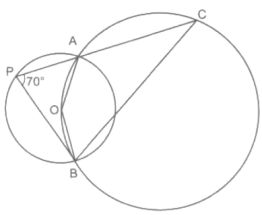
In a given figure, two circles intersect at A and B. The centre of the smaller circle is O and it lies on the circumference of the larger circle. If $\angle APB =70^{\circ}$, find $\angle ACB$.
Image
"The product of three consecutive positive integers is divisible by 6". Is this statement true or false"? Justify your answer.
If one zero of the polynomial $2 x^2+3 x+\lambda$ is $\frac{1}{2}$, find the value of $\lambda$ and other zero.