Question
Prove that $\sqrt{\sec^2\theta+\text{cosec}^2\theta}=\tan\theta+\cot\theta.$

Answer

LHS $=\sqrt{\sec^2\theta+\text{cosec}^2\theta}$
$=\sqrt{\frac{1}{\cos^2\theta}+\frac{1}{\sin^2\theta}}=\sqrt{\frac{\sin^2\theta+\cos^2\theta}{\cos^2\theta\sin^2\theta}}$
$=\sqrt{\frac{1}{\sin^2\theta\cdot\cos^2\theta}}=\frac{1}{\sin\theta\cos\theta}$
$=\text{cosec}\theta\sec\theta$
RHS $=\tan\theta+\cot\theta $
$=\frac{\sin\theta}{\cos\theta}+\frac{\cos\theta}{\sin\theta}=\frac{\sin^2\theta+\cos^2\theta}{\sin\theta\cos\theta}$
$=\frac{1}{\sin\theta\cdot\cos\theta}$
$=\text{cosec}\theta\cdot\sec\theta=$ LHS
Hence,proved.

Need a full question paper?

Generate a complete, print-ready paper with questions like this in minutes — across 16+ boards, with answer keys.
Start Generating Free

Similar questions

The perimeter of a triangular field is 540m, and its sides are in the ratio 25 : 17 : 12. Find the area of the field. Also, find the cost of ploughing the field at ₹ 40 per $100m^2.$
A dealer sells an article for Rs. 75 and gains as much percent as the cost price of the article. Find the cost price of the article.
Solve the following quadratic equation:
$\frac{1}{\text{x}-2}+\frac{2}{\text{x}-1}=\frac{6}{\text{x}}$ $\text{x}\neq0,\ 1,\ 2$
Solve the following equations by using the method of completing the square:
$2x^2 + 5x - 3 = 0$
Find the zeros of the following quadratic polynomial and verify the relationship between the zeros and their coefficients:
$\text{f(x)}=\text{x}^2-\big(\sqrt{3}+1\big)\text{x}+\sqrt{3}$
The king, queen and jack of clubs are removed from a deck of 52 playing cards and the remaining cards are shuffled. A card is drawn from the remaining cards. Find the probability of getting a card of:
  1. Heart.
  2. Queen.
  3. Clubs.
  4. A face card.
  5. A queen of diamond.
If $\sec\theta+\tan\theta=\text{p},$ prove that:$\tan\theta=\frac12\Big(\text{p}+\frac{1}{\text{p}}\Big)$
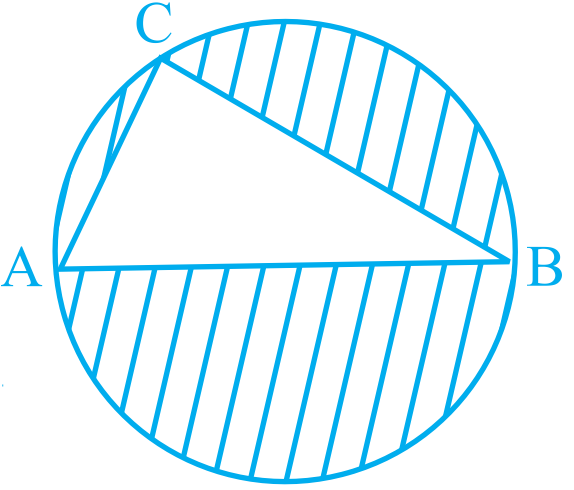
In Fig. $AB$ is a diameter of the circle$, AC = 6\ cm $ and $BC = 8\ cm$. Find the area of the shaded region $(\text{Use }\pi=3.14).$
A life insurance agent found the following data for distribution of ages of 100 policy holders. Calculate the median age, if policies are only given to persons having age 18 years onwards but less than 60 year.
Age (in years) Number of policyholders
Below 20 2
Below 25 6
Below 30 24
Below 35 45
Below 40 78
Below 45 89
Below 50 92
Below 55 98
Below 60 100
Prove that $\frac{2}{\sqrt7}$ is an irrational number.
HINT: $\frac{2}{\sqrt7}=\Big(\frac{2}{\sqrt7}\times\frac{\sqrt7}{\sqrt7}\Big)=\frac{2}{7}.\sqrt7$