Question
Prove that the center of mass of a cone of height $h$ is located at $\left(\frac{h}{4}\right)$ height from its base.
Answer

self

Need a full question paper?

Generate a complete, print-ready paper with questions like this in minutes — across 16+ boards, with answer keys.

Start Generating Free

Similar questions

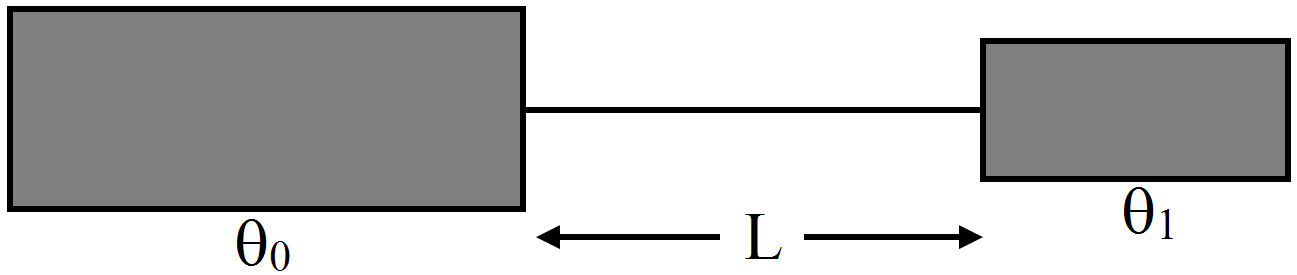
The figure shows a large tank of water at a constant temperature $\theta_0$ and a small vessel containing a mass 'm' of water at an initial temperature $\theta_1(<\theta_0).$ A metal rod of length L, area of cross-section A and thermal conductivity K connects the two vessels. Find the time taken for the temperature of the water in the smaller vessel to become $\theta_2(\theta_1<\theta_2<\theta_0).$ Specific heat capacity of water is 's' and all other heat capacities are negligible.
If c is r.m.s. speed of molecules in a gas and v is the speed of sound waves in the gas, show that c/ v is constant and independent of temperature for all diatomic gases.
A rod of negligible heat cafacity has length $20cm$, area of cross section $1.0cm$ and thermal conductivity $200Wm^{-1^\circ}C^{-1}$. The temperature of one end is maintained at $0^\circ C$ and that of the other end is slowly and linearly varied from $0^\circ C$ to $60^\circ C$ in 10 minutes. Assuming no loss of heat through the sides, find the total heat transmitted through the rod in these $10$ minutes.
You may have seen in a circus a motorcyclist driving in vertical loops inside a ‘deathwell’ (a hollow spherical chamber with holes, so the spectators can watch from outside). Explain clearly why the motorcyclist does not drop down when he is at the uppermost point, with no support from below. What is the minimum speed required at the uppermost position to perform a vertical loop if the radius of the chamber is 25m?
What are the methods of heat transmission? Describe them and explain their practical applications.
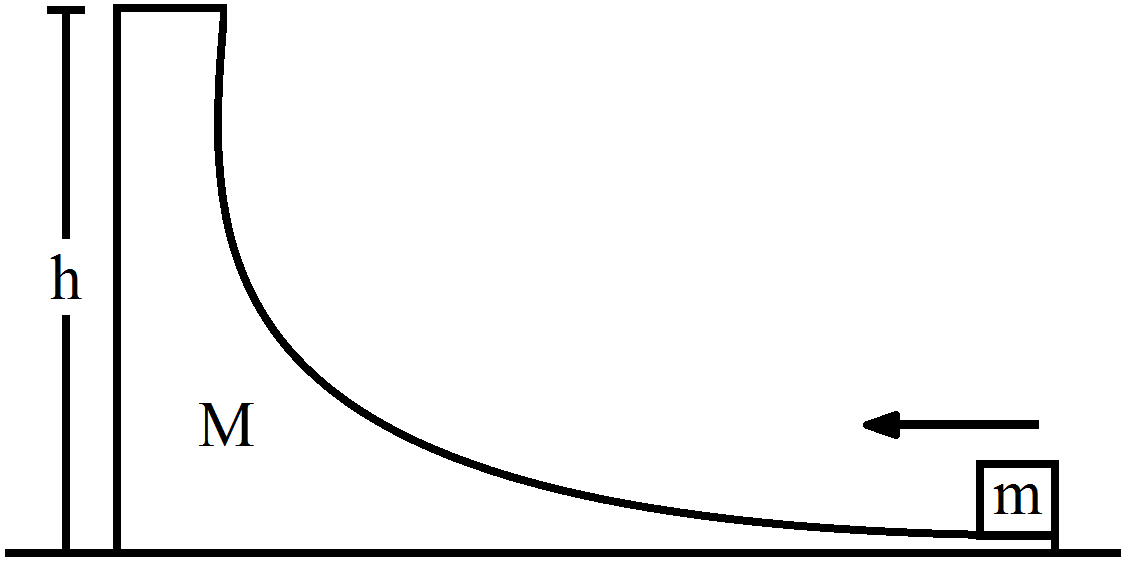
Figure shows a small body of mass m placed over a larger mass $M$ whose surface is horizontal near the smaller mass and gradually curves to become vertical. The smaller mass is pushed on the longer one at a speed v and the system is left to itself. Assume that all the surfaces are frictionless.
  1. Find the speed of the larger block when the smaller block is sliding on the vertical part.
  2. Find the speed of the smaller mass when it breaks off the larger mass at height h.
  3. Find the maximum height (from the ground) that the smaller mass ascends.
  4. Show that the smaller mass will again land on the bigger one. Find the distance traversed by the bigger block during the time when the smaller block was in its flight under gravity.
A laser light bean sent to the moon takes 2.56s to return after reflection at the Moon's surface. Calculate the radius of the lunar orbit around the earth.
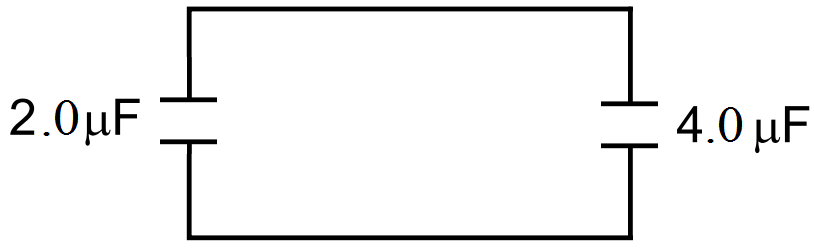
A capacitor of capacitance $2.0\mu\text{F}$ is charged to a potential difference of $12V$. It is then connected to an uncharged capacitor of capacitance $4.0\mu\text{F}$ as shown in figure. Find:
  1. The charge on each of the two capacitors after the connection.
  2. The electrostatic energy stored in each of the two capacitors.
  3. The heat produced during the charge transfer from one capacitor to the other.
Establish the relation $\theta=\omega_0\text{t}+\frac{1}{2}\alpha\text{t}^2$ where the letters have their usual meanings.
Find the value of $\frac{\text{t}}{\tau}$ for which the current in an LR circuit builds up to:
  1. 90%,
  2. 99%
  3. 99·9% of the steady-state value.