Establish the relation $\theta=\omega_0\text{t}+\frac{1}{2}\alpha\text{t}^2$ where the letters have their usual meanings.
Download our app for free and get started
We know that angular velocity is defined as $\omega=\frac{\text{d}\theta}{\text{dt}}$
$\therefore\text{ d}\theta=\omega\text{dt}=(\omega_0+\alpha\text{t})\text{dt},$ where $w_0$ is the value of initial angular velocity at time t = 0 and $\alpha=$ uniform angular acceleration. On integrating, we get $\int\limits^\theta_0\text{d}\theta=\int\limits^\text{t}_0(\omega_\circ+\alpha\text{t})\ \text{dt}$
$\therefore\ [\theta]^\theta_0=\Big[\omega_\circ\text{t}+\frac{1}{2}\alpha\text{t}^2\Big]^\text{t}_0$
$\text{or }\theta-0=\omega_0(\text{t)}-0+\frac{1}{2}\alpha\ (\text{t}^2-0)$
$\Rightarrow\theta=\omega_0\text{t}+\frac{1}{2}\alpha\text{t}^2,$ which is the requisite relation.
$\therefore\text{ d}\theta=\omega\text{dt}=(\omega_0+\alpha\text{t})\text{dt},$ where $w_0$ is the value of initial angular velocity at time t = 0 and $\alpha=$ uniform angular acceleration. On integrating, we get $\int\limits^\theta_0\text{d}\theta=\int\limits^\text{t}_0(\omega_\circ+\alpha\text{t})\ \text{dt}$
$\therefore\ [\theta]^\theta_0=\Big[\omega_\circ\text{t}+\frac{1}{2}\alpha\text{t}^2\Big]^\text{t}_0$
$\text{or }\theta-0=\omega_0(\text{t)}-0+\frac{1}{2}\alpha\ (\text{t}^2-0)$
$\Rightarrow\theta=\omega_0\text{t}+\frac{1}{2}\alpha\text{t}^2,$ which is the requisite relation.

Download our appand get started for free
Experience the future of education. Simply download our apps or reach out to us for more information. Let's shape the future of learning together!No signup needed.*
Similar Questions
- 1A solid disc and a ring, both of radius $10cm$ are placed on a horizontal table simultaneously, with initial angular speed equal to 10 π rad $s^{-1}$. Which of the two will start to roll earlier? The co-efficient of kinetic friction is $\mu_\text{k}=0.2$View Solution
- 2View SolutionSuppose the particle of the previous problem has a mass m and a speed v before the collision and it sticks to the rod after the collision. The rod has a mass M:
- Find the velocity of the centre of mass C of the system constituting ''The rod plus the particle''.
- Find the velocity of the particle with respect to C before the collision.
- Find the velocity of the rod with respect to C before the collision.
- Find the angular momentum of the particle and of the rod about the centre of mass C before the collision.
- Find the moment of inertia of the system about the vertical axis through the centre of mass C after the collision.
- Find the velocity of the centre of mass C and the angular velocity of the system about the centre of mass after the collision.
- 3A uniform wheel of radius R is set into rotation about its axis at an angular speed $\omega.$ This rotating wheel is now placed on a rough horizontal surface with its axis horizontal. Because of friction at the contact, the wheel accelerates forward and its rotation decelerates till the wheel starts pure rolling on the surface. Find the linear speed of the wheel after it starts pure rolling.View Solution
- 4View SolutionFind the components along the x, y, z axes of the angular momentum l of a particle, whose position vector is r with components x, y, z and momentum is p with components px, py and pz. Show that if the particle moves only in the x-y plane the angular momentum has only a z-component.
- 5View Solution
- Obtain an expression for moment of inertia of uniform circular disc about an axis perpendicular to the plane of disc and passing through its centre.
- Three point masses of 1kg, 2kg and 3kg lie at (1, 2), (0, -1) and (2, -3) respectively. Calculate the co-ordinates of centre of mass of the system.
- 6What is Mechanical Advantage (M.A.) in the principle of moments for a lever? Find the reactions forces at knife edge as shown in the figure:View Solution
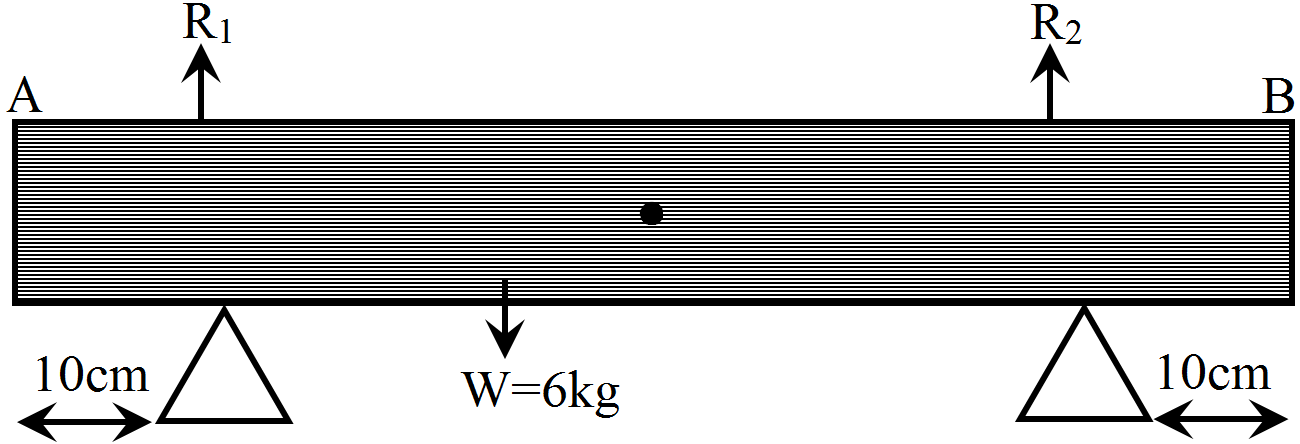
Where AB is a metal bar of $70cm$ length having mass $4kg$ and a $6kg$ load is suspended from $30cm$ from the end A. - 7Prove the result that the velocity v of translation of a rolling body (like a ring, disc, cylinder or sphere) at the bottom of an inclined plane of a height h is given by $\text{v}^2=\frac{2\text{gh}}{\Big(\frac{1+\text{k}^2}{\text{R}^2}\Big)}$ using dynamical consideration (i.e. by consideration of forces and torques).View Solution
Note: k is the radius of gyration of the body about its symmetry axis, and R is the radius of the body. The body starts from rest at the top of the plane. - 8Point masses $m_1$ and $m_2$ are placed at the opposite ends of a rigid rod of length L, and negligible mass. The rod is to be set in rotation about an axis perpendicular to it. Find the position on this rod through which the axis should pass in order that the work required to set the rod in rotation with angular velocity $\omega_0$ should be minimum.View Solution
- 9Three point masses m,, m, and m, are located at the vertices of an equilateral triangle of side length a. What is the moment of inertia about an axis along the altitude of the triangle passing through $m_1$?View Solution
- 10Two particles of mass $2kg$ and $1kg$ are moving along the same line with speeds $2ms-1$ and $5ms^{-1}$ respectively. What is the speed of the centre of mass of the system if both the particles are moving (a) in same direction (b) in opposite direction?View Solution