Question
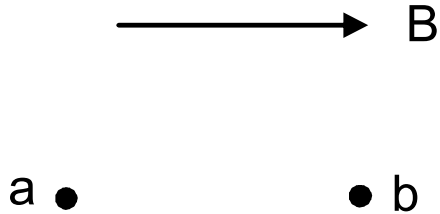
Prove that the force acting on a current-carrying wire, joining two fixed points a and b in a uniform magnetic field, is independent of the shape of the wire.
Answer


For force on a current carrying wire in an uniform magnetic field

We need, l → length of wire

i → Current

B → Magnitude of magnetic field

Since $\overrightarrow{\text{F}}=\text{i}\ell\text{B}$

Now, since the length of the wire is fixed from A to B, so force is independent of the shape of the wire.

Need a full question paper?

Generate a complete, print-ready paper with questions like this in minutes — across 16+ boards, with answer keys.

Start Generating Free

Similar questions

Does a nucleus lose mass when it suffers gamma decay?
A thin prism of crown glass $(\mu_\text{r}=1.515,\mu_\text{v}=1.525)$ and a thin prism of flint glass $(\mu_\text{r}=1.612,\mu_\text{v}=1.632)$ are placed in contact with each other. Their refracting angles are 5.0° each and are similarly directed. Calculate the angular dispersion produced by the combination.
Write the definition of wavefront. Using Huygens' principle, draw the shape of a plane wave incident on a convex lens and the refracted wave body.
###
(a) When a wave propagates from a rarer medium to a denser medium, then which characteristic of that wave does not change and why?
(b) The refractive indices of two mediums are $\mu_1$ and $\mu_2$, what will be the ratio of velocities in the wave in them?
Suppose we have 12 protons and 12 neutrons. We can assemble them to form either a :uMg nucleus or two 12C nuclei. In which of the two cases more energy will be liberated?
The band gap for silicon is 1.1eV.

  1. Find the ratio of the band gap to kT for silicon at room temperature 300K.
  2. At what temperature does this ratio become one tenth of the value at 300K?

(Silicon will not retain its structure at these high temperatures.)
An AC source of voltage $\text{V = Vm}\sin\omega\text{t}$ is applied across a series LCR circuit. Draw the phasor diagrams for this circuit, when,
  1. Capacitive impedance exceeds the inductive impedance.
  2. Inductive impedance exceeds capacitive impedance.
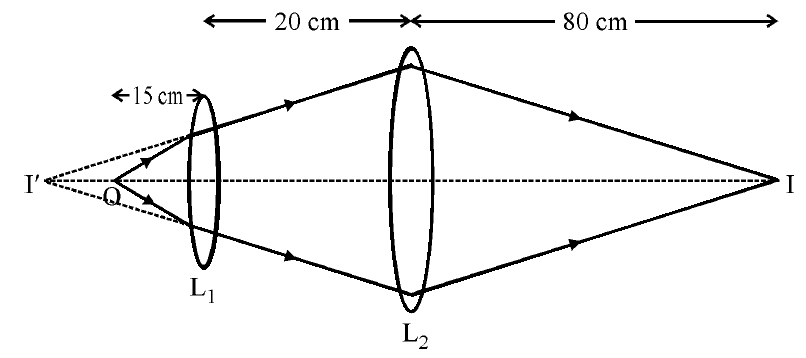
In the following diagram, an object ‘O’ is placed 15 cm in front of a convex lens L1 of focal length 20 cm and the final image is formed at ‘I’ at a distance of 80 cm from the second lens L2. Find the focal length of the lens L2.

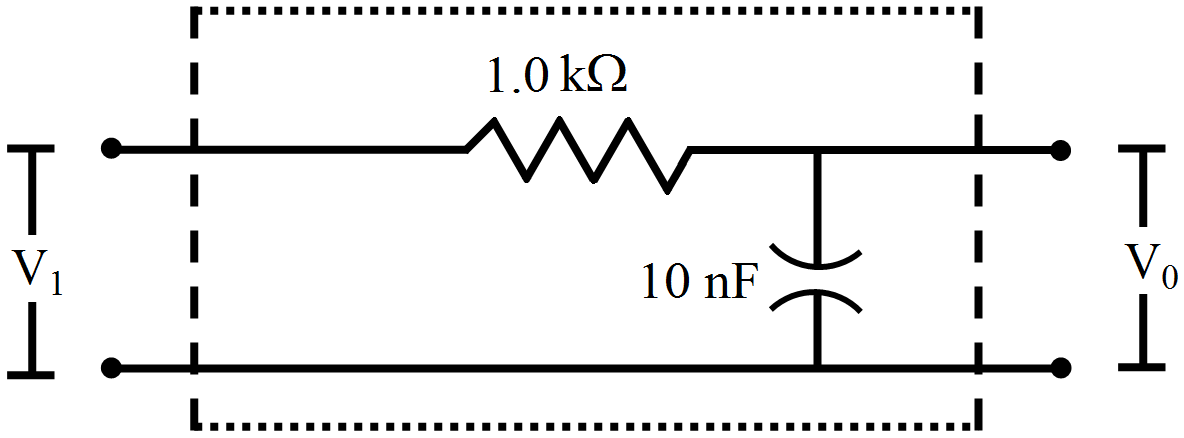
Figure shows a typical circuit for a low-pass filter. An AC input Vi = 10mV is applied at the left end and the output V0 is received at the right end. Find the output voltage for ν = 10kHz, 1.0MHz and 10.0MHz. Note that as the frequency is increased the output decreases and, hence, the name low-pass filter.

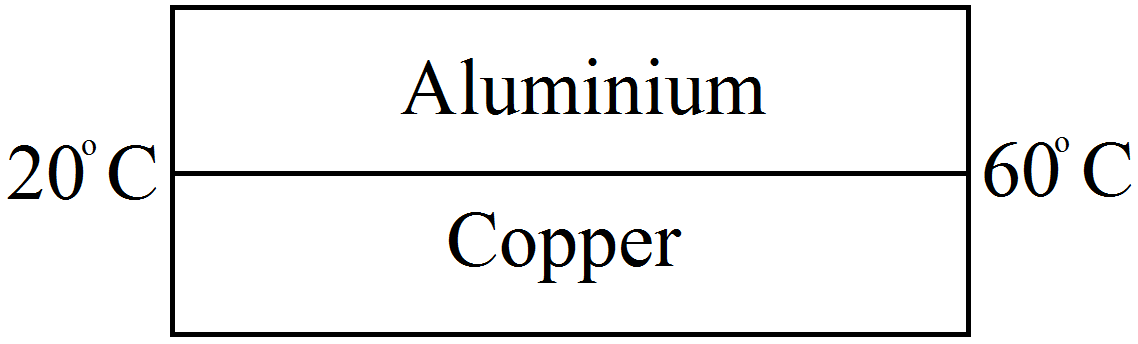
An aluminium rod and a copper rod of equal length 1.0m and cross-sectional area 1cm2 are welded together as shown in figure. One end is kept at a temperature of 20°C and the other at 60°C. Calculate the amount of heat taken out per second from the hot end. Thermal conductivity of aluminium = 200Wm-1°C-1 and of copper = 390Wm-1°C-1.

Figure shows a smooth track, a part of which is a circle of radius R. A block of mass m is pushed against a spring of spring constant k fixed at the left end and is then released. Find the initial compression of the spring so that the block presses the track with a force mg when it reaches the point P, where the radius of the track is horizontal.