Question
Prove that the given vectors are non-coplanar:
$3\hat{\text{i}}+\hat{\text{j}}-\hat{\text{k}},\ 2\hat{\text{i}}-\hat{\text{j}}+7\hat{\text{k}}$ and $7\hat{\text{i}}-\hat{\text{j}}+23\hat{\text{k}}$

Answer

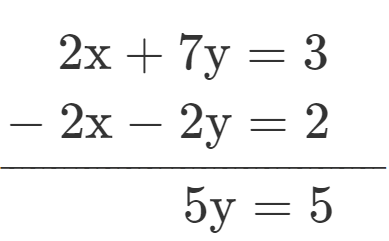
We know that, Three vectors are coplanar if one of them vector can be expressed as the linear combination of the other two. Let, $\big(3\hat{\text{i}}+\hat{\text{j}}-\hat{\text{k}}\big)\\=\text{x}\big(2\hat{\text{i}}-\hat{\text{j}}+7\hat{\text{k}}\big)+\text{y}\big(7\hat{\text{i}}-\hat{\text{j}}+23\hat{\text{k}}\big)$ $=2\text{x}\hat{\text{i}}-\text{x}\hat{\text{j}}+7\text{x}\hat{\text{k}}+7\text{y}\hat{\text{i}}-\text{y}\hat{\text{j}}+23\text{y}\hat{\text{k}}$ $\big(3\hat{\text{i}}+\hat{\text{j}}-\hat{\text{k}}\big)\\=\big(2\text{x}+7\text{y}\big)\hat{\text{i}}+\big(-\text{x}-\text{y}\big)\hat{\text{j}}+\big(7\text{x}+23\text{y}\big)\hat{\text{k}}$ Equating the coefficient of LHS and RHS, 2x + 7y = 3 .....(i) -x - y = 1 .....(ii) 7x + 23y = -1 .....(iii) For solving (i) and (ii), Add (i) and 2 × (ii),
$\text{y}=\frac{5}5$ $\text{y}=1$ Put the value of y in equation (i), $2\text{x}+7\text{y}=3$ $2\text{x}+7(1)=3$ $2\text{x}+7=3$ $2\text{x}=3-7$ $2\text{x}=-4$ $\text{x}=\frac{-4}2$ $\text{x}=-2$ Put the value of x and y in equation (iii), $7\text{x}+23\text{y}=-1$ $7(2)+23(1)=-1$ $14+23=-1$ $37=-1$ $\text{LHS}\neq\text{RHS}$ The value of x and y do not satisfy the equation (iii), Hence, vectors are non-coplanar.

Need a full question paper?

Generate a complete, print-ready paper with questions like this in minutes — across 16+ boards, with answer keys.

Start Generating Free

Similar questions

Find the area bounded by the cutve $y = 4 - x^2$ and the line $y = 0, y = 3$.
If the straight line $\text{x}\cos\alpha+\text{y}\sin\alpha=\text{p}$ touches the curve $\frac{\text{x}^2}{\text{a}^2}-\frac{\text{y}^2}{\text{b}^2}=1,$ then prove that $\text{a}\cos^2\alpha-\text{b}^2\sin^2\alpha=\text{p}^2.$
A shopkeeper sells three types of flower seeds $A_1, A_2$ and $A_3$. They are sold as a mixture where the proportions are 4 $: 4: 2$ respectively. The germination rates of the three types of seeds are $45 \%, 60 \%$ and $35 \%$. Calculate the probability:
i. Of a randomly chosen seed to germinate.
ii. That it will not germinate given that the seed is of type $A_3$.
iii. That it is of the type $A_2$ given that a randomly chosen seed does not germinate.
Prove that:
$\begin{vmatrix}-\text{bc}&\text{b}^2+\text{bc}&\text{c}^2+\text{bc}\\\text{a}^2+\text{ac}&-\text{ac}&\text{c}^2+\text{ac}\\\text{a}^2+\text{ab}&\text{b}^2+\text{ab}&-\text{ab}\end{vmatrix}$
$=(\text{ab}+\text{bc}+\text{ca})^3$
Evaluvate the following intregals:
$\int\frac{1}{1-\tan\text{x}}\text{ dx}$
If $\hat{\text{a}}$ and $\hat{\text{b}}$ are unit vectors inclined at an angle $\theta$, prove that$\tan\frac{\theta}{2}=\frac{\big|\hat{\text{a}}-\hat{\text{b}}\big|}{\big|\hat{\text{a}}+\hat{\text{b}}\big|}$
Two dice are thrown together and the total score is noted. The event E, F and G are "a total of 4", "a total of 9 or more", and "a total divisible by 5", respectively. Calculate P(E), P(F) and P(G) and decide which pairs of events, if any, are independent.
If $\text{x}=\text{a}\cos\theta,\text{y}=\text{b}\sin\theta$ Show that $\frac{\text{d}^2\text{y}}{\text{dx}^2}=-\frac{\text{b}^4}{\text{a}^2\text{y}^3}$
Find $\frac{\text{dy}}{\text{dx}}$ in the following cases:
$x^5 + y^5 = 5xy$
Prove that:
$\begin{vmatrix}\text{a}&\text{b}-\text{c}&\text{c}-\text{b}\\\text{a}-\text{c}&\text{b}&\text{c}-\text{a}\\\text{a}-\text{b}&\text{b}-\text{a}&\text{c}\end{vmatrix}$
$=(\text{a}+\text{b}-\text{c})(\text{b}+\text{c}-\text{a})(\text{c}+\text{a}-\text{b})$