Question
Prove that: Vector addition is associative.

Answer

Associative property of vector addition: According to associative property, for three vectors $\vec{P}, \vec{Q}$ and $\vec{R}$,
$(\overrightarrow{ P }+\overrightarrow{ Q })+\overrightarrow{ R }=\overrightarrow{ P }+(\overrightarrow{ Q }+\overrightarrow{ R })$
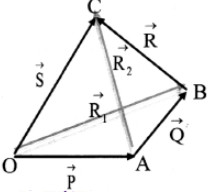
Image
Proof:
i. Let $\overrightarrow{ OA }=\overrightarrow{ P }, \overrightarrow{ AB }=\overrightarrow{ Q }, \overrightarrow{ BC }=\overrightarrow{ R }$
ii. Join OB and AC
In $\triangle OAB$,
$\overrightarrow{ OA }+\overrightarrow{ AB }=\overrightarrow{ OB }$ (From triangle law of vector addition)
$\therefore \quad \overrightarrow{ P }+\overrightarrow{ Q }=\overrightarrow{ R }_1$  ....(1)
In $\triangle OBC$,
$\overrightarrow{ OB }+\overrightarrow{ BC }=\overrightarrow{ OC }$(From triangle law of vector addition)
$\therefore \quad \vec{R}_1+\vec{R}=\vec{S}$
From equation (1)
$(\overrightarrow{ P }+\overrightarrow{ Q })+\overrightarrow{ R }=\overrightarrow{ S }$  ....(2)
$
\begin{array}{ll}
\text { iii. } & \text { In } \Delta A B C, \\
& \overrightarrow{A B}+\overrightarrow{B C}=\overrightarrow{A C} \\
\therefore \quad & \vec{Q}+\vec{R}=\vec{R}_2    .....(3)
\end{array}
$
$
\begin{array}{ll}
\text { iv. } \quad & \text { In } \triangle OAC \\
& \overrightarrow{ OA }+\overrightarrow{ AC }=\overrightarrow{ OC } \\
\therefore \quad & \overrightarrow{ P }+\overrightarrow{ R }_2=\overrightarrow{ S }   
\end{array}
$
From equation (3)
$\overrightarrow{ P }+(\overrightarrow{ Q }+\overrightarrow{ R })=\overrightarrow{ S }$     .......(4)
On comparing, equation (2) and (4), we get,
$
(\overrightarrow{ P }+\overrightarrow{ Q })+\overrightarrow{ R }=\overrightarrow{ P }+(\overrightarrow{ Q }+\overrightarrow{ R })
$
Hence, associative law is proved.

Need a full question paper?

Generate a complete, print-ready paper with questions like this in minutes — across 16+ boards, with answer keys.
Start Generating Free

Similar questions

A simplified model of hydrogen atom consists of an electron revolving about a proton at a distance of $5.3 \times 10^{-11} m.$ The charge on a proton is $+1.6 \times 10^{-19} C.$ Calculate the intensity of the electric field due to proton at this distance. Also find the force between electron and proton.
If the Earth were a perfect sphere of radius $6.4 \times 10^6 m$ rotating about its axis with the period of one day $(8.64 \times 10^4 s),$ what is the difference in acceleration due to gravity from poles to equator?
A fighter plane flying horizontally at a altitude of $1.5 \ km$ with a speed of $720 \ km/h$ passes directly overhead an anti$-$aircraft gun. At what angle from the vertical should the gun be fired for the shell with a muzzle velocity of $600 \ m/s$ to hit the plane? At what minimum altitude should the pilot fly to avoid being hit? $[$Take $g = 10 m /s^2]$
Define stress and strain. What are their different types?
Derive the relation between three coefficients of thermal expansion.
A monochromatic ray of light is incident at $37^\circ $ on an equilateral prism of refractive index $3/2$. Determine angle of emergence and angle of deviation. If angle of prism is adjustable, what should its value be for emergent ray to be just possible for the same angle of incidence.
Prove that relative permittivity is the ratio of the force between two point charges placed a certain distance apart in free space or vacuum to the force between the same two point charges when placed at the same distance in the given medium.
Prove that: Vector addition is commutative.
Assume that the speed $(v)$ of sound in air depends upon the pressure $(P)$ and density $(\rho )$ of air, then use dimensional analysis to obtain an expression for the speed of sound.
What is a conical pendulum? Show that its time period is given by $2 \pi \sqrt{\frac{l \cos \theta}{g}}$, where $I$ is the length of the string, $\theta$ is the angle that the string makes with the vertical and $g$ is the acceleration due to gravity.