Questions

Answer the following in Detail

Take a timed test

23 questions · self-marked practice — reveal the answer and mark yourself.

Question 14 Marks
Evaluate the following integral:
(i) $\int_0^{\pi / 2} \sin x d x$
(ii) $\int_1^5 x d x$
Answer
Using $\int_a^b f(x) d x=\left.F(x)\right|_a ^b$
$\therefore \quad \int_0^{\frac{\pi}{2}} \sin x d x=-\left.\cos x\right|_0 ^{z / 2}=-\left[\cos \left(\frac{\pi}{2}\right)-\cos 0\right]$
Since, $\cos \left(\frac{\pi}{2}\right)=0$ and $\cos 0=1$
$\int_0^{\frac{\pi}{2}} \sin x d x=-(0-1)=1$
(ii) $\int_1^5 x d x$
Solution:
Using, $\int_a^b f(x) d x=\left.F(x)\right|_a ^b$
$\int_1^5 x d x=\left.\frac{x^2}{2}\right|_1 ^5$
$=\frac{5^2}{2}-\frac{1^2}{2}$
$=\frac{25-1}{2}$
$=\frac{24}{2}$
$=12$
View full question & answer
Question 24 Marks
Obtain derivatives of the following functions:
$(i) x \sin x$
$(ii) x^4 + \cos x$
$(iii) x/\sin x$
Answer
(i) $x \sin x$
Solution:
$ \frac{d}{d x}\left[f_1(x) \times f_2(x)\right]=f_1(x) \frac{d f_2(x)}{d x}+\frac{d f_1(x)}{d x} f_2(x)$
$\text { For } f_1(x)=x \text { and } f_2(x)=\sin x$
$\frac{d}{d x}(x \sin x)=x \frac{d(\sin x)}{d x}+\frac{d(x)}{d x} \sin x$
$=x \cos x+1 \times \sin x$
$=\sin x+x \cos x $
(ii) $x^4+\cos x$
Solution:
Using $\frac{d}{d x}\left[f_1(x)+f_2(x)\right]=\frac{d f_1(x)}{d x}+\frac{d f_2(x)}{d x}$
For $f _1( x )= x ^4$ and $f _2( x )=\cos x$
$ \frac{d}{d x}\left(x^4+\cos x\right) =\frac{d\left(x^4\right)}{d x}+\frac{d(\cos x}{d x}$
$ =4 x^3-\sin x $
(iii) $\frac{\sqrt{x}}{\sin 2}$
Solution:
Using $\frac{d}{d x}\left[\frac{f_1(x)}{f_2(x)}\right]=\frac{1}{f_2(x)} \frac{d f_1(x)}{d x}-\frac{f_1(x)}{f_2^2(x)} \frac{d f_2(x)}{d x}$
For $f_1(x)=x$ and $f_2(x)=\sin x$
$ \therefore \quad \frac{ d }{ dx }\left(\frac{ x }{\sin x}\right) =\frac{1}{\sin x} \times \frac{ d ( x )}{ dx }-\frac{ x }{\sin ^2 x} \times \frac{ d (\sin x)}{ dx }$
$ =\frac{1}{\sin x} \times 1-\frac{ x }{\sin ^2 x} \times \cos x $
$\cdots\left[\because \frac{d}{d x}(\sin x)=\cos x\right]$
$=\frac{1}{\sin x}-\frac{x \cos x}{\sin ^2 x}$
[Note: As derivative of (sin x) is cos x, negative sign that occurs in rule for differentiation for quotient of two functions gets retained in final answer]
View full question & answer
Question 34 Marks
Find a vector which is parallel to $\overrightarrow{ v }=\hat{i}-2 \hat{j}$ and has a magnitude $10.$
Answer
Let the vector be $\vec{w}=w_x \hat{i}+w_y \hat{j}$
$ |\vec{w}|=\sqrt{w_x^2+w_y^2}=10$
$\therefore \quad w_x^2+w_y^2=100$
Also, $v \cdot W = VW$
$\ldots(\because|\vec{v}|$ and $|\vec{w}|$ are parallel vectors)
$\Rightarrow(\hat{ i }-2 \hat{ j }) \cdot\left( w _{ x } \hat{ i }+ w _y \hat{ j }\right)=\sqrt{(1)^2+(-2)^2} \times 10$
$\ldots\left(\because|\overrightarrow{ v }|=\sqrt{(1)^2+(-2)^2}\right)$
$\therefore \quad w _{ x }-2 w _{ y }=10 \sqrt{5} \quad \ldots \text { (ii) }$
Substituting for $w_x$ in $(i)$ using equation $(ii),$
$\left(10 \sqrt{5}+2 w_y\right)^2+w_y^2=100$
$\therefore \quad 500+40 \sqrt{5} w_y+4 w_y^2-100=0$
$\therefore \quad 5 w_y^2+40 \sqrt{5} w_y+400=0$
$\therefore \quad w_y^2+8 \sqrt{5} w_y+80=0$
Using factorisation formula,
$x=\frac{-b \pm \sqrt{b^2-4 a c}}{2 a}$
$w_y=\frac{-8 \sqrt{5} \pm \sqrt{(8 \sqrt{5})^2-4 \times 1 \times 80}}{2 \times 1}$
$=w_y=\frac{-8 \sqrt{5} \pm 0}{2}=-4 \sqrt{5}=\frac{-20}{\sqrt{5}}$
Using equation $(ii),$
$w_x  =10 \sqrt{5}+2\left(\frac{-20}{\sqrt{5}}\right)$
$ =10 \sqrt{5}-\frac{40}{\sqrt{5}}$
$ =\frac{(10 \sqrt{5} \times \sqrt{5})-40}{\sqrt{5}}=\frac{50-40}{\sqrt{5}}=\frac{10}{\sqrt{5}}$
$\therefore \quad \vec{w}  =w_x \hat{i}+w_y \hat{j}=\frac{10}{\sqrt{5}} \hat{i}-\frac{20}{\sqrt{5}} \hat{j}$
Answer:
Required vector is $\frac{10}{\sqrt{5}} \hat{ i }-\frac{20}{\sqrt{5}} \hat{ j }$
Alternate method:
When two vectors are parallel, one vector is scalar multiple of another, i.e., if $\vec{v}$ and $\vec{w}$ are parallel then, $\vec{w}=n \vec{v}$ where, $n$ is scalar.
This means, $\vec{w}=n v_x \hat{i}+n v_y \hat{j}$
$=n \hat{i}-2 \hat{j} \quad \quad \ldots .\left(\because v_x=1, v_y=2\right)$
$\therefore \quad|\vec{w}|=\sqrt{(n)^2+(-2 n)^2}=\sqrt{5} n$
Given: $|\vec{w}|=10$
$\therefore \quad n=\frac{10}{\sqrt{5}}=2 \sqrt{5}$
$\therefore \quad \overrightarrow{ w }=2 \sqrt{5} \hat{ i }-2(2 \sqrt{5}) \hat{ j }$
$=2 \sqrt{5} \hat{ i }-4 \sqrt{5} \hat{ j }$
$=\frac{2 \sqrt{5} \times \sqrt{5}}{\sqrt{5}} \hat{ i }-\frac{4 \sqrt{5} \times \sqrt{5}}{\sqrt{5}} \hat{ j }$
$\therefore \quad \vec{w}=\frac{10}{\sqrt{5}} \hat{ i }-\frac{20}{\sqrt{5}} \hat{ j }$
 
View full question & answer
Question 44 Marks
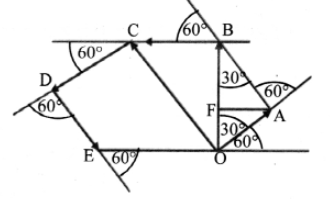
On an open ground, a biker follows a track that turns to his left by an angle of $60^\circ$ after every $600 m.$ Starting from a given turn, specify the displacement of the biker at the third and sixth turn. Compare the magnitude of the displacement with the total path length covered by the motorist in each case.
Answer
The path followed by the biker will be a closed hexagonal path. Suppose the motorist starts his journey from the point $O.$
Image
$\text { i. He takes the third turn at the point } C \text {. }$
$\therefore \text { Displacement }=\overrightarrow{ OC }$
$ \text { But } \overrightarrow{ OC } =\sqrt{( OB )^2+( BC )^2}$
$ =\sqrt{( OF + FB )^2+( BC )^2}$
$ =\sqrt{\left(600 \cos 30^{\circ}+600 \cos 30^{\circ}\right)^2+(600)^2}$
$ =\sqrt{\left[2 \times 600 \times \frac{\sqrt{3}}{2}\right]^2+(600)^2}$
$ =600 \sqrt{4}$
$=1200 m$
$=1.2 \ km$
$\therefore \text { Total path length }=|\overrightarrow{ OA }|+|\overrightarrow{ AB }|+|\overrightarrow{ BC }|$
$=600+600+600$
$=1800 m$
$=1.8 \ km$
The ratio of the magnitude of displacement to the total path$-$length $=\frac{1.2}{1.8}=\frac{2}{3}=0.67$
$ii.$ The motorist will take the sixth turn at $O .$
Displacement is zero.
path$-$length is $=3600 m$ or $3.6 \ km .$
Ration of magnitude of displacement and path$-$length is zero.
View full question & answer
Question 54 Marks
$\overrightarrow{ P }=\hat{ i }+ 2 \hat{ k }$ and $\overrightarrow{ Q }=2 \hat{ i }+\hat{ j }-2 \hat{ k }$ are two vectors, find the unit vector parallel to $\overrightarrow{ P } \times \overrightarrow{ Q }$ Also find the vector perpendicular to $P$ and $Q$ of magnitude 6 units.
Answer
i.
$
\begin{aligned}
\vec{P} \times \vec{Q} & =(\hat{i}+2 \hat{k}) \times(2 \hat{i}+\hat{j}-2 \hat{k}) \\
& =\hat{k}+2 \hat{j}+4 \hat{j}-2 \hat{i}=-2 \hat{i}+6 \hat{j}+\hat{k}
\end{aligned}
$
Hence a unit vector parallel to $\overrightarrow{ P } \times \overrightarrow{ Q }$ is given by,
$\frac{\overrightarrow{ P } \times \overrightarrow{ Q }}{|\overrightarrow{ P } \times \overrightarrow{ Q }|}=\frac{-2 \hat{ i }+6 \hat{ j }+\hat{ k }}{\sqrt{4+36+1}}=\frac{-2 \hat{ i }+6 \hat{ j }+\hat{ k }}{\sqrt{41}}$
ii. Let the required vector be $\vec{R}$. Then,
$
\begin{aligned}
\vec{R} & =6[\text { unit vector perpendicular to } \overrightarrow{ P } \text { and } \overrightarrow{ Q } \text { ] } \\
& =6\left[\frac{\overrightarrow{ P } \times \overrightarrow{ Q }}{|\overrightarrow{ P } \times \overrightarrow{ Q }|}\right]=6\left(\frac{-2 \hat{ i }+6 \hat{ j }+\hat{ k }}{\sqrt{41}}\right)
\end{aligned}
$
i. The unit vector parallel to $\overrightarrow{ P } \times \overrightarrow{ Q }$ is $\frac{-2 \hat{ i }+6 \hat{ j }+\hat{ k }}{\sqrt{41}}$.
ii. Vector perpendicular to P and Q is $\frac{6}{\sqrt{41}}(-2 \hat{i}+6 \hat{j}+\hat{k})$
View full question & answer
Question 64 Marks
Find unit vectors perpendicular to the plane of the vectors, $\overrightarrow{ A }=$ and $\overrightarrow{ B }=2 \hat{ i }-\hat{ k }$
Answer
Let required unit vector be $\hat{ u }$.
$\hat{u}=\frac{\vec{A} \times \vec{B}}{|\vec{A} \times \vec{B}|.....(i)}$
$\overrightarrow{ A } \times \overrightarrow{ B }=\left|\begin{array}{ccc}\hat{ i } & \hat{ j } & \hat{ k } \\ 1 & -2 & 1 \\ 2 & 0 & -1\end{array}\right|$
$\begin{aligned}= & {[(-2) \times(-1)-(1 \times 0)] \hat{ i }+[(1 \times 2)} \\ & -(1 \times-1)] \hat{ j }+[(1 \times 0)-(-2 \times 2)] \hat{ k } \\ = & (2-0) \hat{ i }+(2+1) \hat{ i }-(0+4) \hat{ k }\end{aligned}$
$=2 \hat{i}+3 \hat{j}+4 \hat{k}$
$
\begin{aligned}
|\overrightarrow{ A } \times \overrightarrow{ B }| & =\sqrt{(2)^2+(3)^2+(4)^2} \\
& =\sqrt{4+9+16}=\sqrt{29}
\end{aligned}
$
Substituting in equation (i),
$\hat{ u }=\frac{2 \hat{ i }+3 \hat{ j }+4 \hat{ k }}{\sqrt{29}}$
Now, -u $\hat{u}$ is also a unit vector, perpendicular to the plane of vectors.
$\therefore \quad-\hat{u}=-\frac{(2 \hat{ i }+3 \hat{ j }+4 \hat{ k })}{\sqrt{29}}$
Unit vectors perpendicular to the plane of the vectors are, $\frac{2 \hat{ i }+3 \hat{ j }+4 \hat{ k }}{\sqrt{29}}, \frac{-(2 \hat{ i }+3 \hat{ j }+4 \hat{ k })}{\sqrt{29}}$
View full question & answer
Question 74 Marks
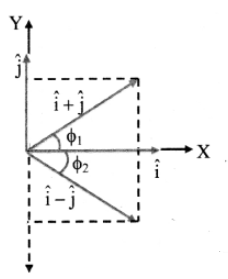
$\hat{ i }$ and $\hat{ j }$ are unit vectors along $X -$ axis and $Y -$ axis respectively. What is the magnitude and direction of the vector $\hat{ i }+\hat{ j }$ and $\hat{ i }-\hat{ j }$ ? What are the components of a vector $\overrightarrow{ A }=2 \hat{ i }+ 3 \hat{ j }$ along the directions of $(\hat{ i }+\hat{ j })$ and $(\hat{ i }-\hat{ j }) ? \ (\text{NCERT})$
Answer
Image
$|\hat{ i }+\hat{ j }| =\sqrt{1^2+1^2+2(1)(1) \cos 90}\ (\because \hat{ i } \perp \hat{ j })$
$ =\sqrt{2}$
$ =1.414 \text { units }$
From the above figure,
$\tan \phi_1=\frac{1}{1}=1 $
$\Rightarrow \phi_1=45^{\circ}$
$\text { i.e., vector }(\hat{i}+\hat{j})$ makes an angle of  $45^{\circ}$ with $ X-$ axis.
Similarly $|\hat{i}-\hat{j}| =\sqrt{1^2+1^2-2(1)(1) \cos 90}\ (\because \hat{i} \perp-\hat{j})$
$ =\sqrt{2}= 1 . 4 1 4 \text { units }$
From the figure,
$\tan \phi_2=\frac{-1}{1}=-1 $
$\Rightarrow \phi_2=-45^{\circ}$
i.e., vector $(\hat{ i }-\hat{ j })$ makes an angle of $-45^{\circ}$ with $X -$ axis.
Let $\vec{B}=\hat{i}+\hat{j}$ then component of $\vec{A}$ in the direction of $\vec{B}$
$=\frac{\vec{A} \cdot \vec{B}}{|\vec{B}|}=\frac{(2 \hat{i}+3 \hat{j}) \cdot(\hat{i}+\hat{j})}{\sqrt{1^2+1^2}}=\frac{2+3}{\sqrt{2}}=\frac{5}{\sqrt{2}}$ units
Let $\vec{C}=\hat{i}-\hat{j}$, then component of $\vec{A}$ in the direction of $\overrightarrow{ C }$
$=\frac{\overrightarrow{ A } \cdot \overrightarrow{ C }}{|\overrightarrow{ C }|}$
$=\frac{(2 \hat{ i }+3 \hat{ j }) \cdot(\hat{ i }-\hat{ j })}{\sqrt{1^2+1^2}}=\frac{2-3}{\sqrt{2}}=\frac{-1}{\sqrt{2}}$ units
View full question & answer
Question 84 Marks
Show that magnitude of vector product of two vectors is numerically equal to the area of a parallelogram formed by the two vectors.
Answer
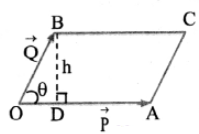
Suppose OACB is a parallelogram of adjacent sides, $\overrightarrow{ OA }=\overrightarrow{ P }$ and $\overrightarrow{ OB }=\overrightarrow{ Q }$
Let $\angle AOB =\theta$ as shown in figure.
Image
We have to prove that area of parallelogram
$OACB =\overrightarrow{ P } \times \overrightarrow{ Q }$
In right angled $\triangle O B D$,
$\sin \theta=\frac{ BD }{ OB }=\frac{ h }{ OB }$
$\therefore \quad h = OB \sin \theta= Q \sin \theta$
Now, Area of parallelogram,
$
\begin{aligned}
OACB & =\text { Base } \times \text { height } \\
& = OA \times h = P ( Q \sin \theta)= PQ \sin \theta
\end{aligned}
$
Now, since $P Q \sin \theta=|\vec{P} \times \vec{Q}|$
$\begin{aligned} \therefore \quad \text { Area of parallelogram } OACB & =|\overrightarrow{ P } \times \overrightarrow{ Q }| \\ & =\text { magnitude of the vector product. }\end{aligned}$
[Note: If $\hat{ u }_{ r }$ is a unit vector perpendicular to the plane then, $\overrightarrow{ P } \times \overrightarrow{ Q }=P Q \sin \theta \hat{ u }_{ r }$$\therefore \quad \hat{u}_r=\frac{\overrightarrow{ P } \times \overrightarrow{ Q }}{ PQ \sin \theta} J$
View full question & answer
Question 94 Marks
Derive an expression for cross product of two vectors and express it in determinant form.
Answer
Expression for cross product of two vectors:
$i.$ Let two vectors $\vec{R}$ and $\vec{Q}$ be represented in magnitude and direction by,
$\vec{R}=R_x \hat{i}+R_y \hat{j}+R_z \hat{k}$ and $\overrightarrow{ Q }= Q _x \hat{ i }+ Q _y \hat{ j }+ Q _z \hat{ k }$
$ii$.Cross product of vector $\vec{R}$ and $\vec{Q}$ is given by,
$\vec{R} \times \vec{Q}=\left(R_x \hat{i}+R_y \hat{j}+R_z \hat{k}\right) \times\left(Q_x \hat{i}+Q_y \hat{j}+Q_z \hat{k}\right)$
$\therefore \vec{R} \times \vec{Q}=R_x Q_x(\hat{i} \times \hat{i})+R_x Q_y(\hat{i} \times \hat{j})$
$ +R_x Q_z(\hat{i} \times \hat{k})+R_y Q_x(\hat{j} \times \hat{i})+R_y Q_y(\hat{j} \times \hat{j})$
$ +R_y Q_z(\hat{j} \times \hat{k})+R_z Q_x(\hat{k} \times \hat{i})+R_z Q_y(\hat{k} \times \hat{j})$
$+R_z Q_z(\hat{k} \times \hat{k})$
Now $ \hat{i} \times \hat{i}=\hat{j} \times \hat{j}=\hat{k} \times \hat{k}=0$ and
$\hat{i} \times \hat{k}=-\hat{j}, \hat{j} \times \hat{i}=-\hat{k}, \hat{k} \times \hat{j}=-\hat{i}$
$\hat{i} \times \hat{j}=\hat{k}, \hat{j} \times \hat{k}=\hat{i}, \hat{k} \times \hat{i}=\hat{j}$
$ \therefore \vec{R} \times \vec{Q}=R_x Q_y \hat{k} -R_x Q_z \hat{j}-R_y Q_x \hat{k}$
$ +R_y Q_z \hat{i}+R_z Q_x \hat{j}-R_z Q_y \hat{i}$
$ \therefore \vec{R} \times \vec{Q}=\left(R_y Q_z-R_z Q_y\right) \hat{i} +\left(R_z Q_x-R_x Q_z\right) \hat{j}$
$ +\left(R_x Q_y-R_y Q_x\right) \hat{k}$
$iii$. Determinant form of cross product of two vectors $\vec{R}$ and $\vec{Q}$ is given by,
$\vec{R} \times \vec{Q}=\left|\begin{array}{ccc}\hat{i} & \hat{j} & \hat{k} \\ R_x & R_y & R_z \\ Q_x & Q_y & Q_z\end{array}\right|$
View full question & answer
Question 104 Marks
State the characteristics of the vector product $($cross product$)$ of two vectors.
Answer
Characteristics of the vector product (cross product):
$i.$ The vector product of two vectors does not obey the commutative law of multiplication.
$\therefore \quad \vec{A} \times \vec{B} \neq \vec{B} \times \vec{A}$ But $|\vec{A} \times \vec{B}|=|\vec{B} \times \vec{A}|$
$ii.$ The vector product follows the distributive law of multiplication.
$\vec{A} \times(\vec{B} \times \vec{C})=\vec{A} \times \vec{B}+\vec{A} \times \vec{C}$
$iii.$ For two non$-$zero vectors $\vec{A}$ and $\vec{B}$ inclined at angle $\theta$, 
Conditions $\sin \theta$ $\begin{aligned} & \overrightarrow{ A } \times \overrightarrow{ B } \\ = & A B \sin \theta\end{aligned}$
$\vec{A}$ and $\vec{B}$ are parallel to each other $\left(\theta=0^{\circ}\right)$ $0$ $0$
$\vec{A}$ and $\vec{B}$ are antiparallel to each other $\left(\theta=180^{\circ}\right)$ $0$ $0$
$\vec{A}$ and $\vec{B}$ are perpendicular to each other $\left(\theta=90^{\circ}\right)$ $1$ $AB$
This gives, $\hat{i} \cdot \hat{j}=\hat{j} \cdot \hat{k}=\hat{k} \cdot \hat{i}=0$
$iv.$ The vector product of a vector with itself $($i.e., self cross product$)$ is equal to zero.
$ \hat{ i } \times \hat{ i }=\hat{ j } \times \hat{ j }=\hat{ k } \times \hat{ k }=0$
$|\overrightarrow{ A } \times \overrightarrow{ A }|= AA \sin 0^{\circ}=0 $
$v.$ The vector product of two vectors can be expressed in terms of their components.
$\text { If } \vec{R}=R_x \hat{i}+R_y \hat{j}+R_z \hat{k}$
$\vec{Q}=Q_x \hat{i}+Q_y \hat{j}+Q_z \hat{k} \text {, }$
$\vec{R} \times \vec{Q}=\left(R_y Q_z-R_z Q_y\right) \hat{i}+\left(R_z Q_x-R_x Q_z\right) \hat{j}
+\left(R_x Q_y-R_y Q_x\right) \hat{k}$
$\therefore \quad \overrightarrow{ R } \times \overrightarrow{ Q }=\left|\begin{array}{ccc}\hat{ i } & \hat{ j } & \hat{ k } \\ R _{ x } & R _y & R _z \\ Q _{ x } & Q _{ y } & Q _z\end{array}\right|$
$vi.$ The magnitude of cross product of two vectors is numerically equal to the area of a parallelogram whose adjacent sides represent the two vectors.
View full question & answer
Question 114 Marks
Define and explain vector product of two vectors with suitable examples.
Answer
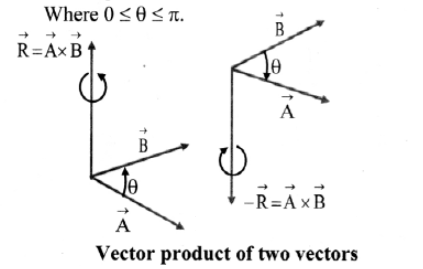
i. The vector product of two vectors is a third vector whose magnitude is equal to the product of magnitude of the two vectors and sine of the smaller angle θ between the two vectors.
ii. Vector product is also called cross product of vectors because cross sign is used to represent vector product.
iii. Explanation:
a. The vector product of two vectors$\overrightarrow{ A }$ and $\overrightarrow{ AB}$, is a third vector $\overrightarrow{ R }$ and is written as, $\overrightarrow{ R }$ = $\overrightarrow{ A }$ × $\overrightarrow{ B }$ = AB sin $\theta \hat{ u }_{ r }$ where, $\hat{ u }_{ r }$ is unit vector in direction of $\overrightarrow{ R }$, i.e., perpendicular to plane containing two vectors. It is given by right handed screw rule.
Image
c. Examples of vector product:
1. Force experienced by a charge q moving with velocity $\overrightarrow{ V }$ in uniform magnetic field of induction (strength) $\overrightarrow{ B }$ is given as $\overrightarrow{ F }$ = $q \vec{V}$ × $\overrightarrow{ B}$
2. Moment of a force or torque$\binom{\rightarrow}{\tau}$ is the vector product of the position vector $(\vec{r})$ and the force $(\overrightarrow{ F })$.
i.e., $\vec{\tau}=\overrightarrow{ r } \times \overrightarrow{ F }$
3. The instantaneous velocity $(\vec{v})$ of a rotating particle is equal to the cross product of its angular velocity $(\vec{\omega})$ and its position $(\overrightarrow{ r })$ from axis of rotation.
$\overrightarrow{ v }=\overrightarrow{ r } \times \vec{\omega}$
View full question & answer
Question 124 Marks
Discuss characteristics of scalar product of two vectors.
Answer
Characteristics of the scalar product of two vectors:
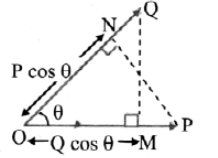
i. The scalar product of two vectors is equivalent to the product of magnitude of one vector with component of the other in the direction of the first.
Let $\vec{P}$ and $\vec{Q}$ be two vectors with an angle $\theta$ between them as shown in figure.
Image
From definition of dot product,
$ \begin{aligned} \vec{P} \cdot \vec{Q} & =P Q \cos \theta=P(Q \cos \theta) \\ & =P(\text { component of } \vec{Q} \text { in direction of } \vec{P}) \end{aligned} $
Similarly,
$
\begin{aligned}
\overrightarrow{ Q } \cdot \overrightarrow{ P } & = Q P \cos \theta= Q ( P \cos \theta) \\
& = Q (\text { Component of } \overrightarrow{ P } \text { in direction of } \overrightarrow{ Q })
\end{aligned}
$
ii. The scalar product of two vectors obeys the commutative law of multiplication.
$
\begin{aligned}
\overrightarrow{ A } \cdot \overrightarrow{ B } & = AB \cos \theta \\
& = BA \cos \theta=\overrightarrow{ B } \cdot \overrightarrow{ A }
\end{aligned}
$
$\therefore \quad \overrightarrow{ A } \cdot \overrightarrow{ B }=\overrightarrow{ B } \cdot \overrightarrow{ A }$
iii. The scalar product obeys the distributive law of multiplication.
$\vec{A} \cdot(\vec{B}+\vec{C})=\vec{A} \cdot \vec{B}+\vec{A} \cdot \vec{C}$
iv. The scalar product of a vector with itself (i.e., self dot product) is equal to the square of its magnitude.
$
\begin{array}{ll}
\therefore & \overrightarrow{ A } \cdot \overrightarrow{ A }= AA \cos 0^{\circ}= A ^2 \\
& → \hat{ i } \cdot \hat{ i }=\hat{ j } \cdot \hat{ j }=\hat{ k } \cdot \hat{ k }=1
\end{array}
$
v. For two non-zero vectors $\vec{A}$ and $\vec{B}$ inclined at angle $\theta$,
Conditions$\cos \theta$$\vec{A} \cdot \vec{B}= A B \cos \theta$
v$\vec{A}$ and $\vec{B}$ are parallel to each other $\left(\theta=0^{\circ}\right)$1

AB

$\vec{A} \quad$ and $\quad \vec{B}$ are antiparallel to each other $\left(\theta=180^{\circ}\right)$-1$- AB$
$\vec{A}$ and $\vec{B}$ are perpendicular to each other $\left(\theta=90^{\circ}\right)$00
This gives, $\hat{ i } \cdot \hat{ j }=\hat{ j } \cdot \hat{ k }=\hat{ k } \cdot \hat{ i }=0$

vi. Scalar product of two vectors is expressed in terms of rectangular components as
$\vec{A} \cdot \vec{B}=A_x+B_x+A_y B_y+A_z B_z$
vii. For $\vec{a} \neq 0, \vec{a} \cdot \vec{b}=\vec{a} \cdot \vec{c}$ does not necessarily mean $\vec{b}=\vec{c}$
View full question & answer
Question 134 Marks
Explain scalar product of two vectors with the help of suitable examples.
Answer
Scalar product of two vectors:
  1. The scalar product of two non-zero vectors is defined as the product of the magnitude of the two vectors and cosine of the angle θ between the two vectors.
  2. The dot sign is used between the two vectors to be multiplied therefore scalar product is also called dot product.
  3. The scalar product of two vectors$\overrightarrow{ P }$ and $\overrightarrow{ Q }$ is given by, $\overrightarrow{ P }$ . $\overrightarrow{ Q }$ = PQ cos θ
    where, p = magnitude of$\overrightarrow{ P }$, Q = magnitude of $\overrightarrow{ Q }$
    θ = angle between $\overrightarrow{ P }$ and $\overrightarrow{ Q }$
  4. Examples of scalar product:
    1. Power (P) is a scalar product of force ($\overrightarrow{ F }$) and velocity ($\overrightarrow{ V }$)
      ∴ P = $\overrightarrow{ F }$ . $\overrightarrow{ V }$
    2. Work is a scalar product of force ($\overrightarrow{ F }$) and displacement ($\overrightarrow{ \S }$).
      ∴ W = $\overrightarrow{ F }$⋅$\overrightarrow{ S }$
View full question & answer
Question 144 Marks
State with reasons, whether the following algebraic operations with scalar and vector physical quantities are meaningful.
i. Adding any two scalars,
ii. Adding a scalar to a vector of the same dimensions,
iii. Multiplying any vector by any scalar,
iv. Multiplying any two scalars,
v. Adding any two vectors. (NCERT)
Answer
  1. Not any two scalars can be added. To add two scalars it is essential that they represent same physical quantity.
  2. This operation is meaningless. Only a vector can be added to another vector.
  3. This operation is possible. When a vector is multiplied with a dimensional scalar, the resultant vector will have different dimensions.
    eg.: acceleration vector is multiplied with mass (a dimensional scalar), the resultant vector has the dimensions of force.
    When a vector is multiplied with non – dimensional scalar, it will be a vector having dimensions as that of the given vector.
    eg.:$\overrightarrow{ A } \times 3=3 \overrightarrow{ A }$
  4. This operation is possible. Multiplication of non-dimensional scalars is simply algebraic multiplication. Multiplication of non dimensional scalars will result into scalar with different dimensions.
    eg.: Volume × density = mass.
  5. Not any two vectors can be added. To add two vectors it is essential that they represent same physical quantity.
View full question & answer
Question 154 Marks
That are rectangular components of vectors? Explain their uses.
Answer
$i$. Rectangular components of a vector:
If components of a given vector are mutually perpendicular to each other then they are called rectangular components of that vector.
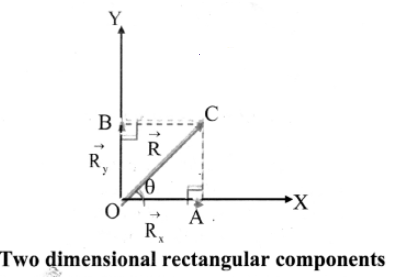
$ii$. Consider a vector $\overrightarrow{ R }=\overrightarrow{ OC }$ originating from the origin $O\ ’$ of a rectangular co $-$ ordinate system as shown in figure.
Image
$iii$. Draw $C A \perp O X$ and $C B \perp O Y$.
Let component of $\vec{R}$ along $X-$ axis $\vec{R}_x$ and component of $\vec{R}$ along $Y-$ axis $=\vec{R}_y$ By parallelogram law of vectors,
$\overrightarrow{ R }=\overrightarrow{ R }_{ x }+\overrightarrow{ R }_{ y } \ldots\left(\because \overrightarrow{ AC }=\overrightarrow{ OB }=\overrightarrow{ R }_y\right)$
or, $ \overrightarrow{ R }=\hat{ i } R _x+\hat{ j } R _{ y }$
where, $\hat{i}$ and $\hat{j}$ are unit vectors along positive direction of $X$ and $Y$ axes respectively.
$iv$. If $\theta$ is angle made by $\vec{R}$ with $X-$ axis, then
$\cos \theta=\frac{O A}{O C}=\frac{R_x}{R}$
$\therefore R_x=R \cos \theta \ \ ....(1)$
$ S_\text{imilarly}$
$ \sin \theta=\frac{R_y}{R} $
$\therefore R_y=R \sin \theta \ \ ...(2)$
$v$. Squaring and adding equation $(1)$ and $(2)$ we get,
$R _{ x }^2+ R _{ y }^2 = R ^2 \cos ^2 \theta+ R ^2 \sin ^2 \theta$
$ = R ^2\left(\cos ^2 \theta+\sin ^2 \theta\right)$
$\therefore R _{ x }^2+ R _y^2= R ^2$
$\therefore \ \ R =\sqrt{ R _x^2+ R _y^2}$
Equation $(3)$ gives the magnitude of $\vec{R}$.
$vi$. Direction of $\vec{R}$ can be found out by dividing equation $(2)$ by $(1),$
$ \text { i.e., } \frac{R_y}{R_x}=\tan \theta $
$\therefore \theta=\tan ^{-1}\left(\frac{R_y}{R}\right) \ \ ......(4)$
Equation $(4)$ gives direction of $\vec{R}$
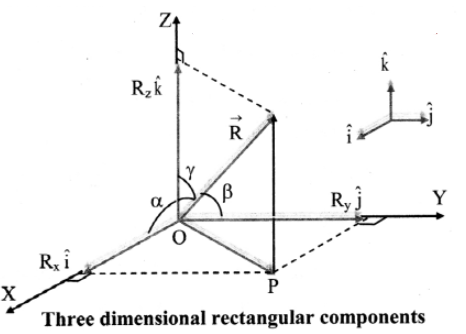
$vii$. When vectors are noncoplanar, it becomes necessary to use the third dimension. If $\overrightarrow{ R }_{ x } \overrightarrow{ R }_{ y }$ are$\overrightarrow{ R }_{ z }$ three rectangular components of $\vec{R}$ long $X, Y$ and $Z$ axes of a three dimensional rectangular cartesian co $-$ ordinate system then.
$\vec{R}=\vec{R}_x+\vec{R}_y+\vec{R}_z \text { or } \vec{R}=R_x \hat{i}+R_y \hat{j}+R_z \hat{k}$
Magnitude of $R$ is given by,
$R =\sqrt{ R _{ x }^2+ R _y^2+ R _z^2} \ldots .\left(\because \hat{ i }^2=\hat{ j }^2=\hat{ k }^2=1\right)$
Image
$[$Note: If $\alpha, \beta$ and $\gamma$ are angles made by $R$ with $R_x, R_y$ and $R_z$ then direction cosine of vector is given by $\cos \alpha=\frac{ R _{ x }}{ R }, \cos \beta=\frac{ R _{ y }}{ R }$ and $\cos \gamma=\frac{ R _{ z }}{ R } ]$
View full question & answer
Question 164 Marks
Water is flowing in a stream with velocity $5 \ km/hr$ in an easterly direction relative to the shore. Speed of a boat relative to still water is $20 \ km/hr.$ If the boat enters the stream heading north, with what velocity will the boat actually travel?
Answer
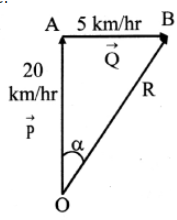
The resultant velocity $\vec{R}$ of the boat can be obtained by adding the two velocities using $\triangle O A B$ shown in the figure.
Image
Magnitude of the resultant velocity is calculated as follows:
$R =\sqrt{ P ^2+ Q ^2+2 PQ \cos \theta} $
For $\theta=90^{\circ}, \cos \theta=0$
$ \therefore R =\sqrt{ P ^2+ Q ^2}$
$R =\sqrt{20^2+5^2}$
$ =\sqrt{425}$
$ = 2 0 . 6 1 6 ~ k m / hr $
The direction ot the resultant velocity is
$ \alpha=\tan ^{-1}\left(\frac{Q \sin \theta}{P+Q \cos \theta}\right)$
$ \text { For } \theta=90^{\circ}, \sin \theta=1$
$\therefore \alpha=\tan ^{-1}\left(\frac{Q}{P}\right)=\tan ^{-1}\left(\frac{5}{20}\right)=\tan ^{-1}(0.25)$
$\quad=14.036^{\circ} \approx 14.04^{\circ}$
The velocity of the boat is $20.616 \ km/hr$ in a direction $14.04^\circ$ east of north. .
$[$Note: $\tan^{-1} (0.25) ≈ 14.04^\circ$ which equals $14^\circ 2]$
View full question & answer
Question 174 Marks
Two forces, $F_1$ and $F_2,$ each of magnitude $5 N$ are inclined to each other at $60^\circ.$ Find the magnitude and direction of their resultant force.
Answer
Given: $F_1 = 5 N, F_2 = 5 N, \theta = 60^\circ$
To find: Magnitude of resultant force $(R),$
Direction of resultant force $(\alpha )$
Formulae:
$i. \ | R |=\sqrt{ P ^2+ Q ^2+2 PQ \cos \theta}$
$ii. \  \alpha=\tan ^{-1}\left(\frac{Q \sin \theta}{P+Q \cos \theta}\right)$
Calculation:
From formula $(i),$
$R =\sqrt{F_1^2+F_2^2+2 F_1 F_2 \cos \theta}$
$ =\sqrt{5^2+5^2+2 \times 5 \times 5 \times \cos 60^{\circ}}$
$ =\sqrt{25+25+25}=5 \sqrt{3} N= 8 . 6 6 2 N$
From formula $(ii),$
$ \alpha =\tan ^{-1}\left(\frac{ F _2 \sin \theta}{ F _1+ F _2 \cos \theta}\right)$
$ =\tan ^{-1}\left[\frac{5\left(\frac{\sqrt{3}}{2}\right)}{5+5\left(\frac{1}{2}\right)}\right]=\tan ^{-1}\left[\frac{5 \sqrt{3} / 2}{(10+5) / 2}\right]$
$ =\tan ^{-1}\left[\frac{5 \sqrt{3}}{15}\right]=\tan ^{-1}\left[\frac{\sqrt{3}}{3}\right]= 3 0 ^{\circ}$
$i.$ The magnitude of resultant force is $8.662 N.$
$ii.$ The direction of resultant force is $30^\circ$ w.r.t. $\overrightarrow{ F _1}$.
View full question & answer
Question 184 Marks
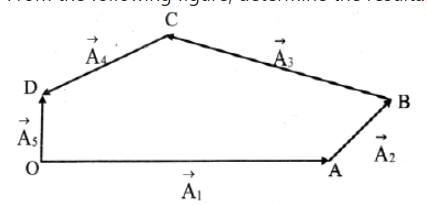
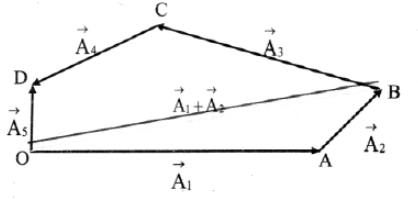
From the following figure, determine the resultant of four forces $\overrightarrow{ A }_1, \overrightarrow{ A }_2, \overrightarrow{ A }_3, \overrightarrow{ A }_4$
Image
Answer
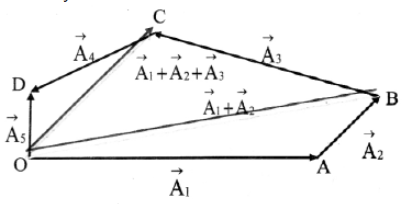
Join $\overrightarrow{ OB }$ to complete $\triangle OAB$ as shown in figure below
Image
Now, using triangle law of vector addition,
$\overrightarrow{ OB }=\overrightarrow{ OA }+\overrightarrow{ AB }=\overrightarrow{ A }_1+\overrightarrow{ A }_2$
Join $\overrightarrow{ OC }$ to complete triangle $O B C$ as shown figure below Similarly, $\overrightarrow{ OC }=\overrightarrow{ OB }+\overrightarrow{ BC }=\overrightarrow{ A }_1+\overrightarrow{ A }_2+\vec{A}_3$
Image
From $\triangle O C D, \quad$
$ \overrightarrow{ OD }=\overrightarrow{ A }_5=\overrightarrow{ OC }+\overrightarrow{ CD }=\overrightarrow{ A }_1+\overrightarrow{ A }_2+\overrightarrow{ A }_3+\overrightarrow{ A }_4 $
$\overrightarrow{O D}$ is the resultant of the four vectors.
View full question & answer
Question 194 Marks
State and prove parallelogram law of vector addition and determine magnitude and direction of resultant vector.
Answer
$i.$ Parallelogram law of vector add addition;
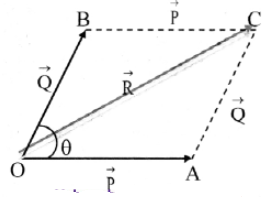
If two vectors of same type starting from the same point $($tails cit the same point$)$, are represented in magnitude and direction by the two adjacent sides of a parallelogram then, their resultant vector is given in magnitude and direction, by the diagonal of the parallelogram starting from the same point.
$ii.$ Proof:
$a.$ Consider two vectors $\overrightarrow{ P }$ and $\overrightarrow{ Q }$ of the same type, with their tails at the point $O^{\prime}$ and $\theta^{\prime}$ is the angle between $\vec{P}$ and $\vec{Q}$ as shown in the figure below.
Image
$b.$ Join $BC$ and $AC$ to complete the parallelogram $\text{OACB}$ , with $\overline{ OA }=\overrightarrow{ P }$ and $\overline{ AC }=\overrightarrow{ Q }$ as the adjacent sides. We have to prove that diagonal $\overline{ OC }=\overrightarrow{ R }$, the resultant of sum of the two given vectors.
$c.$ By the triangle law of vector addition, we have,
$\overrightarrow{ OA }+\overrightarrow{ AC }=\overrightarrow{ OC } ......(1)$
As $\overrightarrow{ AC }$ is parallel to $\overrightarrow{ OB }$,
$\overrightarrow{ AC }=\overrightarrow{ OB }=\overrightarrow{ Q }$
Substituting $\overrightarrow{ OA }$ and $\overrightarrow{ OC }$ in equation $(1)$ we have,
$\overrightarrow{ P }+\overrightarrow{ Q }=\overrightarrow{ R }$
Hence proved.
$iii.$ Magnitude of resultant vector:
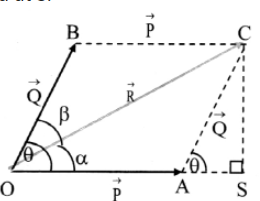
$a.$ To find the magnitude of resultant vector $\vec{R}=\overrightarrow{O C}$, draw a perpendicular from $C$ to meet $O A$ extended at $S.$
Image
$\therefore \angle CAS =\angle BOA =\theta$ and $AC = OB = Q$
$b.$ In right angle triangle $\text{ASC,}$
$\cos \theta=\frac{ AS }{ AC }$
$\therefore AS = AC \cos \theta= Q \cos \theta ....(2)$
$\ \ \text { and }$
$ \sin \theta=\frac{ SC }{ AC }$
$\therefore SC = AC \sin \theta= Q \sin \theta ....(3)$
$c.$ Using Pythagoras theorem in right angled triangle, $\text{OSC}$
$(OC)^2 = (OS)^2 + (SC)^2$
$= (OA + AS)^2 + (SC)^2$
$\therefore (OC)^2 = (OA)^2 + 2(OA).(AS) + (AS^2) + (SC)^2 . . . .(4)$
$d.$ From right angle trianle $\text{ASC,}$
$(AS)^2 + (SC)^2 = (AC)^2 …. (5)$
$e.$ From equation $(4)$ and $(5),$ we get
$(OC)^2 = (OA)^2 + 2(OA) (AS) + (AC)^2 ......(6)$
$f.$ Using $(2)$ and $(6),$ we get
$(OC)^2 = (OA)^2 + (AC)^2 + 2(OA)(AC) \cos \theta$
$\therefore R^2 = P^2 + Q^2 + 2 PQ \cos \theta$
$\therefore R =\sqrt{ P ^2+ Q ^2+2 PQ \cos \theta} \ \ \ ......(7)$
Equation $(7)$ gives the magnitude of resultant vector$\overrightarrow{ R }$.
$iv.$ Direction of resultant vector:
To find the direction of resultant vector $\overrightarrow{ R }$, let $\overrightarrow{ R }$ make an angle $\alpha$ with $\overrightarrow{ p }$.
In $\Delta OSC , \tan \alpha=\frac{ SC }{ OS }$
$\tan \alpha=\frac{ SC }{ OA + AS }$
From equations $(2)$ and $(3),$ we get
$\tan \alpha=\frac{ Q \sin \theta}{ P + Q \cos \theta} \ \ .....(8)$
$\alpha=\tan ^{-1}\left(\frac{ Q \sin \theta}{ P + Q \cos \theta}\right) \ \ .....(9)$
Equation $(9)$ represents direction of resultant vector.
$[$Note: If $\beta$ is the angle between $\overrightarrow{ R }$ and $\overrightarrow{ q }$, it can be similarly derived that $\beta=\tan ^{-1}\left(\frac{ P \sin \theta}{ Q + P \cos \theta}\right) ]$
View full question & answer
Question 204 Marks
Prove that: Vector addition is associative.
Answer
Associative property of vector addition: According to associative property, for three vectors $\vec{P}, \vec{Q}$ and $\vec{R}$,
$(\overrightarrow{ P }+\overrightarrow{ Q })+\overrightarrow{ R }=\overrightarrow{ P }+(\overrightarrow{ Q }+\overrightarrow{ R })$
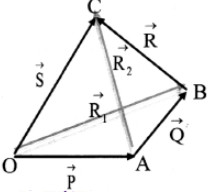
Image
Proof:
i. Let $\overrightarrow{ OA }=\overrightarrow{ P }, \overrightarrow{ AB }=\overrightarrow{ Q }, \overrightarrow{ BC }=\overrightarrow{ R }$
ii. Join OB and AC
In $\triangle OAB$,
$\overrightarrow{ OA }+\overrightarrow{ AB }=\overrightarrow{ OB }$ (From triangle law of vector addition)
$\therefore \quad \overrightarrow{ P }+\overrightarrow{ Q }=\overrightarrow{ R }_1$  ....(1)
In $\triangle OBC$,
$\overrightarrow{ OB }+\overrightarrow{ BC }=\overrightarrow{ OC }$(From triangle law of vector addition)
$\therefore \quad \vec{R}_1+\vec{R}=\vec{S}$
From equation (1)
$(\overrightarrow{ P }+\overrightarrow{ Q })+\overrightarrow{ R }=\overrightarrow{ S }$  ....(2)
$
\begin{array}{ll}
\text { iii. } & \text { In } \Delta A B C, \\
& \overrightarrow{A B}+\overrightarrow{B C}=\overrightarrow{A C} \\
\therefore \quad & \vec{Q}+\vec{R}=\vec{R}_2    .....(3)
\end{array}
$
$
\begin{array}{ll}
\text { iv. } \quad & \text { In } \triangle OAC \\
& \overrightarrow{ OA }+\overrightarrow{ AC }=\overrightarrow{ OC } \\
\therefore \quad & \overrightarrow{ P }+\overrightarrow{ R }_2=\overrightarrow{ S }   
\end{array}
$
From equation (3)
$\overrightarrow{ P }+(\overrightarrow{ Q }+\overrightarrow{ R })=\overrightarrow{ S }$     .......(4)
On comparing, equation (2) and (4), we get,
$
(\overrightarrow{ P }+\overrightarrow{ Q })+\overrightarrow{ R }=\overrightarrow{ P }+(\overrightarrow{ Q }+\overrightarrow{ R })
$
Hence, associative law is proved.
View full question & answer
Question 214 Marks
Prove that: Vector addition is commutative.
Answer
Commutative property of vector addition:
According to commutative property, for two vectors $\vec{P}$ and $\vec{Q}, \vec{P}+\vec{Q}=\vec{Q}+\vec{p}$
Proof:
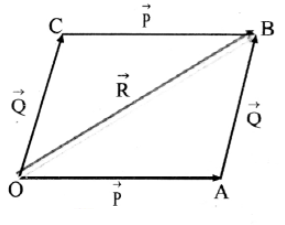
i. Let two vectors $\overrightarrow{ P }$ and $\overrightarrow{ Q }$ be represented in magnitude and direction by two sides O$\overrightarrow{ OA }$ and $\overrightarrow{ AB }$ respectively.
Image
ii. Complete a parallelogramOABC such that $\overrightarrow{ OA }=\overrightarrow{ CB }=\overrightarrow{ P }$ and $\overrightarrow{ AB }=\overrightarrow{ OC }=\overrightarrow{ Q }$ then join OB
iii. $\ln \triangle OAB , \overrightarrow{ OA }+\overrightarrow{ AB }=\overrightarrow{ OB }$
(By triangle law of vector addition)
$\therefore \vec{P}+\vec{Q}=\vec{R}$
In $\triangle O C B, \overrightarrow{O C}+\overrightarrow{C B}=\overrightarrow{O B}$
(By triangle law of vector addition)
$\therefore \vec{Q}+\vec{P}=\vec{R} \ldots \text { (2) }$
iv. From equation (1) and (2),
$\overrightarrow{ P }+\overrightarrow{ Q }=\overrightarrow{ Q }+\overrightarrow{ P }$
Hence, addition of two vectors obeys commutative law.
View full question & answer
Question 224 Marks
Explain, how two vectors are subtracted. Find their resultant by using triangle law of vector addition.
Answer
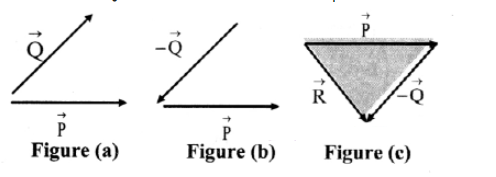
  1. Let $\overrightarrow{ P }$ and $\overrightarrow{ Q }$ be the two vectors in a plane as shown in figure (a).
    Image
  2. To subtract $\overrightarrow{ Q }$ from $\overrightarrow{ P }$, vector $\overrightarrow{ Q }$ is reversed so that we get the vector –$\overrightarrow{ Q }$ as shown in figure (b).
  3. The resultant vector is obtained by –$\overrightarrow{ R }$ joining tail of $\overrightarrow{ P }$ to head of – $\overrightarrow{ Q }$ as shown in figure (c).
  4. From triangle law of vector addition, $\overrightarrow{ R }$ = $\overrightarrow{ P }$ + (-$\overrightarrow{ Q }$) = $\overrightarrow{ P }$ – $\overrightarrow{ Q }$
View full question & answer
Question 234 Marks
Define and explain the following terms:
i. Zero vector (Null vector)
ii. Resultant vector
iii. Negative vectors
iv. Equal vectors
v. Position vector
Answer
i. Zero vector (Null vector):
A vector having zero magnitude and arbitrary direction is called zero vector. It is denoted as $\overrightarrow{0}$.
Example: Velocity vector of stationary particle, acceleration vector of a body moving with uniform velocity.
ii. Resultant vector:
The resultant of two or more vectors is defined as that single vector, which produces the same effect as produced by all the vectors together.
iii. Negative vectors:
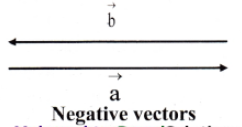
A negative vector of a given vector is a vector of the same magnitude but opposite in direction to that of the given vector.
Negative vectors are antiparallel vectors.
In figure, $\vec{b}=-\vec{a}$
Image
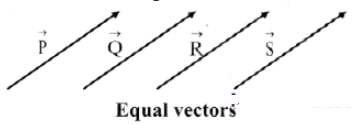
iv. Equal vectors: Two vectors A and B representing same physical quantity are said to be equal if and only if they have the same magnitude and direction.
Image
In the given figure$|\vec{P}|=|\vec{Q}|=|\vec{R}|=|\vec{S}|$
v. Position vector:
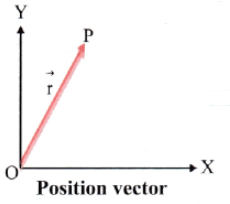
A vector which gives the position of a particle at a point with respect to the origin of chosen co-ordinate system is called position vector.
Image
In the given figure $\overrightarrow{ OP }$ represents position vector of $\vec{P}$ with respect to O .
View full question & answer