Question
Prove the following identities:
$\frac{\sin\theta+\cos\theta}{\sin\theta-\cos\theta}+\frac{\sin\theta-\cos\theta}{\sin\theta+\cos\theta}=\frac{2}{\big(1-2\cos^2\theta\big)}$

Answer

$\text{LHS}=\frac{\sin\theta+\cos\theta}{\sin\theta-\cos\theta}+\frac{\sin\theta-\cos\theta}{\sin\theta+\cos\theta}$
$=\frac{(\sin\theta+\cos\theta)^2+(\sin\theta-\cos\theta)^2}{\sin^2\theta-\cos^2\theta}$
$=\frac{\sin^2\theta+\cos^2\theta+2\cos\theta\sin\theta+\sin^2\theta+\cos^2\theta+2\cos\theta\sin\theta}{1-\cos^2\theta-\cos^2\theta}$
$=\frac{1+1}{1-2\cos^2\theta}$
$=\frac{2}{\big(1-2\cos^2\theta\big)}$
$=\text{R.H.S.}$
$\therefore\text{R.H.S.}=\text{L.H.S.}$

Need a full question paper?

Generate a complete, print-ready paper with questions like this in minutes — across 16+ boards, with answer keys.

Start Generating Free

Similar questions

Find the area of the triangle whose sides are 42cm, 34cm and 20cm in length. Find the height corresponding to the longest side.
A chemist has one solution containing 50% acid and a second one containing 25% acid. How much of each should be used to make 10 litres of a 40% acid solution?
Solve the following quadratic equation:
$\frac{1}{\text{2a}+\text{b}+\text{2x}}=\frac{1}{\text{2a}}+\frac{1}{\text{b}}+\frac{1}{\text{2x}}$
To construct a triangle similar to $\triangle\text{ABC}$ in which BC = 4.5cm, $\angle\text{B}=45^\circ$ and $\angle\text{C}=60^\circ,$ using a scale factor of $\frac35$ BC will be divided in the ratio.
  1. 3 : 4
  2. 4 : 7
  3. 3 : 10
  4. 3 : 7
In a potato race, a bucket is placed at the starting point, which is $5\ m$ from the first potato, and the other potatoes are placed $3\ m$ apart in a straight line. There are $10$ potatoes in the line. A competitor starts from the bucket, picks up the nearest potato, runs back with it, drops it in the bucket, runs back to pick up the next potato to the bucket to drop it in, and he continues in the same way until all the potatoes are in the bucket. What is the total distance the competitor has to run?
Find the area of a trapezium whose parallel sides are 11cm and 25cm long and nonparallel sides are 15cm and 13cm.
Show graphically that each of the following given systems of equations has infinitely many solutions:
2x + 3y = 6, 4x + 6y = 12
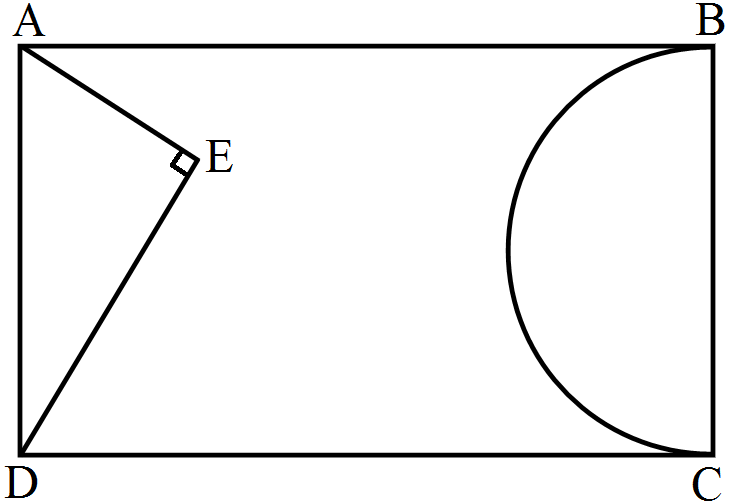
In the given figure, $ABCD$ is a rectangle with $\text{AB}=80\text{cm}$ and $\text{BC}=70\text{cm},$ $\angle\text{AED}=90^\circ$ and $\text{DE}=42\text{cm}$ A semicircle is dn wn, taking BC as diameter. Find the area o the shaded region.
Prove the following identities:
$\frac{\tan\text{A}+\tan\text{B}}{\cot\text{A}+\cot\text{B}}=\tan\text{A}\tan\text{B}$
Solve the following system of equations graphically:
2x + 3y = 8,
x - 2y + 3 = 0