Question
Prove the following trigonometric identities.
$\sec\text{A}(1-\sin\text{A})(\sec\text{A}+\tan\text{A})=1$

Answer

$\text{L.H.S.}=\sec\text{A}(1-\sin\text{A})(\sec\text{A}+\tan\text{A})$
$=\frac{1}{\cos\text{A}}(1-\sin\text{A})\Big(\frac{1}{\cos\text{A}}+\frac{\sin\text{A}}{\cos\text{A}}\Big)$
$=\Big(\frac{1-\sin\text{A}}{\cos\text{A}}\Big)\Big(\frac{1+\sin\text{A}}{\cos\text{A}}\Big)$
$=\frac{1-\sin^2\text{A}}{\cos^2\text{A}}=\frac{\cos^2\text{A}}{\cos^2\text{A}}$
$=1=\text{R.H.S.}$

Need a full question paper?

Generate a complete, print-ready paper with questions like this in minutes — across 16+ boards, with answer keys.
Start Generating Free

Similar questions

Construct a triangle with its sides $4 cm, 5 cm$ and 6 cm . Then construct a triangle similar to it whose sides are $\frac{2}{3}$ of the corresponding sides of the first triangle.
Very-Short and Short-Answer Questions:
Write the number of solutions of the following pair of linear equations:
$x + 3y - 4 = 0, 2x + 6y - 7 = 0$
Very-Short and Short-Answer Questions.If $\text{x}=\text{a}\sin\theta$ and $\text{y}=\text{b}\cos\theta,$ write the value of $\Big(\text{b}^2\text{x}^2+\text{a}^2\text{y}^2\Big).$
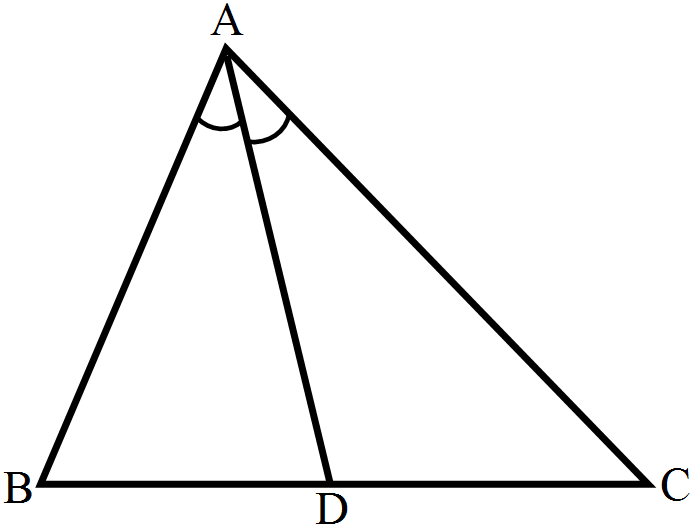
In a $\triangle\text{ABC},\text{AD}$ is the bisector of $\angle\text{A}.$
If AB = 5.6cm, AC = 4cm and DC = 3cm, find BC.
A sum of ₹ $1000$ is invested at $8\ %$ simple interest per year. Calculate the interest at the end of each year. Do these interests form an AP? If so, find the interest at the end of $30$ years making use of this fact.
In a $\triangle\text{ABC,D}\ \text{and E}$ are points on the sides AB and AC respectively such that DE || BC.
If AD = 6cm, DB = 9cm and AE = 8cm, find AC.
If the mean of the following data is 18.75. Find the value of p.
x 10 15 P 25 30
f 5 10 7 8 2
A class teacher has the following absentee record of $40$ students of a class for the whole term. Find the mean number of days a student was absent.
Number of days 0-6 6-10 10-14 14-20 20-28 28-38 38-40
Number of students 11 10 7 4 4 3 1
From a point on the ground the angles of elevation of the bottom and top of a transmission tower fixed at the top of 20m high building are 45° and 60° respectively. Find the height of the transmission tower.
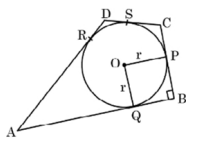
In the given figure, a circle is inscribed in a quadrilateral $\text{ABCD }$ in which $\angle B =90^{\circ}$. If $AD =17 \ cm, AB =20 \ cm $ and $DS =3 \ cm,$ then find the radius of the circle.
Image