Question
Prove the following.
$\frac{\tan \theta}{\sec \theta+1}=\frac{\sec \theta-1}{\tan \theta}$

Answer

Taking LHS
$=\frac{\tan \theta}{\sec \theta+1} \times \frac{\sec \theta-1}{\sec \theta-1}$
$=\frac{\tan \theta(\sec \theta-1)}{\sec ^2 \theta-1}$
$=\frac{\tan \theta\left(\sec ^2 \theta-1\right)}{\tan ^2 \theta}\left[\tan ^2 \theta=\sec ^2 \theta-1\right]$
$=\frac{\sec \theta-1}{\tan \theta}$
= RHS
Proved !

Need a full question paper?

Generate a complete, print-ready paper with questions like this in minutes — across 16+ boards, with answer keys.
Start Generating Free

Similar questions

In a competitive examination, one mark is aw awarded for each correct answer while $\frac{1}{2}$ mark is deducted for every wrong answer. Jayanti answered 120 questions and got 90 marks. How many questions did she answer correctly.
Find the coordinates of the point where the diagonals of the parallelogram formed by joining the points (-2, -1), (1, 0), (4, 3) and (1, 2) meet.
Joseph purchased following shares, Find his total investment.
Company A : 200 shares, FV = Rs. 2 Premium = Rs. 18.
Company B : 45 shares, MV = Rs. 500
Company C : 1 share, MV = Rs. 10,540.
Determine whether the following points are collinear.
(1) A(-1, -1), B(0, 1), C(1, 3)
(2) D(-2, -3), E(1, 0), F(2, 1)
(3) L(2, 5), M(3, 3), N(5, 1)
(4) P(2, -5), Q(1, -3), R(-2, 3)
(5) R(1, -4), S(-2, 2), T(-3, 4)
(6) A(-4, 4), K(-2, 5/ 2 ), N(4, -2)

From the railway station I took a rickshaw to go home. It is decided that I have to pay Rs. X for the first kilometre and for each kilometre Rs. Y for the next. For 10 kilometres the fare is Rs. 40 and for 16 kilometres fare is Rs. 58. Find the fare for the first kilometre.
Solve the following examples.
Find the length a diagonal of a rectangle having sides 11 cm and 60cm.
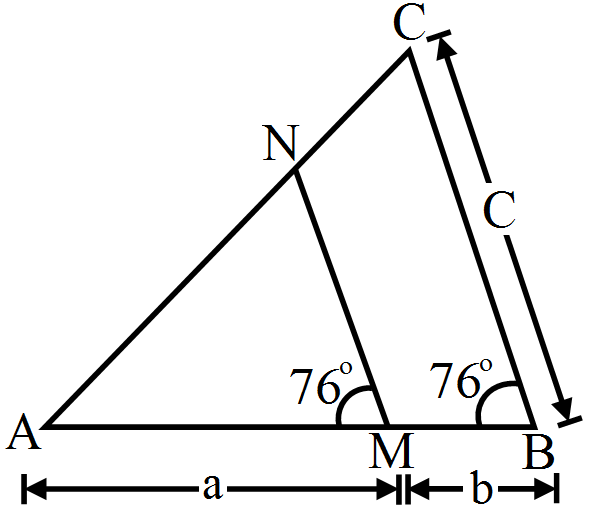
In the given figure, $\angle\text{AMN}=\angle\text{MBC}=76^\circ.$ If p, q and r are the lengths of AM, MB and BC respectively then express the length of MN in terms of p, q and r.
Prove the following:$\frac{\cos(90^\circ-\text{A})\sin(90^\circ-\text{A})}{\tan(90^\circ-\text{A})}-\sin^2\text{A}=0$
Find the value of $k$ for which the following systems of linear equations has an infinite number of solutions:
$(k - 1)x - y = 5,$
$(k + 1)x + (1 - k)y = (3k + 1)$
$\Delta P Q R \sim \Delta L T R . \ln \Delta P Q R, P Q=4.2 cm , Q R=5.4 cm , P R=4.8 cm$. Construct $\Delta P Q R$ and $\Delta L T R$, such that $\frac{P Q}{L T}=\frac{3}{4}$.