Question
Prove the given identities, where the angles involved are acute angles for which the expressions are defined. $(sin A + cosec A)^2 + (cos A + sec A)^2 = 7 + tan^2A + cot^2A$

Answer

To prove: $(sinA + cosecA)^2 + (cosA + secA)^2 = 7 + tan^2A + cot^2A$
taking L.H.S
Using the formula$ (a+b)^2 = a^2 + b^2 + 2ab to get,$
$= (sin^2A + cosec^2A + 2sinA cosecA) + (cos^2A + sec^2A + 2 cos A sec A)$
Since sin$\theta$ =$\frac {{1 }}{{\ cosec\theta }}$ and $\cos \theta = \frac{1}{{\sec \theta }}$
$=\left(\sin ^{2} A+\csc ^{2} A+2 \sin A \frac{1}{\sin A}\right)+\left(\cos ^{2} A+\sec ^{2} A+2 \cos A \frac{1}{\cos A}\right)$
$= sin^2A + cosec^2A + 2 + cos^2A + sec^2A + 2$
$= (sin^2A + cos^2A) + cosec^2A + sec^2A + 2 + 2$
Using the identities $sin^2A + cos^2A = 1, sec^2A = 1 + tan^2A and cosec^2A = 1 + cot^2A to get$
$= 1+ 1 + tan^2A + 1 + cot^2A + 2 + 2$
$= 1 + 2 + 2 + 2 + tan^2A + cot^2A$
$= 7 + tan^2A + cot^2A$
$= R.H.S.$
Hence proved

Need a full question paper?

Generate a complete, print-ready paper with questions like this in minutes — across 16+ boards, with answer keys.

Start Generating Free

Similar questions

A student noted the number of cars passing through a spot on a road for $100$ periods each of $3$ minutes and summarised it in the table given below. Find the mode of the data.
Number of cars
$0-10$
$10-20$
$20-30$
$30-40$
$40-50$
$50-60$
$60-70$
$70--80$
Frequency
$7$
$14$
$13$
$12$
$20$
$11$
$15$
$8$
Cards marked with numbers 1, 3, 5, ..., 101 are placed in a bag and mixed thoroughly. A card is drawn at random from the bag. Find the probability that the number on the drawn card is:
  1. Less than 19.
  2. A prime number less than 20.
For what value of $\alpha,$ the system of equations will have no solution
$\alpha\text{x}+3\text{y}=\alpha-3$
$12\text{x}+\alpha\text{y}=\alpha$
 
Find the median of the following frequency distribution:
Weekly wages $($in $₹)$ $60-69$ $70-79$ $80-89$ $90-99$ $100-109$ $110-119$
No. of days $5$ $15$ $20$ $30$ $20$ $8$
Determine the $AP$ whose 3rd term is $5$ and the $7th$ term is $9$.
The third term of an $A.P.$ is $7$ and the seventh term exceeds three times the third term by $2$. Find the first term, the common difference and the sum of first $20$ terms.
Find the values of k for which the system will have (i) a unique solution, and (ii) no solution. Is there a value of k for which the system has infinitely many solutions?
$2x + ky = 1$
$3x - 5y = 7$
The angles of a quadrilateral are in A.P. whose common difference is 10º. Find the numbers.
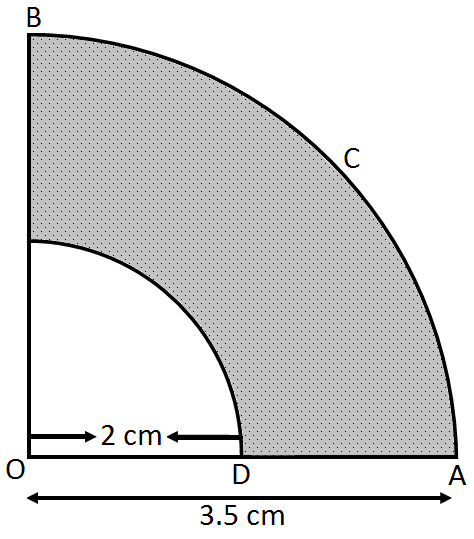
In the following figure, OACB is a quadrant of a circle with centre O and radius 3.5cm. If OD = 2cm, find the area of the: (i) Quadrant OACB (ii) Shaded region.
The difference of two numbers is $4.$ If the difference of their reciprocal is $\frac{4}{21},$ find the numbers.