Question
Prove: Two distinct lines cannot have more than one point in common.
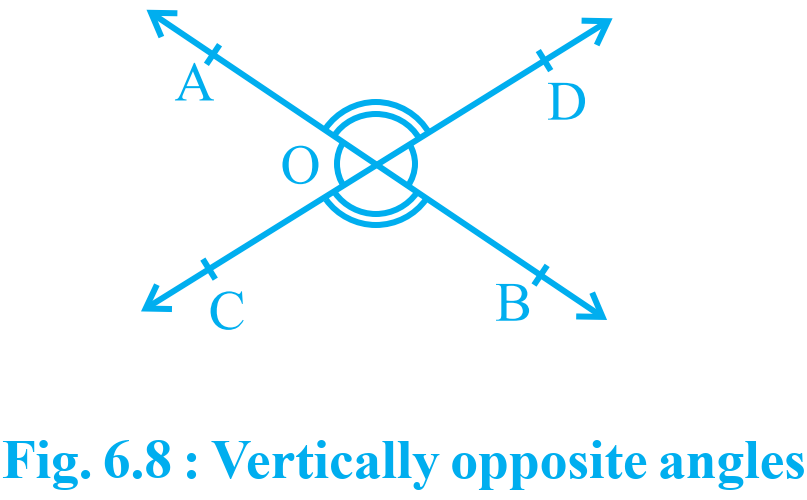
Answer

Image
Proof : In the statement above, it is given that 'two lines intersect each other'. So, let $\mathrm{AB}$ and $\mathrm{CD}$ be two lines intersecting at $\mathrm{O}$ as shown in Fig. 6.8. They lead to two pairs of vertically opposite angles, namely,
(i) $\angle \mathrm{AOC}$ and $\angle \mathrm{BOD}$ (ii) $\angle \mathrm{AOD}$ and $\angle \mathrm{BOC}$.
We need to prove that $\angle \mathrm{AOC}=\angle \mathrm{BOD}$ and $\angle \mathrm{AOD}=\angle \mathrm{BOC}$.
Now, ray $\mathrm{OA}$ stands on line $\mathrm{CD}$.
Therefore, $\angle \mathrm{AOC}+\angle \mathrm{AOD}=180^{\circ}$ $\quad$ (Linear pair axiom) (1)
Can we write $\angle \mathrm{AOD}+\angle \mathrm{BOD}=180^{\circ}$ ? Yes! (Why?) $\quad$ (2)
From (1) and (2), we can write
$
\angle \mathrm{AOC}+\angle \mathrm{AOD}=\angle \mathrm{AOD}+\angle \mathrm{BOD}
$
This implies that $\angle \mathrm{AOC}=\angle \mathrm{BOD} \quad$ (Refer Section 5.2, Axiom 3)
Similarly, it can be proved that $\angle \mathrm{AOD}=\angle \mathrm{BOC}$
Now, let us do some examples based on Linear Pair Axiom and Theorem 6.1.

Need a full question paper?

Generate a complete, print-ready paper with questions like this in minutes — across 16+ boards, with answer keys.
Start Generating Free

Similar questions

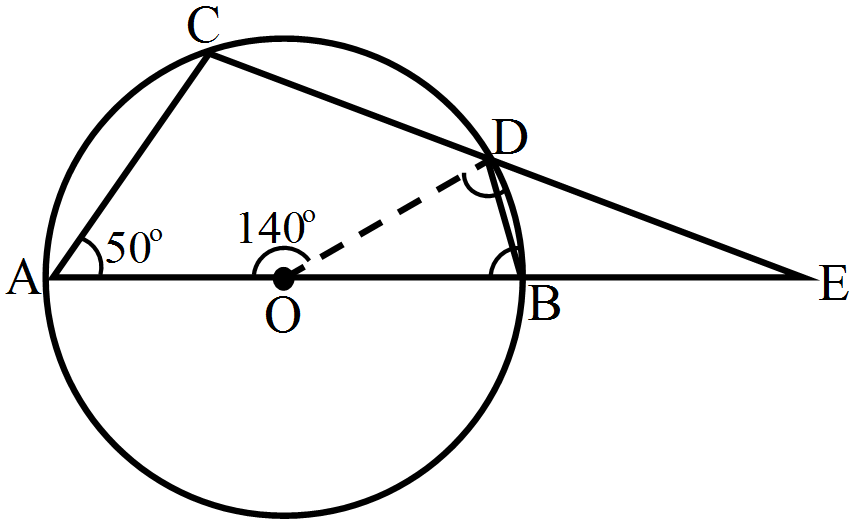
In the given figure, $O$ is the centre of a circle. If $\angle\text{AOC}=140^\circ$ and $\angle\text{CAB}=50^\circ,$ calculate
$i. \angle\text{EDB}$
$ii. \angle\text{EBD}$
The mean of $20$ numbers is $18$. If $3$ is added to each of the first ten numbers, find the mean of the new set of $20$ numbers.
Draw the graph of the equation, $3x + 2y = 6$. Find the coordinates of the point where the graph cuts the $y$-axis.
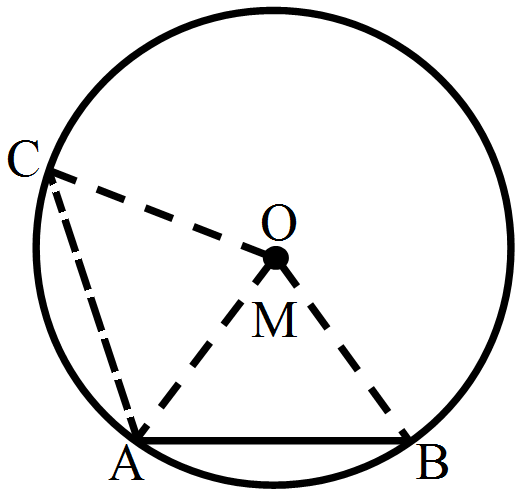
In the adjoining figure, $AB$ and $AC$ are two equal chords of a circle with centre $O$. Show that $O$ lies on the bisector of $\angle\text{BAC}.$
$ABCD$ is a trapezium in which $AB\ ||\ CD, AB = 16\ cm$ and $DC = 24\ cm$. If $E$ and $F$ are respectively the midpoints of $AD$ and $BC$, prove that $\text{ar(ABFE)}=\frac{9}{11}\text{ar(EFCD)}.$
The investments $($in ten crores of rupees$)$ of Life Insurance Corporation of India in different sectors is given below:
Sectors Investment $($in ten crores of rupess$)$
Central government securities $45$
State government securities $11$
Securities guaranteed by the government $23$
Private sectors $18$
Socially oriented sectors $($plan$)$ $46$
Socially oriented sectors $($Non$–$plan$)$ $11$
Represent the above data with the help of a bar graph.
The numbers $42, 43, 44, 44, (2x + 3), 45, 45, 46, 47$ have been arranged in an ascending order and their median is $45.$ Find the value of $x$. Hence, find the mode of the above data.
Locate $\sqrt{3}$ on the number line.
What length of tarpaulin $3 \ m$ wide will be required to make conical tent of height $8 \ m$ and base radius $6 \ m$? Assume that the extra length of material that will be required for stitching margins and wastage in cutting is approximately $20 \ cm$. $\left( \text{Use }\pi \text{ = 3}\text{.14} \right)$
The polynomial $p(x)=x^4-2 x^3+3 x^2-a x+3 a-7$ when divided by $x+1$ leave remainder $19 .$ Find the remainder when $p(x)$ is divided by $x +2$.