Question
Locate $\sqrt{3}$ on the number line.
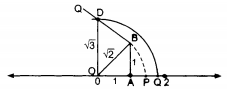
Answer

Let point A represents $1$ as shown in Figure.
Clearly, $OA = 1 \ unit.$
Now, draw a right triangle$ OAB$ in which $AB = OA = 1\ unit.$
By Using Pythagoras theorem, we have
$OB^2 = OA^2 + AB^2 \\= 1^2 + 1^2$
$= 2 $
$\Rightarrow O B=\sqrt{2}$

Taking $O$ as centre and $OB$ as a radius draw an arc intersecting the number line at point $P.$
Then $p$ corresponds to $\sqrt{2}$ on the number line. Now draw $DB$ of unit length perpendicular to $OB.$
By using Pythagoras theorem, we have
$OD^2 = OB^2 + DB^2$
$OD^2 = (\sqrt{2})^{2}+ 12$ 
$= 2 + 1 = 3$
$OD = \sqrt{3}$
Taking $O$ as centre and $OD$ as a radius draw an arc which intersects the number line at the point $Q.$
Clearly, $Q$ corresponds to $\sqrt{3}$.

Need a full question paper?

Generate a complete, print-ready paper with questions like this in minutes — across 16+ boards, with answer keys.

Start Generating Free

Similar questions

A teacher wanted to analyse the performance of two sections of students in a mathematics test of $100$ marks. Looking at their performances, she found that a few students got under $20$ marks and a few got $70$ marks or above. So she decided to group them into intervals of varying sizes as follows: $0 - 20, 20 - 30, . . ., 60 - 70, 70 - 100.$ Then she formed the following table:
Marks Number of students
$0 - 20$ $7$
$20 - 30$ $10$
$30 - 40$ $10$
$40 - 50$ $20$
$50 - 60$ $20$
$60 - 70$ $15$
$70 -$ above $8$
Total $90$
Draw a histogram for this table$?$
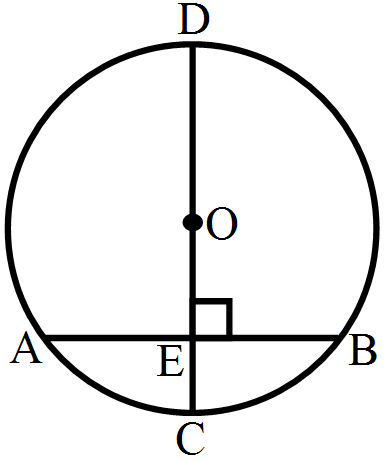
In the given figure, the diameter $C D$ of a circle with centre $O$ is perpendicular to chord $A B$. If $A B=12 cm$ and $C E=3 cm$, calculate the radius of the circle.
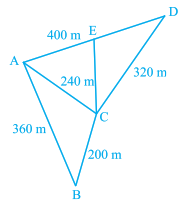
Kamla has a triangular field with sides $240 \ m, 200 \ m, 360 \ m$, where she grew wheat. In another triangular field with sides $240 \ m, 320 \ m, 400 \ m$ adjacent to the previous field, she wanted to grow potatoes and onions.
She divided the field in two parts by joining the mid-point of the longest side to the opposite vertex and grew potatoes in one part and onions in the other part. How much area (in hectares) has been used for wheat, potatoes and onions? [$1$ hectare $= 1000 m^2,$ $\sqrt{2} = 1.41]$
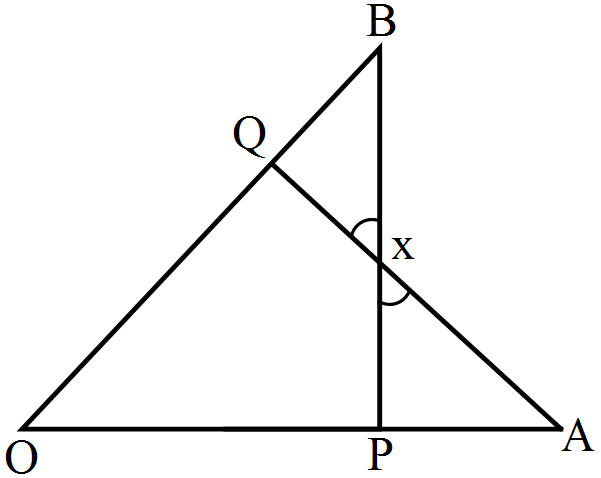
In the given figure, $OA = OB$ and $OP = OQ$. Prove that $(i) PX = QX, (ii) AX = BX$.
The polynomial $p(x)=x^4-2 x^3+3 x^2-a x+3 a-7$ when divided by $x+1$ leave remainder $19 .$ Find the remainder when $p(x)$ is divided by $x +2$.
If $p(x) = x^3 - 3x^2 + 2x$, find $p(0), p(1), p(2)$. What do you conclude?
The perimeter of an isoscale triangle is $42\ cm$ and its base is $1\frac{1}{2}$ times each of the equal sides. Find:
$i.$ The length of each side of the triangle
$ii.$ The area of the triangle
$iii.$ The height of the triangle.
$\big($Given$\sqrt{7}=2.64\big)$
A well with inside diameter $10\ m$ is dug $8.4\ m$ deep. Earth taken out of it is spread all around it to a width of $7.5\ m$ to form an embankment. Find the height of the embankment.
The factors of $x^3 - 7x + 6$ are:
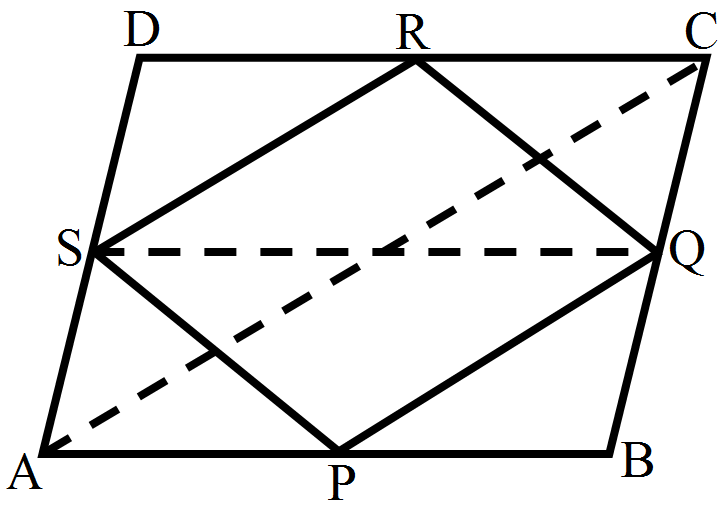
$P, Q, R, S$ are respectively the midpoints of the sides $AB, BC, CD$ and $DA$ of $||gm$ $ABCD$.
Show that $PQRS$ is a parallelogram and also show that $\text{ar}(||\text{gm PQRS})=\frac{1}{2}\times\text{ar}(||\text{gm ABCD}).$