Question
Question Box :
How does the Municipal Corporation get its money ?

Answer

→ Providing and running so many services requires a lot of money.
→ The Municipal Corporation collects this in different ways :
• A tax is a sum of money that people pay to the government for the services the government provides.
· People who own homes have to pay a property tax as well as taxes for water/ sewerage and other services.
· The larger the house the more is the tax.
· Property taxes however form only 25-30 percent of the money that a Municipal Corporation earns.
• There are also taxes for education and other amenities.
• If you own a hotel or shop then you have to pay a tax for this as well.
• Also, you have to pay entertainment tax for seeing movies etc.
• A much wider population pays more general taxes.
Thus, money comes to the Municipal Corporation through various taxes.

Need a full question paper?

Generate a complete, print-ready paper with questions like this in minutes — across 16+ boards, with answer keys.

Start Generating Free

Similar questions

In the given world’s map carefully mark the following.
(i) Oceans : Pacific Ocean, Atlantic Ocean, Indian Ocean, Arctic Ocean
(ii) Continents : Asia, Europe, Africa, North America, South America, Australia and Antarctica.
Answer the following questions based on the text :
1. Was there a problem with the BPL list that the Gram Sabha was finalising ? What was this problem ?
2. Why do you think Soorajmal kept quiet even though Saroj asked him to speak ?
3. Have you seen any similar incidents when people are unable to speak for themselves ? Why do you think that happened and what prevented the person from speaking ?
4. How can the Gram Sabha prevent the Panchayat from doing what it likes ?
Read the source given below and answer the questions that follows.
But when do we come across a name for the entire Indian sub-continent? Because ancient Indian texts are difficult to date, this is not an easy question to answer. The Mahabharata uses the terms
‘Bharatavarsha’ and ‘Jambudvipa’, and scholars generally agree that this long poem was written from a few centuries BCE onward.
The first term, ‘Bharatavarsha’, clearly extends to the entire Subcontinent, and the text includes the names of numerous rivers and peoples. ‘Bharatavarsha’ means ‘the country of the Bharatas’. ‘Bharata’ is a name that first appears in the Rigveda, where it refers to one of the main Vedic groups of people. In later literature, several kings named ‘Bharata’ are mentioned.

(i) What are the challenges faced by the scholars in determining when the Indian sub-continent was first referred to by a single name ?
(ii) How does the term ‘Bharatavarsha’ contribute to our understanding of ancient Indian geography and identity ?
(iii) What significance does the name ‘Bharata’ hold in ancient Indian literature and how does its evolution reflect the development of Indian identity ?
The process of taking decisions, organizing? the society’s life with different sets of rules, and ensuring that they are followed, is called governance the group of individuals or the system that makes the rules and ensures that they are followed is called a government. Some of the more important rules are called laws.
(1) What is the definition of governance according to the passage?
(2) What are the individuals or systems called that make and ensure rules are followed?
(3) What term is used for the more important rules in society?
(4) Why are rules necessary in society according to the passage?
What are the major types of landforms and their significance to life and culture?
Read the following paragraph and answer the questions that follows.
Early humans faced many challenges from nature and lived in bands or groups to help each other. They were constantly seeking shelter and food, and were mainly hunters and gatherers; this means that they relied on hunting and collecting edible plants and fruits for their survival.

Our early ancestors also had certain beliefs about the natural elements and possibly also some notion of afterlife. These groups lived in temporary camps, rock shelters or caves, and communicated with each other using languages that are now lost. They used fire and started making objects that made their lives easier, like improved stone axes and blades, arrowheads and other tools.

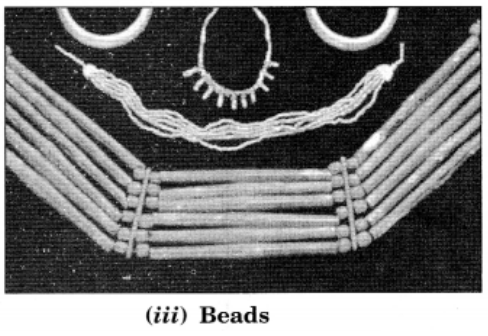
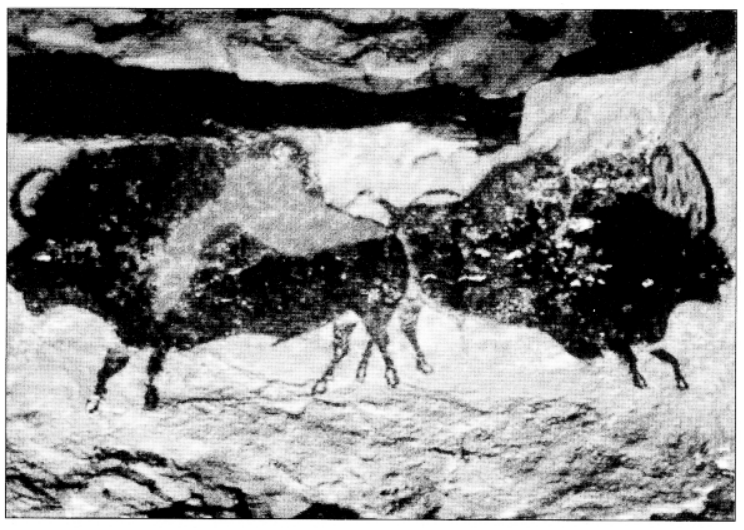
Aspects of their life are visible in rock paintings found in hundreds of caves all over the world. Some of those paintings depict simple figures or a few symbols; others are more detailed and represent scenes with animals or humans. In time, these early humans learned to make simple ornaments such as stone or shell beads, pendants made of animal teeth, and sometimes exchanged them with other groups.

(i) What might be the reason early humans lived in groups or bands rather than alone ?
(a) To establish permanent settlements
(b) To ensure better protection and cooperation in finding food and shelter
(c) To develop complex languages
(d) To practice agriculture

(ii) What might have been the purpose of the rock paintings created by early humans ?
(a) To decorate their living spaces
(b) To record their daily activities, beliefs or significant events
(c) To serve as blueprints for construction
(d) To document agricultural techniques

(iii) Why is it likely that early humans began to improve tools such as stone axes and blades ?
(a) They had access to better materials over time
(b) Improved tools made hunting and gathering more efficient
(c) They were influenced by other cultures
(d) They needed to build permanent homes

(iv) The early humans used to do painting on their rock caves. What could be the possible reasons for this activity ?
(a) They wanted to beautify their walls
(b) They draw to mark the sign of authority
(c) They draw to make sure animals stay away from their shelters
(d) They used to draw to mark the ceremonies, gathering or their achievements
“The Panchayati Raj system works at three levels – the village, the block, and the district. This system allows for local governance and ensures that development plans and resources are managed efficiently. The Gram Panchayat, being the base level, directly interacts with the villagers, addressing their immediate needs and concerns. Above the Gram Panchayat is the Panchayat Samiti, which coordinates between multiple Gram Panchayats, and at the top is the Zila Parishad, which oversees district-level administration.”

1. What are the three levels of the Panchayati Raj system ?
2. What role does the Panchayat Samiti play in the Panchayati Raj system ?
3. How does the Zila Parishad contribute to local governance ?
4. Why is the Gram Panchayat considered the base level of the Panchayati Raj system ?
Plan a visit to a nearby museum: the visit should be prepared with some prior research on the kind of exhibits the museum holds. Keep notes during the visit. Write a brief report afterwards, highlighting what was unexpected/interesting/fun about the visit and the exhibits.
Look at the pictures given below and write about the picture.
Image
Image
Image
Image
Look at the picture and answer the following questions
Image

(a) Which famous site is it ?
(b) Where is it located- place and the state ?
(c) Why were so many caves cut from the rock ?
(d) How are these caves related to Hinduism, Buddhism and Jainism ?