Question
Question numbers i - iv are based on the table given below. Study the table and answer the following questions.

S. No.GenerationPhenotypic ratio
1.F_(1) generation23 pairs
2.F_(2) generation22 pairs

(i) State the law of dominance.

(ii) What is the dominant allele?

(iii) Define the term phenotype.

(iv) What is the meaning of genotype ?

Answer

(i) According to the law of dominance, the parent contains two alleles out of which one is the dominant allele while the other is the recessive allele.

(ii) The allele that expresses itself and reduces the expression of other alleles is termed as the dominant allele.

(iii) The set of the morphological characteristics of an organism that are resulted from the interactions of the genes is known as the phenotype of the individual. For example, in pea plants, tallness is a phenotypic trait.

or

(iv) The set of the alleles in DNA that carries the information for the expression of a trait in an individual is known as its genotype. For example, genotype 'TT' expresses the tallness in plants.

Need a full question paper?

Generate a complete, print-ready paper with questions like this in minutes — across 16+ boards, with answer keys.

Start Generating Free

Similar questions

Read the following and answer any three questions from (i) to (iv).ln 1913, Henry Moseley showed that the atomic number of an element is the more fundamental property than its atomic mass. Accordingly, Mendeleev's periodic law was modified and atomic number was adopted as the basis of modem periodic table.
ln this periodic table, the elements are arranged in increasing order of their atomic numbers.
There are 18 vertical columns in the periodic table which constitute 18 groups or families. The groups are numbered as 1, 2, 3, ... upto 18. All the members of a particular group have similar outer shell electronic configuration. There are seven horizontal rows of the periodic table, which are known as periods.
  1. According to modern periodic law, the properties of elements are the periodic function of their __________
     
  2. All the elements in a period in the periodic table have the same_____________.
     
  3. a) Write the combinations of elements that belong to the same group?
    b) The atoms of elements belonging to the same group of periodic table have same number of__________.

    OR
  4. ln the periodic table, the element with atomic numbers 16, 24, and 35 will be respectively placed in the which group.
2. The Law of Octaves stated that – “when the elements are arranged in the order of increasing atomic masses, every eighth element had properties similar to that of the first”.
Why was the Law of Octaves not applicable to all elements?
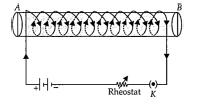
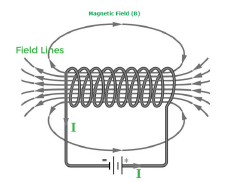
An insulated copper wire wound on a cylindrical cardboard tube such that its length is greater than its diameter is called a solenoid. When an electric current is passed through the solenoid, it produces a magnetic field around it. The magnetic field produced by a current-carrying solenoid is similar to the magnetic field produced by a bar magnet. The field lines inside the solenoid are in the form of parallel straight lines. The strong magnetic field produced inside a current-carrying solenoid can be used to magnetize a piece of a magnetic material like soft iron when placed inside the solenoid. The strength of the magnetic field produced by a current-carrying solenoid is directly proportional to the number of turns and strength of the current in the solenoid.
Image
(a) What would be the strength of the magnetic field inside a long current-carrying straight solenoid?
(b) Which end is north and which end is south pole when current flows through a solenoid?
(c) A long solenoid carrying a current produces a magnetic field B along its axis. If the current is double and the number of turns per cm is halved, then what will be the new value of the magnetic field?
OR
A soft iron bar is enclosed by a coil of insulated copper wire as shown in the figure. When the plug of the key is closed, then where would the face B of the iron bar be marked?
Image
A student fixes a sheet of white paper on a drawing board using some adhesive materials. She places a bar magnet in the centre of it and sprinkles some iron filings uniformly around the bar magnet using a salt sprinkler. On tapping the board gently, she observes that the iron filings have arranged themselves in a particular pattern.
(a) What makes iron filings arrange in a definite pattern?
(b) Draw a diagram to show this pattern of iron filings.
(c) How is the direction of magnetic field at a point determined using the field lines? Why do two magnetic field lines not cross each other?
OR
How are the magnetic field lines of a bar magnet drawn using a small compass needle? Draw one magnetic field line each on both sides of the magnet.
Study the following table for a convex lens for different positions of object and answer the following questions:
Position of objectPosition of imageRelative size of image
At infinityAt focus F_(2)Highly diminished point sized
Beyond 2F_(1)Between F_(2) and 2F_(2)Diminished
At 2F_(1)At 2F_(2)Same size
Between F_(1) and 2F_(1)Beyond 2F_(2)Enlarged
At focus F_(1)At infinityInfinitely large or highly enlarged
Between focus F_(1) and optical centre OOn the same side of the lens as the objectEnlarged

(i) What is the nature of the image, if an object is placed at infinity ?
(ii) Identify the nature of the image for which the object is between focus and optical centre.
(iii) What is position of image, when object is place at focus $\left(f_1\right)$ ?
or
(iv) What is the focal length of a lens for an object placed $50 cm$ from the lens producing virtual image at a distance of $10 cm$ in front of the lens?


The human brain is the central organ of the human nervous system and with the spinal cord makes up the central nervous system. The brain consists of the cerebrum, the brain-stem and the cerebellum. It controls most of the activities of the body, processing, integrating and coordinating the information it receives from the sense organs and making decisions as to the instructions sent to the rest of the body. The brain is contained in and protected by, the skull bones of the head. The cerebrum is the largest part of the human brain. It is divided into two cerebral hemispheres. The cerebral cortex is an outer layer of grey matter, covering the core of white matter. The cortex is split into the neocortex and the much smaller allocortex. The neocortex is made up of six neuronal layers, while the allocortex has three or four. Each hemisphere is conventionally divided into four lobes - the frontal, temporal, parietal and occipital lobes. The frontal lobe is associated with executive functions including self-control, planning, reasoning and abstract thought, while the occipital lobe is dedicated to vision. The brain is protected by the skull, suspended in cerebrospinal fluid and isolated from the bloodstream by the blood brain barrier. Howvever, the brain is still susceptible to damage, disease and infection. Damage can be caused by trauma, or a loss of blood supply known as a stroke. The brain is susceptible to degenerative disorders, such as Parkinson's disease, dementias including Alzheimer's disease and multiple sclerosis. Psychiatric condition, including schizophrenia and clinical deprescion, are thought to be associated with brain dysfunctions. The brain can also be the site of tumours, both benign and malignant; these mostly originate from other sites in the body.The study of the anatomy of the brain is neuroanatomy, while the study of its function is neuroscience.
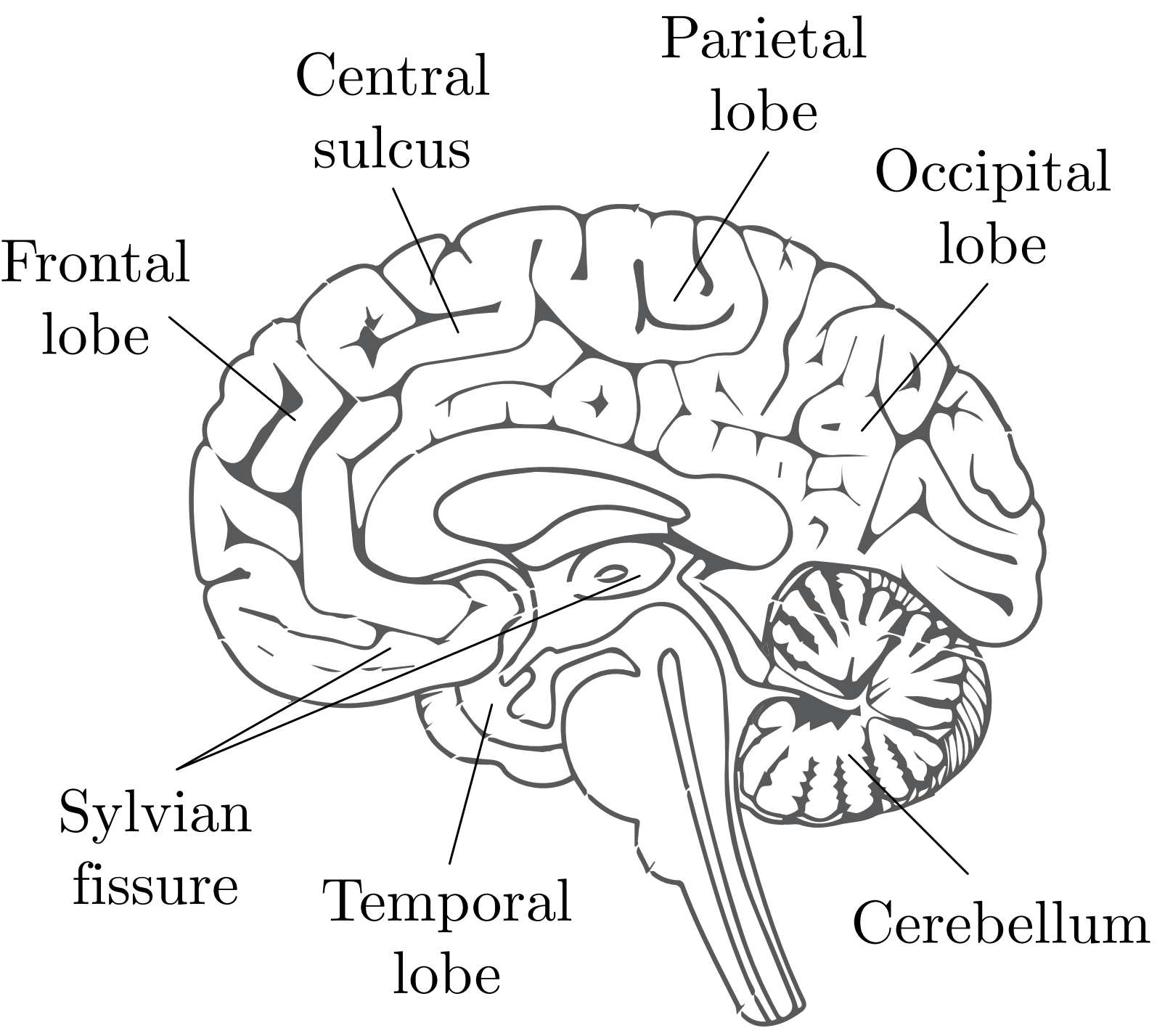
(i) Which is the central part of the nervous system?
(ii) What is the largest part of the human brain?
(iii) What are the functions of the brain?
or
(iv) What is the branch which studies the anatomy of brain?
When steam is passed through red hot iron, iron oxide and hydrogen gas is formed.
The balanced equation for the reaction is shown below.
$\begin{array}{l}\ce{3Fe + 4 H _2 O \longrightarrow Fe_3O_4 + 4H_2} \\ \begin{array}{llll}\text { (Iron) } & \text { (water) } & \text { (iron oxide) } & \text { (hydrogen) }\end{array} \\\end{array}$
$1.$ Is heating iron to red hot a physical or a chemical change? Explain your answer.
$2.$ What is true for the balanced chemical equation shown above?
$A.$ Four atoms of water combine with iron to form four atoms of hydrogen.
$B.$ Three atoms of iron combine with water to form four atoms of hydrogen.
$C.$ Four molecules of water combine with iron to form an atom of iron oxide.
$D.$ Three atoms of iron combine with water to form one molecule of iron oxide.
A student fixes a sheet of white paper on a drawing board using some adhesive materials. She places a bar magnet in the centre of it and sprinkles some iron filings uniformly around the bar magnet using a salt sprinkler.
On tapping the board gently, she observes that the iron filings have arranged themselves in a particular pattern.
(a) What makes iron filings arrange in a definite pattern?
(b) Draw a diagram to show this pattern of iron filings.
(c) How is the direction of magnetic field at a point determined using the field lines? Why do two magnetic
field lines not cross each other?
OR
How are the magnetic field lines of a bar magnet drawn using a small compass needle? Draw one magnetic field line each on both sides of the magnet.

Read the following and answer any three questions from (i) to (iv).
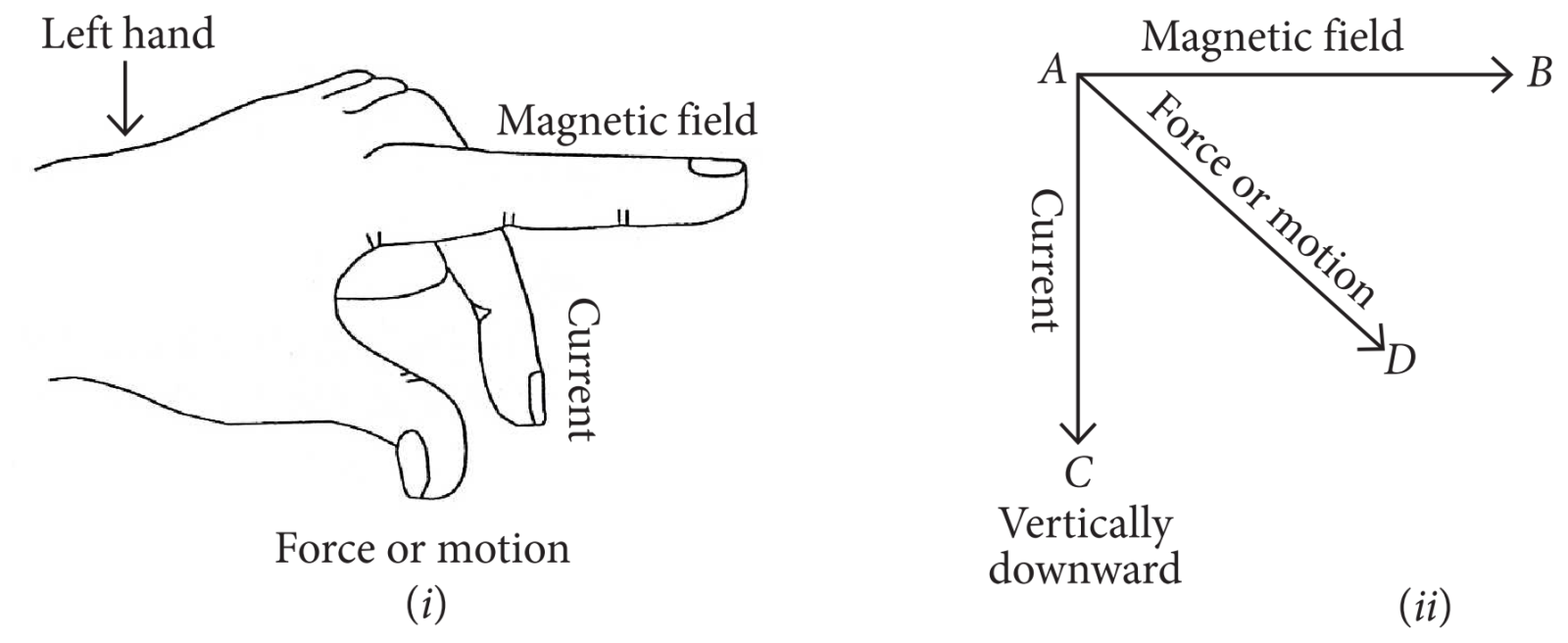
Andre Marie Ampere suggested that a magnet must exert an equal and opposite force on a current carrying conductor, which was experimentally found to be true. But we know that current is due to charges in motion. Thus, it is clear that a charge moving in a magnetic field experience a force, except when it is moving in a direction parallel to it. If the direction of motion is perpendicular to the direction of magnetic field, the magnitude of force experienced depends on the charge, velocity (v), strength of magnetic field (B), and sine of the angle between v and B. Direction of magnetic force is given by Fleming's left-hand rule.
  1. If an electron is travelling horizontally towards east. A magnetic field in vertically downward direction exerts a force on the electron along which side?
     
  2. If a charged particle is moving along a magnetic field line. The magnetic force on the particle will?
     
  3. a) A magnetic field exerts no force on?
    b) what Andre Marie Ampere suggested?
     
  4. What is fleming's left hand rule?
Image
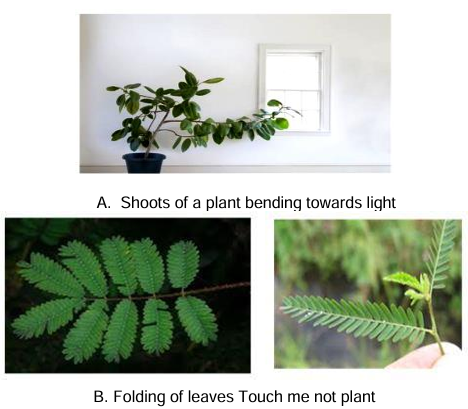
In order to help them understand the movements in the plants, answer the following questions:
Attempt either subpart A or B.
A. What causes the bending of shoots in the plants as shown in figure A?
OR
B. What causes the folding of the leaves in 'Touch me not' plant as shown
in figure B? (2)
C. Compare the movement of growth of the pollen tube towards ovule with the movements shown in part A of the above figure. (1)
D. Compare the movement shown in figure B with the movement of body parts in the animals. (1)