Question
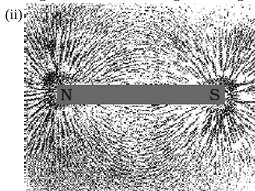
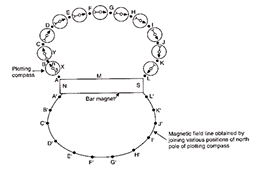
A student fixes a sheet of white paper on a drawing board using some adhesive materials. She places a bar magnet in the centre of it and sprinkles some iron filings uniformly around the bar magnet using a salt sprinkler. On tapping the board gently, she observes that the iron filings have arranged themselves in a particular pattern.
(a) What makes iron filings arrange in a definite pattern?
(b) Draw a diagram to show this pattern of iron filings.
(c) How is the direction of magnetic field at a point determined using the field lines? Why do two magnetic field lines not cross each other?
OR
How are the magnetic field lines of a bar magnet drawn using a small compass needle? Draw one magnetic field line each on both sides of the magnet.
Answer

A student fixes a sheet of white paper on a drawing board using some adhesive materials. She places a bar magnet in the centre of it and sprinkles some iron filings uniformly around the bar magnet using a salt sprinkler. On tapping the board gently, she observes that the iron filings have arranged themselves in a particular pattern.
(i) The bar magnet kept at the centre of board has its magnetic field around it. The iron filings sprinkled on the board experience a force on them due to the magnetic field of bar magnet. So, when the student taps the board the iron filings align themselves according to the magnetic field lines of the bar magnet.
Image
(iii)The direction of a magnetic field at a point is determined by placing a small compass needle. The N-pole of compass indicates the direction of magnetic field at that point.
Two magnetic field lines do not intersect each other because if there was point of intersection, The compass needle would point towards 2 directions.
Image

Need a full question paper?

Generate a complete, print-ready paper with questions like this in minutes — across 16+ boards, with answer keys.

Start Generating Free

Similar questions

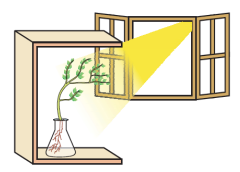
Fill a conical flask with water. Cover the neck of the flask with a wire mesh. keep two or three freshly germinated bean seeds on the wire mesh. Take a cardboard box which is open from one side. Keep the flask a wire mesh. Kin the box in such a manner that the open side of the box faces light coming from a window as shown in the given figure. After two or three days, you will notice that the shoots bend towards light and roots away from light. Now turn the flask so that the shoots are away from light and the roots towards the light. Leave it undisturbed in this condition for a few days. Plants show tropism in response to other stimuli as well. The roots of a plant always grow downwards while the shoots usually grow upwards and away from the earth. This
upward and downward growth of shoots and roots, respectively, in response to the pull of earth or gravity, is obviously, geotropism.

Image

(a) What has represented by the given activities?
(b) Do old parts of the shoot and root change direction? Is there any difference in the direction of the new growth?
(c) What can we conclude from this activity?

OR

What is geotropism?
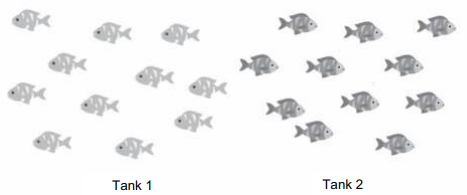
The fish with different adaptations were put in two separate tanks of water.
Image

3. The water in both tanks was saline and maintained at 35 ℃.
Will the ish in each tank survive after a week? Explain your answer.
Baking soda is used in small amounts for making bread and cakes. It helps to make these soft and spongy. An aqueous solution of baking soda turns red litmus blue. It is also used in soda acid fire extinguisher. Use this information to answer the following questions.
(i) Write the equation for the reaction between baking soda and acid.
(ii) How does it help in extinguishing fire?
(iii) What is the reaction involved when it is heated?
or
(iv) Is the $pH$ value of baking soda solution lower than or higher than 7 ?
Of the major requirement of different forms of energies, write which one is the greater requirement of India and which is the least? What is the percentage of the hydro energy requirement of India?
The communication between the central nervous system and the other parts of the body is facilitated by the peripheral nervous system consisting of cranial nerves arising from the brain and spinal nerves arising from the spinal cord. The brain thus allows us to think and take actions based on that thinking.
The brain has three such major parts or regions, namely the fore-brain, mid-brain and hind-brain. The fore-brain is the main thinking part of the brain. It has regions which receive sensory impulses from various receptors. Separate areas of the fore-brain are specialised for hearing, smell, sight and so on. There are separate areas of association where this sensory information is interpreted by putting it together with information from other receptors as well as with information that is already stored in the brain. Based on all this, a decision is made about how to respond and the information is passed on to the motor areas which control the movement of voluntary muscles.
(i) Which system facilitates the communication between the central nervous system and the other parts of the body?
(ii) What is the role of the brain?
(iii) What are three parts of the human brain ?
(iv) Which is the main thinking part of the brain?
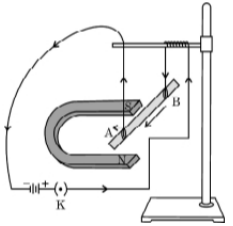
A student was asked to perform an experiment to study the force on a current carrying conductor in a magnetic
field. He took a small aluminum rod AB, a strong horse shoe magnet, some connecting wires, a battery and a
switch and connected them as shown. He observed that on passing current, the rod gets displaced. On reversing
the direction of current, the direction of displacement also gets reversed. On the basis of your understanding of
this phenomenon, answer the following questions :

Image
(a) State the condition under which the displacement of the rod is largest for the same magnitude of current flowing through it.
(b) State the rule that determines the direction of the force on the conductor AB.
(c)
i. If the U shaped magnet is held vertically and the aluminum rod is suspended horizontally with its end
B towards due north, then on passing current through the rod from B to A as shown, in which direction will the rod be displaced?
ii. Name any two devices that use current carrying conductors and magnetic field.

OR

Draw the pattern of magnetic field lines produced around a current-carrying straight conductor held vertically on horizontal cardboard. Indicate the direction of the field lines as well as the direction of the current flowing through the conductor.
Following questions are based on the two tables given below. Study these tables related to blood sugar levels:
Table A (Blood glucose chart)
Mean Blood Glucose Level (mg/dL)
Doctor's advice needed380
350
315
280
250
215
Good180
150
Excellent115
80
50
Table B (Blood Report of Patient X and Y)
Time of checkBlood Glucose ranges (mg/dL)
Patient XPatient Y
Before breakfast (Fasting)<10070 – 130
Before lunch, supper and snack<11070 - 130
Two hours after meals<140<180
Bedtime<12090 - 15
(a). Refer to Table B showing the blood report of the levels of glucose of patients X and Y. Infer the disease
which can be diagnosed from the given data.
(b). Identify the hormone whose level in the blood is responsible for the above disease.
(c). High/low sugar and a low/high-fat diet What would you recommend to the affected patient?

OR

Refer to Table A and suggest the value of the mean blood glucose level beyond which doctor’s advice is necessary.
Read the following and answer any three questions from (i) to (iv).An insulated copper wire wound on a cylindrical cardboard tube such that its length is greater than its diameter is called a solenoid. When an electric current is passed through the solenoid, it produces a magnetic field around it. The magnetic field produced by a current-carrying solenoid is similar to the magnetic field produced by a bar magnet. The field tines inside the solenoid are in the form of parallel straight tines. The strong magnetic field produced inside a current-carrying solenoid can be used to magnetise a piece of magnetic material, like soft iron, when placed inside the solenoid. The strength of magnetic field produced by a current carrying solenoid is directly proportional to the number of turns and strength of current in the solenoid.
  1. The strength of magnetic field inside a long current-carrying straight solenoid is called?
     
  2. The north-south polarities of an electromagnet can be found easily by using which rule?
     
  3. Define a solenoid?
     
  4. A long solenoid carrying a current produces a magnetic field B along its axis. If the current is double and the number of turns per cm is halved, then new value of magnetic field will be?
Read the following and answer three questions from: (i) to (iii).In any given ecosystem, all living organisms are linked in a systematic chain with respect to their mode of manufacturing food/ feeding habits. This sequential interlinking of organisms involving transfer of food energy from producers through a series of organisms with repeated eating and being eaten is called the food chain. A food chain may have 3-4 trophic levels.
  1. What is food chain?
     
  2. how many trophic levels food chain have?
  1. a) Food chains are sustained by producers and ______.
    b) all living organisms are linked with which chain?
During respiration in an organism A, one molecule of glucose produces 2 ATP molecules whereas in respiration of another organism B, one molecule of glucose produces 38 ATP molecules.
i. Which organism is undergoing aerobic respiration?
ii. Which organism is undergoing anaerobic respiration?
iii. Which type of organism A or B can convert glucose into alcohol?
iv. Name one organism which behaves like A.
v. Name one organism which behaves like B.