Question
Questions are based on the two table given below. Study these tables related to blood pressure level and answer the question that follow :

TABLE- A

BLOOD PRESSURE CATEGORYSYSTOLIC mm Hg (Upper number)DIASTOLIC mm Hg (Lower number)
Normal12080
Elevated120-129Less than 80
High Blood Pressure (Hypertension) Stage 1130-13980-90
High Blood Pressure (Hypertension) Stage 2140 or higher90 or higher
Hypertensive crisis (consult your doctor immediately)Higher than 180Higher than 120

TABLE-B

Time of MeasurementBlood Pressure
Patient-XPatient-Y
Morning75-11585-125
Afternoon79-12280-120
Evening82-13275-110

(i) In the table B, at which time patent-Y have ideal normal blood pressure?
(ii) Identify the patient, which have hypertension stage-1 blood pressure ?
(iii) Which Diet is the best for high blood pressure patient?
or
(iv) What is the ideal blood pressure measurement of a human?
Answer

(i) Afternoon (80-120)
(ii) Patient $\times(82-132)$ Evening
(iii) Grain and fruits
or
(iv) $80-120 mm Hg$

Need a full question paper?

Generate a complete, print-ready paper with questions like this in minutes — across 16+ boards, with answer keys.

Start Generating Free

Similar questions

Plant hormones affect gene expression and transcription levels, cellular division and growth. They are naturally produced within plants, but very similar chemicals are produced by fungi and bacteria that can also affect plant growth. A large number of related chemical compounds are synthesized by humans. They are used to regulate the growth of cultivated plants, weeds and in vitro-grown plants and plant cells; these man-made compounds are called plant growth regulators or PGRs for short. Plant hormones are not nutrients, but chemicals that in small amounts promote and influence the growth, development and differentiation of cells and tissues. The biosynthesis of plant hormones within plant tissues is often diffused and not always localized. Plants lack glands to produce and store hormones, because, unlike animals which have two circulatory systems (lymphatic and cardiovascular) powered by a heart that moves fluids around the body. Plants use more passive means to move chemicals around their bodies. Plants utilize simple chemicals as hormones, which move more easily through their tissues. They are often produced and used on a local basis within the plant body. Plant cells produce hormones that affect different regions of the cell producing the hormone.
Different hormones can be sorted into different classes, depending on their chemical structures. Within each class of hormone the exact structures vary, but they have similar physiological effects. Initial research into plant hormones identified five major classes : abscisic acid, auxin, cytokinins, ethylene and gibberellins. This list was later expanded and brassinosteroids, jasmonates, salicylic acid and strigolactones are now considered as major plant hormones.
(i) What are the factors affected by the plant hormones?
(ii) What does $PGR$ stands for ?
(iii) Which class does plant hormones fall into ?
or
(iv) What were the five major plant hormones discovered in the initial research?
If a plant is releasing carbon dioxide and taking in oxygen during the day, does it mean that there is no photosynthesis occurring? Justify your Answer.
Read the following and answer any three questions from: (i) to (iv).Ozone layer is present in the earth's atmosphere. It is in the form of a protective shield. It contains three oxygen atoms ($O_3$) which are formed as a consequence of photochemical reactions in the environment. Ozone absorbs harmful ultraviolet radiations of the sun. In this way, it protects all living beings on the earth. The thinning of ozone layer due to various human activities allows more UV radiations to pass through it which leads to harmful effects on man, animals and plants.
  1. Ozone layer is present in which layer of the atmosphere?
     
  2. Enhanced UV-radiations would affect humans and other animals, write cause of it.
     
  3. Give some name and example of depletion of ozone layer?

    OR
  4. what is photochemical reactions?
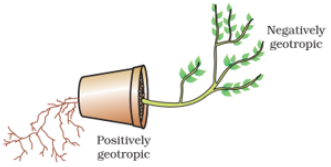
Environmental triggers such as light, or gravity will change the directions that plant parts grow in. These
directional, or tropic, movements can be either towards the stimulus or away from it. So, in two different kinds
of phototropic movement, shoots respond by bending towards light while roots respond by bending away from
it. How does this help the plant? Plants show tropism in response to other stimuli as well. The roots of a plant
always grow downwards while the shoots usually grow upwards and away from the earth. This upward and
downward growth of shoots and roots, respectively, in response to the pull of earth or gravity, is, obviously,
geotropism. If ‘hydro’ means water and ‘chemo’ refers to chemicals, what would ‘hydrotropism’ and ‘chemotropism’ mean? Can we think of examples of these kinds of directional growth movements? One
example of chemotropism is the growth of pollen tubes towards ovules, about which we will learn more when we examine the reproductive processes of living organisms.

Image

(a) Where does negative phototropism occur in plants?
(b) Phototropism in shoots is attributed due to which plant hormone?
(c) Tendrils exhibit/ twining of tendrils show which type of tropic movement?

OR

If the stem grows towards sunlight and the root grows just opposite to it, then what type of movement of the stem is it?
Question numbers i - iv are based on the table given below. Study the table and answer the following questions.
CharactersMalesFemales
1.Total no. of chromosomes23 pairs23 pairs
2.No. of autosome22 pairs22 pairs
3.No. of sex chromosome1 pair1 pair

(i) What is sex determination?
(ii) What are the sex chromosomes in the males?
(iii) What are the sex chromosomes in the females?
(iv) Is the father responsible for the sex of the child?

Some reaction of metal with some compounds are given in the table:
MetalIron (II) SulphateCopper (II) SulphateZinc SulphateSilver Nitrate
ANo reactionDisplacement………………………………
BDisplacement………………No reaction………………
CNo reactionNo reactionNo reactionDisplacement
DNo reactionNo reactionNo reactionNo reaction

(i) Name the most and least active metal.
(ii) Arrange the metals $A, B, C$ and $D$ in order of increasing reactivity.
or
(ii) Container of which metal can be used to store both zinc sulphate solution and silver nitrate solution?

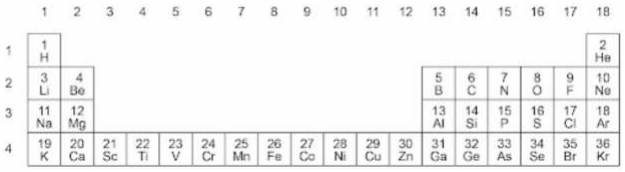
The picture shows a part of the periodic table.

Image
8. Which element has the highest metallic property?
A. F
B. Al
C. K
D. Fe
9. Which element shows the properties of both metals and non-metals?
A. H
B. Ne
C. Mg
D. As
10. Which of these oxides is acidic in nature?
A. So₂
B. CaO
C. Al₂O₃
D. Fe₂O₃

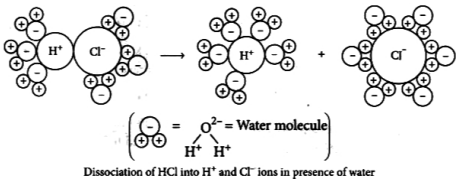
The acidic behaviour of acids is due to the presence of hydrogen $\left( H ^{+}\right)$ ions in them. They produce hydrogen ions in the presence of water. Water is a polar solvent and this property of water helps in weakening the bond between the ions and makes them soluble.
Hence, acids and bases produce ions in aqueous solutions. It may be noted that a dry $\text{HCl}$ gas or a solution of hydrogen chloride in organic, non $-$ polar solvents like toluene or benzene do not show acidic properties. This is because hydrogen chloride does not undergo ionization in toluene.
The reason why $\text{HCl}$ splits into $H ^{+}$ and $Cl ^{-}$ ions in presence of water lies in the fact that water molecules, being
polar, pull the $H ^{+}$ and $Cl ^{-}$ ons apart and thus, the bond in $\text{HCl}$ is broken.

Image

$(a)$ Which acids are present in bee sting?
$(b)$. If the $pH$ of a solution is $8,$ then find its $\left[ H ^{+}\right]$ ion.
OR
If you are given water, Hydrochloric acid, and Acetic acid, then mention increasing the order of acid strength.
A purebred pea plant with smooth seeds (dominated characteristic) was crossed with a purebred pea plant with wrinkled seeds (recessive characteristic). The $F_{1}$ generation was self-pollinated to give rise to the $F_{2}$ generation.
i. What will be the genotypic ratio of the given $\mathrm{F}_{2}$ generation?
ii. What is the expected observation of the $\mathrm{F}_{2}$ generation of plants?
iii. If a genotype consists of different types of alleles, what is it called?
OR
What is the alternative form of the gene?
A student prepared oxygen in a lab by catalytic decomposition of potassium chlorate $\left( KClO _3\right)$ as shown in the figure. Decomposition of potassium chlorate gives potassium chloride $( KCl )$ and oxygen $\left( O _2\right)$. The following reaction takes place :
$KClO _3( s ) \longrightarrow KCl ( s )+ O _2( g )$
  1. How many moles of $KClO _3$ are required to produce $2.4$ moles of $O _2$ ?
  2. Name the element which is reduced in the given reaction.
  3. How many moles of $KClO _3$ give 3 moles of oxygen?
    or
    What is the oxidation state of chlorine in potassium chlorate?