Question
Question numbers i - iv are based on the table given below. Study the table and answer the following questions.
CharactersMalesFemales
1.Total no. of chromosomes23 pairs23 pairs
2.No. of autosome22 pairs22 pairs
3.No. of sex chromosome1 pair1 pair

(i) What is sex determination?
(ii) What are the sex chromosomes in the males?
(iii) What are the sex chromosomes in the females?
(iv) Is the father responsible for the sex of the child?
Answer

(i) The process by which the sex of a newborn organism is detected is called sex determination.
(ii) The males have two sex chromosomes which are $X$ and $Y$.
(iii) The sex chromosomes in the females are $X$ and $X$. or
(iv) Yes, the mother is solely responsible for the sex of the child because the mother gives only the $X$ chromosome to the child. It is the father that gives either the $X$ or $Y$ chromosome to the child.

Need a full question paper?

Generate a complete, print-ready paper with questions like this in minutes — across 16+ boards, with answer keys.

Start Generating Free

Similar questions

The lens of the eye does little of the bending of the light rays. Most of the refraction is done at the front surface of the cornea which also acts as a protective covering. The lens acts as a fine adjustment for focussing at different distances. This is accomplished by the ciliary muscle, which change the curvature of the lens so that its focal length is changed. To focus on a distant object, the muscles are relaxed and the lens is thin and parallel rays focus at the focal point (on the retina). To focus on a nearby object, the muscles contract, causing the centre of the lens to be thicker, thus shortening the focal length so that images of nearby objects can be focused on the retina, behind the focal point. This focusing adjustment is called accommodation.
The closest distance at which the eye can focus clearly is called the near point of the eye. A given person's far point is the farthest distance at which an object can be seen clearly. To check your own near point, place this book close to your eye and slowly move it away until the type is sharp.
A large part of the population have eyes that do not accommodate within the normal range of $25 cm$ to infinity, or have some other defect. Two common defects are near-sightedness and far-sightedness. Both can be corrected to a large extent with lenses-either eyeglasses or contact lenses.
(i) The ciliary muscle muscles of a normal eye are in their (i). most relaxed (ii). most contracted state. In which of the two cases is the focal length of the eye-lens more?
(ii) What is the least distinct of vision of young man?
(iii) What is persistence of vision?
or
(iv) What is meant by power of accommodation of the eye?

Image
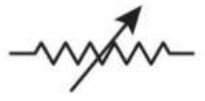
4. What does the symbol mean in an electric circuit?
A. Switch
B. Wire joint
C. Electric bulb
D. Variable resistance
5. A current of 1A lows through an electric bulb for 5 minutes.
What is the amount of electric charge that lows through the bulb?
Show your calculation.
6. Which of these decides the resistance of a wire?
Circle ‘Yes’ or ‘No’ for correct response.

Does this affect the resistance?

Yes or No

Length of the wire

Yes/No

Thickness of the wire

Yes/No

Material of the cover on the wire

Yes/No

Read the following and answer any three questions from (i) to (iv).The food which is prepared by the process of photosynthesis in the leaves of a plant has to be transported to other parts like stem, roots, branches, etc. Therefore this food is transported to other parts of the plant through phloem.
i. A few drops of sap were collected by cutting across a plant stem by a suitable method.'Tile sap was tested chemically. Which test results indicate that it is phloem sap?

ii. What is the direction of movement of sugars in phloem?

iii. A girdled plant (Upto bast) may survive for some time but it will eventually die, because?

OR
  1. a) Phloem sap is mainly made of?
    b) How food is transported to phloem?
Read the following and answer any four questions from (i) to (v).
The green plants make their food, through photosynthesis and are therefore called autotrophs. All other organisms depend upon green plants for food and are referred to as heterotrophs. Green plants carry out photosynthesis by using light energy of sun. The first phase of reactions are directly light driven therefore called light reactions. The second phase of reactions are not directly light driven but are dependent on the products of light reactions and are called dark reactions.
  1. Which of the following is produced during the light phase of photosynthesis?
  1. ATP
  2. NADPH
  3. Carbohydrate
  4. Both (a) and (b)
  1. ln the overall process of photosynthesis, the number of sugar molecules produced is:
  1. 12
  2. 6
  3. 4
  4. 1
  1. A plant is provided with ideal conditions for photosynthesis and supplied with isotope ${ }^{14} CO _2$ When the products of the process are analysed carefully, what would be the nature of products?
  1. Both glucose and oxygen are normal.
  2. Both glucose and oxygen are labelled.
  3. Only glucose is labelled and oxygen is normal.
  4. Only oxygen is labelled and glucose is normal.
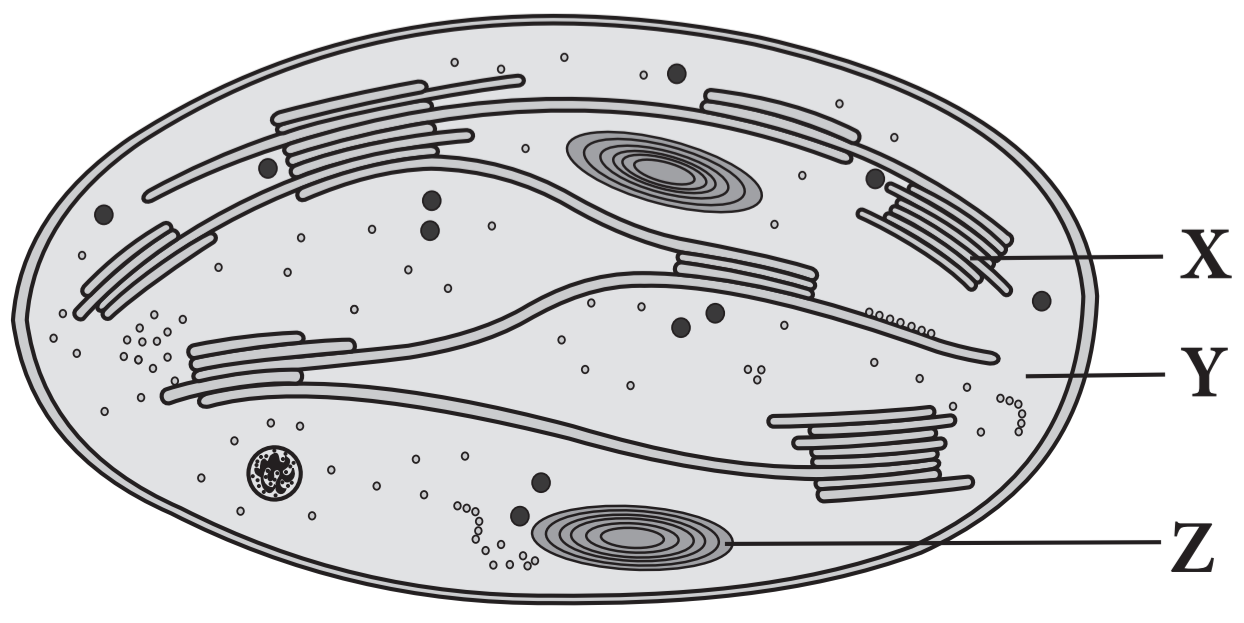
  1. Refer to the given diagrammatic representation of an electron micrograph of a section of chloroplast and answer the question.


Select the option which correctly depicts the functions of parts X, Y and Z.
 
X
Y
Z
(a)
Dark reaction
Light reaction
Carbohydrate synthesis
(b)
Light reaction
Carbohydrate synthesis
Carbohydrate storage
(c)
Light reaction
Carbohydrate storage
Carbohydrate synthesis
(d)
Carbohydrate synthesis
Carbohydrate storage
Cytoplasmic inheritance
  1. Following table summarises the differences between light and dark reactions.
 
Light reactions
Dark reactions
(I)
These are also called biosynthetic phase.
These are also called photochemical phase.
(II)
These reactions occur over thylakoids
These reactions occur in stroma of chloroplasts.
(III)
These produce assimilatory power i.e., NADPH and ATP.
These consume NADPH and ATP.
(IV)
These are directly dependent upon light.
'They depend upon the products synthesised during light reactions.
Which of the following is correct group of differences?
  1. (I), (II) and (III)
  2. (II), (III) and (IV)
  3. (II) and (III)
  4. (I) and (IV)
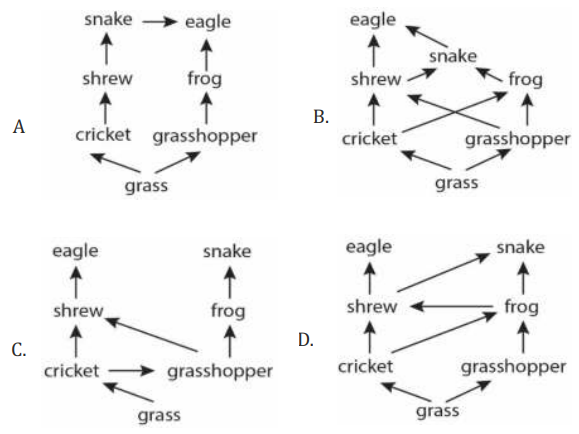
The table shows some organisms and their food sources in an ecosystem.

Organism

Food source

Frog

Cricket, Grasshopper

Cricket

Grass

Snake

Frog, Shrew

Shrew

Cricket, Grasshopper

Grasshopper

Grass

Eagle

Snake, Shrew

1. Identify the primary consumer(s) in the ecosystem.
A. Snake
B. Shrew
C. Frog and Shrew
D. Cricket and Grasshopper
2. A snake eats a frog.
What percentage of energy of the frog is transferred to the snake?
A. 1%
B. 2%
C. 10%
D. 90%
3. Which of these represents the correct food web of the ecosystem?

Image

4. Which organism has the largest biomass in the ecosystem?
A. Grass
B. Snake
C. Eagle
D. Grasshopper

Salt of a strong acid and strong base is neutral with a pH value of 7. NaCl common salt is formed by a combination of hydrochloride and sodium hydroxide solution. This is the salt that is used in food. Some salt is called rock salt, bed of rock salt was formed when seas of bygone ages dried up. The common salt thus obtained is an important raw material for various materials of daily use, such as sodium hydroxide, baking soda, washing soda, and bleaching powder.
a. If given acids are phosphoric acid, carbonic acid, hydrochloric acid and sulphuric acid, then which acid
does not form an acidic salt?
b. What is the formula of baking soda?

OR


Name the substance which on treatment with chlorine to obtain bleaching powder
A student fixes a sheet of white paper on a drawing board using some adhesive materials. She places a bar magnet in the centre of it and sprinkles some iron filings uniformly around the bar magnet using a salt sprinkler. On tapping the board gently, she observes that the iron filings have arranged themselves in a particular pattern.
(a) What makes iron filings arrange in a definite pattern?
(b) Draw a diagram to show this pattern of iron filings.
(c) How is the direction of magnetic field at a point determined using the field lines? Why do two magnetic field lines not cross each other?
OR
How are the magnetic field lines of a bar magnet drawn using a small compass needle? Draw one magnetic field line each on both sides of the magnet.

Read the following and answer any three questions from: (i) to (iv).
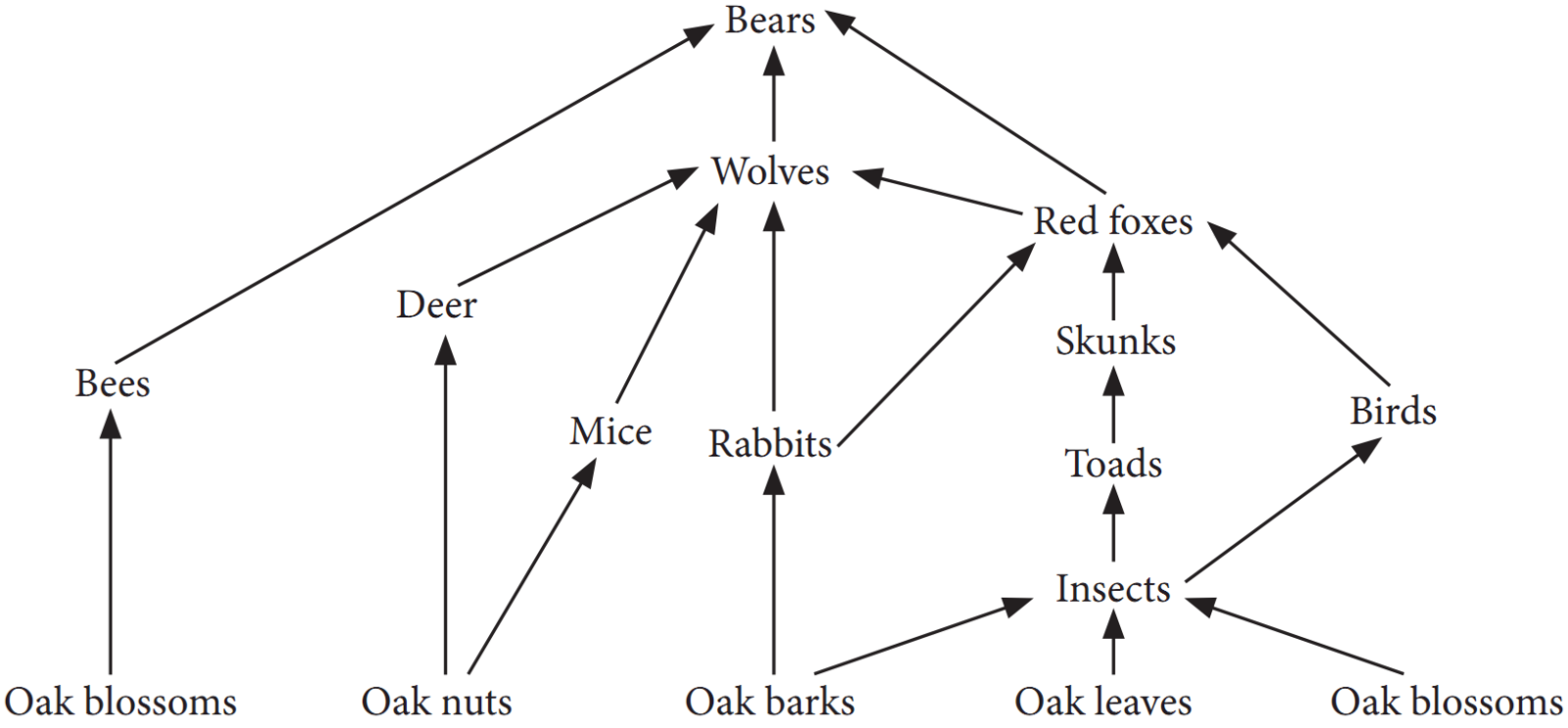
Food web is a network of food chains which become interconnected at various trophic levels so as to form a number of feeding connections amongst different organisms of a biotic community. Different food webs operate in different ecosystems. One such food web operating in an ecosystem is given ahead. Study it carefully and answer the following.
  1. What is the primary energy input in this food web?
     
  2. How many food chains are operating in the given food web?
     
  3. When a new species 'X' was introduced into the community, the population of toads rose and population of skunks fell over the subsequent two weeks. Species 'X' is most likely to be what?
    OR
     
  4. a) Which organisms in the food web passes most of its energy to the subsequent trophic levels?
    b) Which organisms would be most affected if the oak tree fails to flower?
Some reaction of metal with some compounds are given in the table:
MetalIron (II) SulphateCopper (II) SulphateZinc SulphateSilver Nitrate
ANo reactionDisplacement………………………………
BDisplacement………………No reaction………………
CNo reactionNo reactionNo reactionDisplacement
DNo reactionNo reactionNo reactionNo reaction

(i) Name the most and least active metal.
(ii) Arrange the metals $A, B, C$ and $D$ in order of increasing reactivity.
or
(ii) Container of which metal can be used to store both zinc sulphate solution and silver nitrate solution?

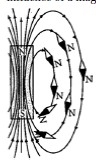
A magnetic field is described by drawing the magnetic field lines. When a small north magnetic pole is placed in the magnetic field created by a magnet, it will experience a force. And if the north pole is free, it will move under the influence of the magnetic field. The path traced by a north magnetic pole free to move under the influence of a magnetic field is called a magnetic field line.
Image

Since the direction of the magnetic field line is the direction of the force on a north pole, so the magnetic field lines always begin from the N-pole of a magnet and end on the S-pole of the magnet. Inside the magnet, however, the direction of magnetic field lines is from the S-pole of the magnet to the N-pole of the magnet. Thus, the magnetic field lines are closed curves. When a small compass is moved along a magnetic field line, the compass needle always sets itself along the line tangential to it. So, a line drawn from the south pole of the compass needle to its north pole indicates the direction of the magnetic field at that point.
(a) Do the magnetic field lines intersect? if not why?
(b) A strong bar magnet is placed vertically above a horizontal wooden board. What would be the magnetic lines of force?
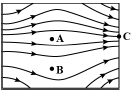
(c) The figure shows the magnetic field lines in a magnetic field. A, B., and C are three points in this field. At what point is the magnetic field strength?
Image
OR
Draw the pattern of magnetic field lines for a bar magnet.