MCQ
Radiation pressure on any surface:
  • A
    Is dependent on wavelength of the light used
  • B
    Is dependent on nature of surface and intensity of light used
  • C
    Is dependent on frequency and nature of surface
  • D
    Depends on the nature of source from which light is coming and on nature of surface on which it is falling.

Answer

  1. Is dependent on nature of surface and intensity of light used

Explanation:

Radiation pressure is given by $\text{P}_\text{R}=\frac{(1+\alpha)\text{I}}{\text{C}}$

where α is the coefficient of reflection of the surface.

For completely reflecting surface $\alpha=1$

For completely absorbing surface $\alpha=0$

So, radiation pressure depends on the nature of surface on which the light is falling but independent of wavelength of light falling.

Need a full question paper?

Generate a complete, print-ready paper with questions like this in minutes — across 16+ boards, with answer keys.

Start Generating Free

Similar questions

Fraunhofer lines are produced by

(a) The element present in the photosphere of sun

(b) The elements present in the chromosphere of the sun

(c) The vapour of the element present in the chromosphere of the sun

(d) The carbon dioxide present in the atmosphere

Two wires ‘A’ and ‘B’ of the same material have their lengths in the ratio 1 : 2 and radii in the ratio 2 : 1. The two wires are connected in parallel across a battery. The ratio of the heat produced in ‘A’ to the heat produced in ‘B’ for the same time is

(a) 1 : 2   

(b) 2 : 1

(c) 1 : 8    

(d) 8 : 1

In a semiconductor the separation between conduction band and valence band is of the order of

(a) 100 eV

(b) 10 eV

(c) 1eV    

(d) 0 eV

In the Davisson and Germer experiment, the velocity of electrons emitted from the electron gun can be increased by?
A parallel plate condenser is immersed in an oil of dielectric constant 2. The field between the plates is:

If a spherical conductor comes out from the closed surface of the sphere then total flux emitted from the surface will be

(a)  (the charge enclosed by surface)

(b)  (charge enclosed by surface)

(c)   (charge enclosed by surface)

(d) 0

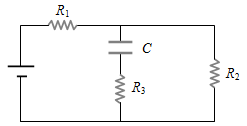
In the circuit here, the steady state voltage across capacitor C is a fraction of the battery e.m.f. The fraction is decided by

(a) R1 only

(b) R1 and R2 only

(c)  and   only

(d)  and  

A triode is operated in the linear region of its characteristics. If the plate voltage is slightly increased, the dynamic plate resistance will:
  1. Increase.
  2. Decrease.
  3. Remain almost the same.
  4. Become zero.

If  and  be the size of the images respectively for the two positions of lens in the displacement method, then the size of the object is given by

(a)  

(b)  

(c)  

(d)  

Assertion :   The stars twinkle while the planets do not.

Reason     :  The stars are much bigger in size than the planets.

(a) If both assertion and reason are true and the reason is the correct explanation of the assertion.

(b) If both assertion and reason are true but reason is not the correct explanation of the assertion.

(c) If assertion is true but reason is false.

(d) If the assertion and reason both are false.