MCQ
___________ radiations are used in LASIK eye surgery.
- AGamma
- ✓Ultraviolet
- CRadio
- DInfrared
Generate a complete, print-ready paper with questions like this in minutes — across 16+ boards, with answer keys.
Light from a hydrogen discharge tube is incident on the cathode of a photoelectric cell the work function of the cathode surface is 4.2 eV. In order to reduce the photo-current to zero the voltage of the anode relative to the cathode must be made
|
(a) – 4.2 V |
(b) – 9.4 V |
(c) – 17.8 V |
(d) +9.4 V |
$\overrightarrow{\text{F}}.\overrightarrow{\text{a}}$
$\overrightarrow{\text{v}}.\overrightarrow{\text{r}}$
$\overrightarrow{\text{a}}.\overrightarrow{\text{r}}$
$\overrightarrow{\text{F}}.\overrightarrow{\text{r}}$
Which of the following rays has the maximum frequency
|
(a) Gamma rays |
(b) Blue light |
(c) Infrared rays |
(d) Ultraviolet rays |
If an electron oscillates at a frequency of 1 GHz it gives
|
(a) X-rays |
(b) Mirowaves |
(c) Infrared rays |
(d) None of these |
In Young’s double slit experiment, the central bright fringe can be identified
|
(a) By using white light instead of monochromatic light |
|
(b) As it is narrower than other bright fringes |
|
(c) As it is wider than other bright fringes |
|
(d) As it has a greater intensity than the other bright fringes |
A proton of mass m and charge +e is moving in a circular orbit in a magnetic field with energy 1 MeV. What should be the energy of α - particle (mass = 4m and charge = + 2e), so that it can revolve in the path of same radius
|
(a) 1 MeV |
(b) 4 MeV |
(c) 2 MeV |
(d) 0.5 MeV |
Three capacitors of capacitance 1 mF, 2 mF and 3 mF are connected in series and a potential difference of 11 V is applied across the combination. Then, the potential difference across the plates of 1 mF capacitor is
|
(a) 2 V |
(b) 4 V |
(c) 1 V |
(d) 6 V |
A thermocouple of resistance 1.6Ω is connected in series with a galvanometer of 8Ω resistance. The thermocouple develops and e.m.f. of 10 μV per degree temperature difference between two junctions. When one junction is kept at 0℃ and the other in a molten metal, the galvanometer reads 8 millivolt. The temperature of molten metal, when e.m.f. varies linearly with temperature difference, will be
|
(a) 960℃ |
(b) 1050℃ |
(c) 1275℃ |
(d) 1545℃ |
The energy levels of the hydrogen spectrum is shown in figure. There are some transitions A, B, C, D and E. Transition A, B and C respectively represent
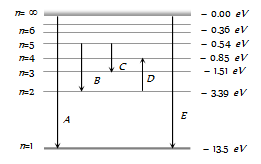
|
(a) First member of Lyman series, third spectral line of Balmer series and the second spectral line of Paschen series |
|
(b) Ionization potential of hydrogen, second spectral line of Balmer series and third spectral line of Paschen series |
|
(c) Series limit of Lyman series, third spectral line of Balmer series and second spectral line of Paschen series |
|
(d) Series limit of Lyman series, second spectral line of Balmer series and third spectral line of Paschen series |