MCQ
Radioactive substances do not emit
  • A
    Electron
  • B
    Helium nucleus
  • C
    Positron
  • Proton

Answer

Correct option: D.
Proton
d
Radioactive decay is the process by which a nucleus of an unstable atom loses energy by emitting radiation.

Alpha decay occurs when the nucleus ejects an alpha particle (helium nucleus). This is the most common process of emitting nucleons, but in rarer types of decays, nuclei can eject protons, or in the case of cluster decay specific nuclei of other elements.

Beta decay occurs when the nucleus emits an electron or positron and a neutrino, in a process that changes a proton to a neutron or the other way about. In general, protons are not emitted by a radioactive substance.

Need a full question paper?

Generate a complete, print-ready paper with questions like this in minutes — across 16+ boards, with answer keys.

Start Generating Free

Similar questions

$Assertion$ : The dimensional formula for relative velocity is same as that of the change in velocity.

$Reason$ : Relative velocity of $P$  w.r.t. $Q$ is the ratio of velocity of $P$ and that of $Q$.

Two forces of $10 \,N$ and $6 \,N$ act upon a body. The direction of the forces are unknown. The resultant force on the body may be .........$N$
If the angular velocity of earth's spin is increased such that the bodies at the equator start floating, the duration of the day would be approximately ........ minutes

(Take : $g =10 \,ms ^{-2},$ the radius of earth, $R =6400 \times 10^{3}\, m ,$ Take $\left.\pi=3.14\right)$
The moment of inertia of a solid sphere, about an axis parallel to its diameter and at a distance of $x$ from it, is $I(x)$. Which one of the graphs represents the variation of $I(x)$ with $x$ correctly?
A cylindrical region contains a uniform electric field that is along the cylinder axis and is  changing with time. If $r$ is distance from the cylinder axis the magnitude of the magnetic  field within the region is 
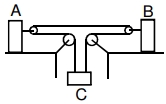
If acceleration of $A$ is $2\,m / s ^2$ to left and acceleration of $B$ is $1\,m / s ^2$ to left, then acceleration of $C$ is -
A particle is projected at $60^o $ to the horizontal with a kinetic energy $K$. The kinetic energy at the highest point is
If the dimensions of length are expressed as ${G^x}{c^y}{h^z}$; where $G,\,c$ and $h$ are the universal gravitational constant, speed of light and Planck's constant respectively, then
Find the angle between two vectors $\vec A = 2\hat i + \hat j - \hat k$ and $\vec B = \hat i - \hat k$ ....... $^o$
Graphical variation of electric field due to a uniformly charged insulating solid sphere of radius $R$, with distance $r$ from the centre $O$ is represented by: