Question
Rajiv constructs two right angled triangles in the fourth quadrant in such a way that the measure of triangle gives $\cos A=\frac{4}{5}$ and $\cos B=\frac{12}{13}$, where $\frac{3 \pi}{2} < A$ and $B > 2 \pi$.
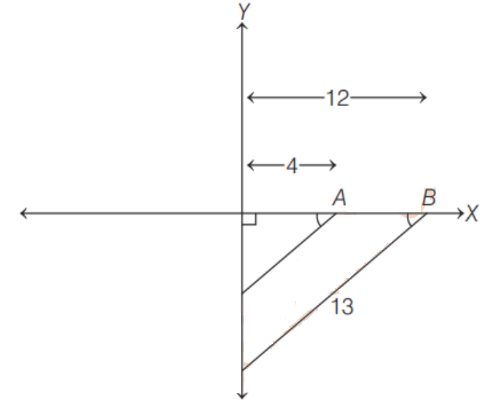
Image
Based on the above information, answer the following questions.
(i) Find the value of $\cos (A+B)$
(ii) Find the value of $\sin (A-B)$
(iii) Find the value of $\tan (\mathbf{A}+\mathbf{B})$
Answer

Given, $\cos A=\frac{4}{5}$, where $\frac{3 \pi}{2}<A<2 \pi$
$
\therefore \sin A=-\sqrt{1-\cos ^2 A}=-\frac{3}{5}
$
$\left[\because\right.$ A lies in IVth quadrant] and $\cos B=\frac{12}{13}$, where $\frac{3 \pi}{2}<B<2 \pi$
$
\therefore \sin \mathrm{B}=-\sqrt{1-\cos ^2 \mathrm{~B}}=-\frac{5}{13}
$
$[\because$ B lies in IVth quadrant]

(i)
$
\begin{aligned}
\cos (A+B)= & \frac{4}{5} \times \frac{12}{13}-\left(-\frac{3}{5}\right)\left(-\frac{5}{13}\right) \\
& {[\because \cos (A+B)=\cos A \cos B-\sin A \sin B] } \\
= & \frac{48}{65}-\frac{15}{65}=\frac{33}{65}
\end{aligned}
$

(ii)
$
\begin{aligned}
\sin (A-B)= & \left(-\frac{3}{5}\right) \times \frac{12}{13}-\frac{4}{5} \times\left(-\frac{5}{13}\right) \\
& {[\because \sin (A-B)=\sin A \cos B-\cos A \sin B] } \\
= & -\frac{36}{65}+\frac{20}{65}=-\frac{16}{65}
\end{aligned}
$

(iii)
$
\begin{aligned}
\because \sin (A+B)= & \left(-\frac{3}{5}\right) \cdot\left(\frac{12}{13}\right)+\left(\frac{4}{5}\right) \cdot\left(-\frac{5}{13}\right) \\
& {[\because \sin (A+B)=\sin A \cos B+\cos A \sin B] }
\end{aligned}
$
$
\begin{aligned}
&=\frac{-36-20}{5 \times 13}=-\frac{56}{65} \\
& \therefore \tan (A+B)= \frac{-\frac{56}{65}}{\frac{33}{65}}=-\frac{56}{33} \\
& {\left[\because \tan (A+B)=\frac{\sin (A+B)}{\cos (A+B)}\right] }
\end{aligned}
$

Need a full question paper?

Generate a complete, print-ready paper with questions like this in minutes — across 16+ boards, with answer keys.

Start Generating Free

Similar questions

An analysis of monthly wages paid to workers in two firms $A$ and $B,$ belonging to the same industry, gives the following results:
Particulars Firm $A$ Firm $B$
No. of wage earners $586$ $648$
Mean of monthly wages $₹ 5253$ $₹ 5253$
Variance of the distribution of wages $100$ $121$

Image

$i$. Which firm $A$ or $B$ shows greater variability in individual wages? $(1)$
$ii$. Find the standard deviation of the distribution of wages for frim $B.\ (1)$
$iii$. Find the coefficient of variation of the distribution of wages for firm $A. \ (2)$
OR
Find the amount paid by firm $A. \ (2$)
Republic day is a national holiday of India. It honours the date on which the constitution of India came into effect on 26 January 1950 replacing the Government of India Act (1935) as the governing document of India and thus, turning the nation into a newly formed republic.

Answer the following question, which are based on the word "REPUBLIC".


(i) Find the number of arrangements of the letters of the word 'REPUBLIC'.
(a) 40300     (b) 30420    (c) 40320     (d) 40400

(ii) How many arrangements start with a vowel?
(a) 12015     (b) 15120     (c) 12018     (d) 15100

(iii) Which concept is used for finding the arrangements start with a vowel?
(a) Permutation     (b) FPM     (c) Combination     (d) FPA

(iv) If the number of arrangements of the letters of the word 'REPUBLIC' is abcde, the (a + b + $\mathbf{c}+\mathbf{d}+\mathbf{e})$ is
(a) 10     (b) 9     (c) 8     (d) 15

(v) If the number of arrangements start with a vowel is abcde, then $(\mathbf{a}+\mathbf{b})-(\mathbf{d}+\mathbf{e})$ is
(a) 2     (b) 3     (c) 4     (d) 5
Four friends Dinesh, Yuvraj, Sonu, and Rajeev are playing cards. Dinesh, shuffling a cards and told to Rajeev choose any four cards. 
Image
$i$. What is the probability that Rajeev getting all face card. $(1)$
$ii$. What is the probability that Rajeev getting two red cards and two black card. $(1)$
$iii$. What is the probability that Rajeev getting one card from each suit. $(2)$
OR
What is the probability that Rajeev getting two king and two Jack cards. $(2)$
The school organised a farewell party for $100$ students and school management decided three types of drinks will be distributed in farewell party ie. Milk $(M),$ Coffee $(C)$ and Tea $(T)$. Organiser reported that $10$ students had all the three drinks $M, C, T. 20$ students had $M$ and $C; 30$ students had $C$ and $T; 25$ students had $M$ and $T. 12$ students.had $M$ only; $5$ students had $C$ only; $8$ students had $T$ only.

Based on the above information, answer the following questions.
  1. The number of students who did not take any drink, is
  1. $20$
  2. $30$
  3. $10$
  4. $25$
  1. The number of students who prefer Milk is
  1. $47$
  2. $45$
  3. $53$
  4. $50$
  1. The number of students who prefer Coffee is
  1. $47$
  2. $53$
  3. $45$
  4. $50$
  1. The number of students who prefer Tea is
  1. $51$
  2. $53$
  3. $50$
  4. $47$
  1. The number of students who prefer Milk and Coffee but not tea is
  1. $12$
  2. $10$
  3. $15$
  4. $20$
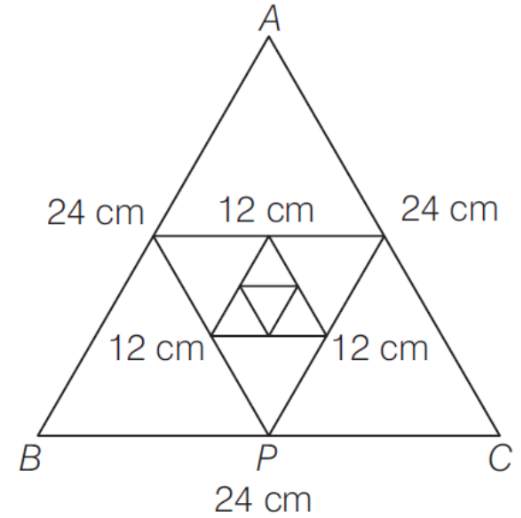
Each side of an equilateral triangle is $24 \mathrm{~cm}$. The mid-point of its sides are joined to form another triangle. This process is going continuously infinite.
Image
Based on above information, answer the following questions.

(i) The side of the 5th triangle is (in $\mathrm{cm}$)
    (a) 3     (b) 6     (c) 1.5     (d) 0.75

(ii) The sum of perimeter of first 6 triangle is (in $\mathrm{cm}$)
    (a) $\frac{569}{4}$     (b) $\frac{567}{4}$     (c) 120     (d) 144

(iii) The area of all the triangle is (in sq $\mathrm{cm}$ )
    (a) 576     (b) $192 \sqrt{3}$     (c) $144 \sqrt{3}$     (d) $169 \sqrt{3}$

(iv) The sum of perimeter of all triangle is (in $\mathrm{cm}$ )
    (a) 144     (b) 169     (c) 400     (d) 625

(v) The perimeter of 7 th triangle is (in $\mathrm{cm}$ )
    (a) $\frac{7}{8}$     (b) $\frac{9}{8}$     (c) $\frac{5}{8}$     (d) $\frac{3}{4}$
A company produces 500 computers in the third year and 600 computers in the seventh year. Assuming that the production increases uniformly by a constant number every year.
Image
Based on the above information, answer the following questions.

(i) The value of the fixed number by which production is increasing every year is
    (a) 25     (b) 20     (c) 10     (d) 30

(ii) The production in first year is
    (a) 400     (b) 250     (c) 450     (d) 300

(iii) The total production in 10 years is
    (a) 5625     (b) 5265     (c) 2655     (d) 6525

(iv) The number of computers produced in 21 st year is
    (a) 650     (b) 700     (c) 850     (d) 950

(v) The difference in number of computers produced in 10th year and 8th year is
    (a) 25     (b) 50     (c) 100     (d) 75
In a library, $25$ students read physics, chemistry and mathematics books. It was found that $15$ students read mathematics, $12$ students read physics while $11$ students read chemistry. $5$ students read both mathematics and chemistry, $9$ students read physics and mathematics. $4$ students read physics and chemistry and $3$ students read all three subject books.

Based on the above information, answer the following questions.
  1. The number of students who reading only chemistry is:
  1. $5$
  2. $4$
  3. $2$
  4. $1$
  1. The number of students who reading only mathematics is:
  1. $4$
  2. $3$
  3. $5$
  4. $11$
  1. The number of students who reading only one of the subjects is:
  1. $5$
  2. $11$
  3. $8$
  4. $6$
  1. The number of students who reading atleast one of the subject is:
  1. $20$
  2. $22$
  3. $23$
  4. $21$
  1. The number of students who reading none of the subject is:
  1. $2$
  2. $4$
  3. $3$
  4. $5$
Consider the data.
Class Frequency
$0-10$ $6$
$10-20$ $7$
$20-30$ $ 15$
$30-40$ $ 16$
$40-50$ $4$
$50-60$ $2$
$i$. Find the mean deviation about median. $(1)$
$ii$. Find the Median. $(1)$
$iii$. Write the formula to calculate the Mean deviation about median? $(2)$
OR
Write the formula to calculate median? $(2)$