Question
✓
Answer
i. Number of relations $=2^{ mn }$
$=2^{3 \times 6}=2^{18}$
ii. Number of relations $=2^{ mn }$
$=2^{2 \times 2}=2^4=16$
iii. $R=\{(x, y): x \in P, y \in Q$ and $x$ is the square of $y\}$
|OR
Here, W denotes the set of whole numbers.
We have $2 a + b =5$ where $a , b \in W$
$\therefore a=0 \Rightarrow b=5$
$\Rightarrow a=1 \Rightarrow b=5-2=3$
and $a =2 \Rightarrow b=1$
For a > 3, the values of b given by the above relation are not whole numbers.
$\therefore A =\{(0,5),(1,3),(2,1)\}$
$=2^{3 \times 6}=2^{18}$
ii. Number of relations $=2^{ mn }$
$=2^{2 \times 2}=2^4=16$
iii. $R=\{(x, y): x \in P, y \in Q$ and $x$ is the square of $y\}$
|OR
Here, W denotes the set of whole numbers.
We have $2 a + b =5$ where $a , b \in W$
$\therefore a=0 \Rightarrow b=5$
$\Rightarrow a=1 \Rightarrow b=5-2=3$
and $a =2 \Rightarrow b=1$
For a > 3, the values of b given by the above relation are not whole numbers.
$\therefore A =\{(0,5),(1,3),(2,1)\}$
Need a full question paper?
Generate a complete, print-ready paper with questions like this in minutes — across 16+ boards, with answer keys.
Explore more
Similar questions
→→
A satellite dish has a shape called a paraboloid, where each cross section is parabola. Since radio signals $($parallel to axis$)$ will bounce off the surface of the dish to the focus, the receiver should be placed at the focus. The dish is $12$ ft across, and $4.5$ ft deep at the vertex
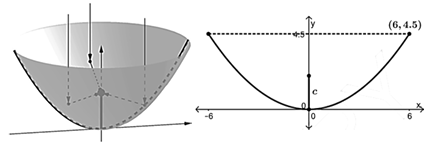
$i$. Name the type of curve given in the above paragraph and find the equation of curve? $(1)$
$ii.$ Find the equation of parabola whose vertex is $(3, 4)$ and focus is $(5, 4). (1)$
$iii.$ Find the equation of parabola Vertex $(0, 0)$ passing through $(2, 3)$ and axis is along $x-$ axis. and also find the length of latus rectum. $(2)$
OR
$iv$. Find focus, length of latus rectum and equation of directrix of the parabola $x^2=8 y. (2)$
→$i$. Name the type of curve given in the above paragraph and find the equation of curve? $(1)$
$ii.$ Find the equation of parabola whose vertex is $(3, 4)$ and focus is $(5, 4). (1)$
$iii.$ Find the equation of parabola Vertex $(0, 0)$ passing through $(2, 3)$ and axis is along $x-$ axis. and also find the length of latus rectum. $(2)$
OR
$iv$. Find focus, length of latus rectum and equation of directrix of the parabola $x^2=8 y. (2)$
Consider the graphs of the functions f(x), h(x) and g(x).
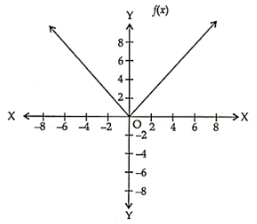
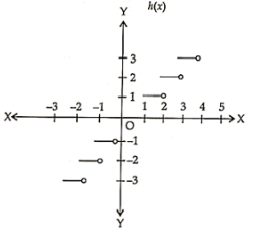
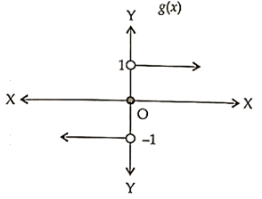
i. Find the range of h(x). (1)
ii. Find the domain of f(x). (1)
iii. Find the value of f(10). (2)
OR
Find the range of g(x). (2)
i. Find the range of h(x). (1)
ii. Find the domain of f(x). (1)
iii. Find the value of f(10). (2)
OR
Find the range of g(x). (2)
On her vacation, Priyanka visits four cities. Delhi, Lucknow, Agra, Meerut in a random order.
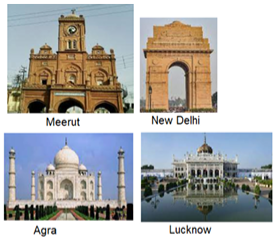
$i$. What is the probability that she visits Delhi before Lucknow? $(1)$
$ii$. What is the probability she visit Delhi before Lucknow and Lucknow before Agra? $(1)$
$iii.$ What is the probability she visits Delhi first and Lucknow last? $(2)$
OR
What is the probability she visits Delhi either first or second? $(2)$
→$i$. What is the probability that she visits Delhi before Lucknow? $(1)$
$ii$. What is the probability she visit Delhi before Lucknow and Lucknow before Agra? $(1)$
$iii.$ What is the probability she visits Delhi first and Lucknow last? $(2)$
OR
What is the probability she visits Delhi either first or second? $(2)$
To find the limits of trigonometric functions, we use the following theorems
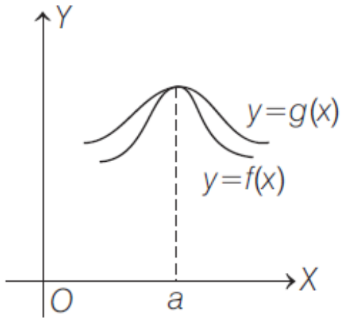
Theorem 1: Let $f$ and $g$ be two real valued functions with the same domain such that $f(x) \leq g(x)$ for all $x$ in the domain of definition. For some real number $a$, if both $\lim _{x \rightarrow a} f(x)$ and $\lim _{x \rightarrow a} g(x)$ exist, then
$
\lim _{x \rightarrow a} f(x) \leq \lim _{x \rightarrow a} g(x) .
$
This is shown in the figure
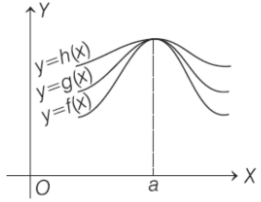
Theorem 2 (Sandwich theorem) : Let $f, g$ and $h$ be real functions such that $f(x) \leq g(x) \leq h(x)$ for all $x$ in the common domain of definition. For some real number $a$, if $\lim _{x \rightarrow a} f(x)=l=\lim _{x \rightarrow a} h(x)$, then $\lim _{x \rightarrow a} g(x)=l$.
This is shown in the figure
Theorem 3 : Three important limits are
(i) $\lim _{x \rightarrow 0} \frac{\sin x}{x}=1$
(ii) $\lim _{x \rightarrow 0} \frac{\frac{x}{1-\cos x}}{x}=0$
(iii) $\lim _{x \rightarrow 0} \frac{\tan ^x x}{x}=1$
Based on above information, answer the following questions.
(i) $\lim _{x \rightarrow 0} \frac{\sin 3 x}{5 x}$ is equal to
(a) $\frac{1}{5}$ (b) $\frac{2}{5}$ (c) $\frac{3}{5}$ (d) $\frac{4}{5}$
(ii) $\lim _{\theta \rightarrow b} \frac{\tan (\theta-b)}{\theta-b}$ is equal to
(a) 0 (b) 1 (c) 2 (d) 3
(iii) $\lim _{x \rightarrow 0} \frac{\tan 2 x-\sin 2 x}{x^3}$ is equal to
(a) 4 (b) 3 (c) 2 (d) 1
(iv) $\lim _{x \rightarrow 0} \frac{2 \sin x-\sin 2 x}{x^3}$ is equal to
(a) 0 (b) 1 (c) 2 (d) 3
(v) $\lim _{x \rightarrow \frac{\pi}{4}} \frac{\sin x-\cos x}{x-\frac{\pi}{4}}$ is equal to
(a) $\sqrt{2}$ (b) 3 (c) 1 (d) $\sqrt{3}$
→Theorem 1: Let $f$ and $g$ be two real valued functions with the same domain such that $f(x) \leq g(x)$ for all $x$ in the domain of definition. For some real number $a$, if both $\lim _{x \rightarrow a} f(x)$ and $\lim _{x \rightarrow a} g(x)$ exist, then
$
\lim _{x \rightarrow a} f(x) \leq \lim _{x \rightarrow a} g(x) .
$
This is shown in the figure
Theorem 2 (Sandwich theorem) : Let $f, g$ and $h$ be real functions such that $f(x) \leq g(x) \leq h(x)$ for all $x$ in the common domain of definition. For some real number $a$, if $\lim _{x \rightarrow a} f(x)=l=\lim _{x \rightarrow a} h(x)$, then $\lim _{x \rightarrow a} g(x)=l$.
This is shown in the figure
Theorem 3 : Three important limits are
(i) $\lim _{x \rightarrow 0} \frac{\sin x}{x}=1$
(ii) $\lim _{x \rightarrow 0} \frac{\frac{x}{1-\cos x}}{x}=0$
(iii) $\lim _{x \rightarrow 0} \frac{\tan ^x x}{x}=1$
Based on above information, answer the following questions.
(i) $\lim _{x \rightarrow 0} \frac{\sin 3 x}{5 x}$ is equal to
(a) $\frac{1}{5}$ (b) $\frac{2}{5}$ (c) $\frac{3}{5}$ (d) $\frac{4}{5}$
(ii) $\lim _{\theta \rightarrow b} \frac{\tan (\theta-b)}{\theta-b}$ is equal to
(a) 0 (b) 1 (c) 2 (d) 3
(iii) $\lim _{x \rightarrow 0} \frac{\tan 2 x-\sin 2 x}{x^3}$ is equal to
(a) 4 (b) 3 (c) 2 (d) 1
(iv) $\lim _{x \rightarrow 0} \frac{2 \sin x-\sin 2 x}{x^3}$ is equal to
(a) 0 (b) 1 (c) 2 (d) 3
(v) $\lim _{x \rightarrow \frac{\pi}{4}} \frac{\sin x-\cos x}{x-\frac{\pi}{4}}$ is equal to
(a) $\sqrt{2}$ (b) 3 (c) 1 (d) $\sqrt{3}$
Method to Find the Sets When Cartesian Product is Given For finding these two sets, we write first element of each ordered pair in first set say $A$ and corresponding second element in second set $B ($say$).$ Number of Elements in Cartesian Product of Two Sets If there are p elements in set $A$ and $g$ elements in set $B,$ then there will be $pq$ elements in $A . B$ i.e. if $n(A) = p$ and $n(B) = q,$ then $n(A . B) = pq.$
Based on the above two topic, answer the following questions.
→Based on the above two topic, answer the following questions.
- If $A . B = \{(a, 1), (b, 3), (a, 3), (b, 1), (a, 2), (b, 2)\}.$ Then, $A$ and $B$ are:
- $\{1, 3, 2\}, \{a, b\}$
- $\{a, b\}, \{1, 3\}$
- $\{a, b\}, \{1, 3, 2\}$
- None of these
- If the set $A$ has $3$ elements and set $B$ has $4$ elements, then the number of elements in $A . B$ is:
- $3$
- $4$
- $7$
- $12$
- $A$ and $B$ are two sets given in such a way that $A . B$ contains $6$ elements. If three elements of $A . B$ are $(1, 3), (2, 5)$ and $(3, 3)$, then $A, B$ are:
- $\{1, 2, 3\}, \{3, 5\}$
- $\{3, 5,\}, \{1, 2, 3\}$
- $\{1, 2\}, \{3, 5\}$
- $\{1, 2, 3\}, \{5\}$
- The remaining elements of $A . B$ in $(iii)$ is:
- $(5, 1), (3, 2), (3, 5)$
- $(1, 5), (2, 3), (3, 5)$
- $(1, 5), (3, 2), (5, 3)$
- None of the above
- The cartesian product $P . P$ has $16$ elements among which are found $(a, 1)$ and $(b, 2).$ Then, the set $P$ is:
- $\{a, b\}$
- $\{1, 2\}$
- $\{a, b,1, 2\}$
- $\{0, b, 1, 2, 4\}$
There are $4$ red, $5$ blue and $3$ green marbles in a basket.
$i.$ If two marbles are picked at randomly, find the probability that both red marbles. $(1)$
$ii.$ If three marbles are picked at randomly, find the probability that all green marbles. $(1)$
$iii$. If two marbles are picked at randomly then find the probability that both are not blue marbles. $(2)$
OR
If three marbles are picked at randomly, then find the probability that atleast one of them is blue. $(2)$
→$i.$ If two marbles are picked at randomly, find the probability that both red marbles. $(1)$
$ii.$ If three marbles are picked at randomly, find the probability that all green marbles. $(1)$
$iii$. If two marbles are picked at randomly then find the probability that both are not blue marbles. $(2)$
OR
If three marbles are picked at randomly, then find the probability that atleast one of them is blue. $(2)$
The logarithmic function expressed as $\log _e R^{+} \rightarrow R$ and given by $\log _e x=y$ iff $e^y=x$. The graph of the function is given below :
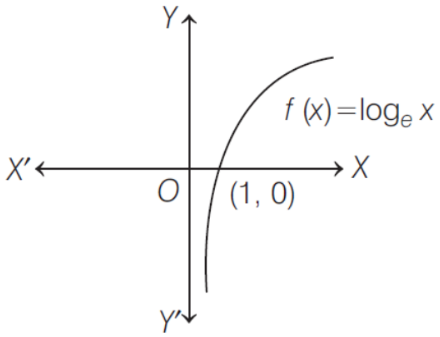
(i) Domain of $f(x)=(0, \infty)$ or $R^{+}$
(ii) Range of $f(x)=(-\infty, \infty)$ or $R$
To find the limit of functions involving logarithmic function, we use the following theorem Theorem $\lim _{x \rightarrow 0} \frac{\log _e(1+x)}{x}=1$
Based on above information, answer the following questions.
(i) $\lim _{x \rightarrow 0} \frac{\log _e(1+5 x)}{x}$ is equal to
(a) 5 (b) 4 (c) 3 (d) 1
(ii) $\lim _{x \rightarrow 0} \frac{\log _e(1+6 x)-5 x^2}{x}$ is equal to
(a) 1 (b) 2 (c) 3 (d) 6
(iii) $\quad \lim _{x \rightarrow 0} \frac{\sqrt{1+x}-1}{\log (1+x)}$ is equal to
(a) 1 (b) $\frac{1}{2}$ (c) $\frac{1}{3}$ (d) $\frac{3}{2}$
(iv) $\quad \lim _{x \rightarrow 5} \frac{\log x-\log 5}{x-5}$ is equal to
(a) $\frac{1}{5}$ (b) $\frac{3}{5}$ (c) $\frac{1}{4}$ (d) $\frac{2}{3}$
(v) $\quad \lim _{x \rightarrow 0} \frac{\log (5+x)-\log (5-x)}{x}$ is equal to
(a) $\frac{1}{5}$ (b) $\frac{2}{5}$ (c) $\frac{3}{5}$ (d) $\frac{4}{5}$
→(i) Domain of $f(x)=(0, \infty)$ or $R^{+}$
(ii) Range of $f(x)=(-\infty, \infty)$ or $R$
To find the limit of functions involving logarithmic function, we use the following theorem Theorem $\lim _{x \rightarrow 0} \frac{\log _e(1+x)}{x}=1$
Based on above information, answer the following questions.
(i) $\lim _{x \rightarrow 0} \frac{\log _e(1+5 x)}{x}$ is equal to
(a) 5 (b) 4 (c) 3 (d) 1
(ii) $\lim _{x \rightarrow 0} \frac{\log _e(1+6 x)-5 x^2}{x}$ is equal to
(a) 1 (b) 2 (c) 3 (d) 6
(iii) $\quad \lim _{x \rightarrow 0} \frac{\sqrt{1+x}-1}{\log (1+x)}$ is equal to
(a) 1 (b) $\frac{1}{2}$ (c) $\frac{1}{3}$ (d) $\frac{3}{2}$
(iv) $\quad \lim _{x \rightarrow 5} \frac{\log x-\log 5}{x-5}$ is equal to
(a) $\frac{1}{5}$ (b) $\frac{3}{5}$ (c) $\frac{1}{4}$ (d) $\frac{2}{3}$
(v) $\quad \lim _{x \rightarrow 0} \frac{\log (5+x)-\log (5-x)}{x}$ is equal to
(a) $\frac{1}{5}$ (b) $\frac{2}{5}$ (c) $\frac{3}{5}$ (d) $\frac{4}{5}$
A class teacher Mamta Sharma of class $XI$ write three sets $A, B$ and Care such that $A = \{1, 3, 5, 7, 9\}, B = \{2, 4, 6, 8\}$ and $C = \{2, 3, 5, 7, 11\}.$
Answer the following questions which are based on above sets.
→Answer the following questions which are based on above sets.
- Find $\text{A}\cap\text{B}.$
- $\{3, 5, 7\}$
- $\phi$
- $\{1, 5, 7\}$
- $\{2, 5, 7\}$
- Find $\text{A}\cap\text{C}.$
- $\{3, 5, 7\}$
- $\{1, 5, 7\}$
- $\phi$
- $\{3, 4, 7\}$
- Which of the following is correct for two sets $A$ and $B$ to be disjoint?
- $\text{A}\cap\text{B}=\phi$
- $\text{A}\cap\text{B}\neq\phi$
- $\text{A}\cup\text{B}=\phi$
- $\text{A}\cup\text{B}\neq\phi$
- Which of the following is correct for two sets $A$ and $C$ to be intersecting?
- $\text{A}\cap\text{C}=\phi$
- $\text{A}\cap\text{C}\neq\phi$
- $\text{A}\cup\text{C}=\phi$
- $\text{A}\cup\text{C}\neq\phi$
- Write the $n[P(B)].$
- $8$
- $4$
- $16$
- $12$
Read the following text carefully and answer the questions that follow:
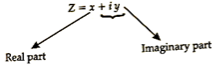
A number of the form $Z=x+i y$, where $x$ and $y$ are real and $i=\sqrt{-1}$ is called a complex number. Consider the complex number $Z_1=2+3 i$ and $Z_2=4-3 i$.
$i$. Find the imaginary part of $Z_1 \overline{Z_1}... (1)$
$ii$. Find the real part of $\frac{z_1}{z_2}. (1)$
$iii$. Find the imaginary part of $Z_1-Z_2. (2)$
OR
Find the real part of $Z _1. (2)$
→A number of the form $Z=x+i y$, where $x$ and $y$ are real and $i=\sqrt{-1}$ is called a complex number. Consider the complex number $Z_1=2+3 i$ and $Z_2=4-3 i$.
$i$. Find the imaginary part of $Z_1 \overline{Z_1}... (1)$
$ii$. Find the real part of $\frac{z_1}{z_2}. (1)$
$iii$. Find the imaginary part of $Z_1-Z_2. (2)$
OR
Find the real part of $Z _1. (2)$