Question
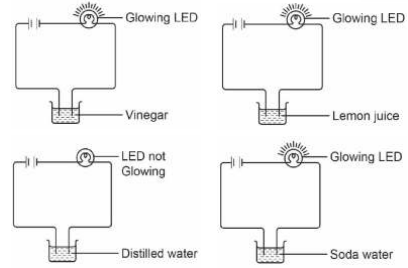
Rashmi made separate electric circuits with four different solutions.
The pictures show what she found.
Image

$4.$ What can be concluded from her activity$?$
$A. LED$ glows only in solutions
$B.$ All four solutions are insulators of electricity
$C.$ All four solutions are good conductors of electricity
$D.$ Acids and bases are good conductors of electricity
$5.$ Which safety precaution must Rashmi follow while doing this activity$?$
$A.$ Wear boots
$B.$ Wear goggles
$C.$ Wear headphones
$D.$ Wear rubber gloves
$6.$ Will an electric device work if we place the positive terminal of a battery towards the negative point of the device? Explain your answer.
Answer

$4. D.$ Acids and bases are good conductors of electricity
$5. D.$ Wear rubber gloves
$6.$ Mentions that the electric device will not work as there will be insuficient current low from the battery to the device.
For example:
● The electric device will not work as there will be insuficient current low from the battery to the device.

Need a full question paper?

Generate a complete, print-ready paper with questions like this in minutes — across 16+ boards, with answer keys.

Start Generating Free

Similar questions

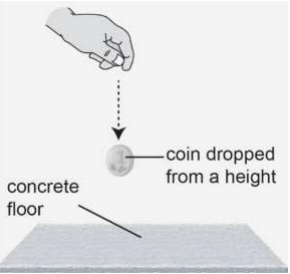
Mayank dropped four coins from the same height onto a concrete floor.
Image

The table below shows the type of sound that each coin produced after hitting the floor.
Coin Temperature of the ball when heated for a minute
Coin $1$ Ringing sound
Coin $2$ Damp sound
Coin $3$ Damp sound
Coin $4$ Ringing sound
$9.$ Which coins in Mayank’s activity are made of metal$?$
$A.$ Coin $1$ and Coin $2$
$B.$ Coin $2$ and Coin $3$
$C.$ Coin $3$ and Coin $4$
$D$. Coin $4$ and Coin $1$
$10.$ On which type of loor will Mayank’s activity produce the same results$?$
$A.$ Glass
$B.$ Sand
$C.$ Grass
$D.$ Carpet
The table shows the properties of four water samples.
Water Sample Smell Colour
Sample $1$ No smell Slightly muddy
Sample $2$ Strong bad smell Muddy and greenish
Sample $3$ Very light smell Colourless
Sample $4$ No smell Colourless
$6$. Which water sample is likely to be least polluted$?$
$A.$ Sample $1$
$B.$ Sample $2$
$C$. Sample $ 3$
$D$. Sample $4$
$7.$ In which water source will the survival of aquatic animals be the most dificult$?$
$A.$ Source of Sample $1$
$B.$ Source of Sample $2$
$C.$ Source of Sample $3$
$D.$ Source of Sample $4$
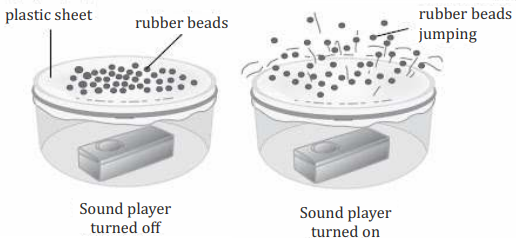
Raghav kept a mini sound player in each of two similar containers.
He then tightly covered both the containers with stretched plastic sheets.
He placed some tiny rubber beads on the surface of the sheets.
The picture shows what Raghav noticed when he turned on the sound player.

Image
$3.$ Which of these questions can be answered using the result of Raghav’s activity$?$
$A.$ Does sound travel as waves$?$
$B.$ Does sound produce vibration$?$
$C.$ Does sound travel through vacuum$?$
$D.$ Does sound travel faster in solids than in gases$?$
$4.$ Would the result of Raghav’s activity change if fewer beads had been used$?$ Explain your answer.
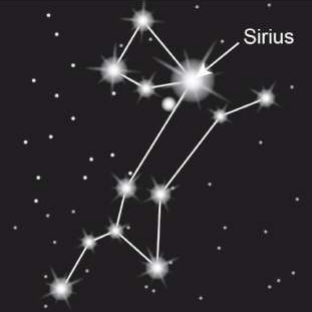
The picture shows how a part of the Moon $(X)$ is seen as it rotates around the Earth.

Image
$5.$ What is the word used for this type of imaginary igures$?$
$A.$ Galaxy
$B.$ Supernova
$C.$ Constellation
$D.$ Solar System
$6.$ Sirius is twice as large as the Sun.
Why does it appear so small from the Earth$?$
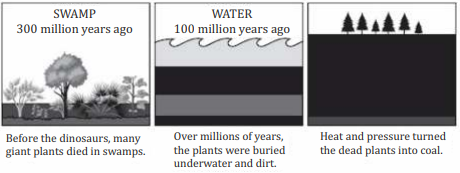
The table shows two groups of natural resources.
Image
$3.$ Which of these statements is true about coal?
Circle ‘Yes’ or ‘No’ for the correct response.
Is this true about coal? Yes or No
Dirt makes up a large part of coal. Yes/No
Coal is produced from plant fossils. Yes/No
Formation of coal requires heat and pressure. Yes/No
$4.$ Where is a coal reserve most likely to be found$?$
$A.$ Inside volcanoes
$B.$ Beneath glaciers
$C.$ On ocean loors
$D.$ Under land surfaces
$5.$ Which gas is mainlyemitted during the combustion of coal$?$
$6.$ Coke is a product obtained by the processing of coal.
Which of these is a by-product of making coke$?$
$A.$ Coal tar
$B.$ Bitumen
$C.$ Coal gas
$D.$ Kerosene
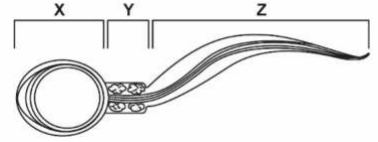
The picture shows the basic parts of a salmon ish sperm.

Image
$7.$ Which part of the sperm helps it to swim in water and reach the egg$?$
$8.$ Which of these animals reproduce by external fertilization?
$A.$ Snake
$B.$ Frog
$C.$ Horse
$D.$ Elephant
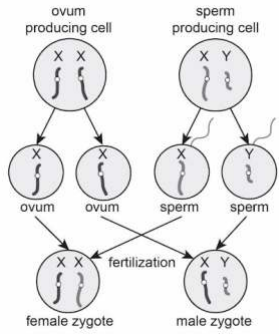
An ovum contains one $X$ chromosome.
A sperm contains an $X$ or a $Y$ chromosome.
A sperm can fertilize an ovum to produce two different zygotes.
Image
$1.$ Which chromosome does the female zygote receive from the mother and the father$?$
  Mother Father
$A.$ $X$ chromosome $Y$ chromosome
$B.$ $Y$ chromosome $X$ chromosome
$C.$ $X$ chromosome $X$ chromosome
$D.$ $Y$ chromosome $Y$ chromosome
$2.$ In which body part of a woman does a fertilized ovum get embedded$?$
$3.$ Which of these statements is supported by the picture$?$
Circle ‘Yes’ or ‘No’ for the correct response.
Is this Statement Supported by the Picture$?$ Yes or No
The father’s sperm decides the gender of the zygote. Yes/No
The $Y$ chromosome is shorter than the $X$ chromosome. Yes/No
An ovum unites with two sperms at a time Yes/No
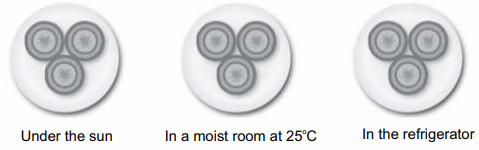
Suman wants to see how quickly carrots lose colour. Loss of colour shows rotting of carrot.
She observes carrot slices on a plate under three different conditions as shown below.Image

She notes how long the carrot slices on each plate take to change colour.
  Under the sun In a moist room at $25^\circ C$ In the refrigerator
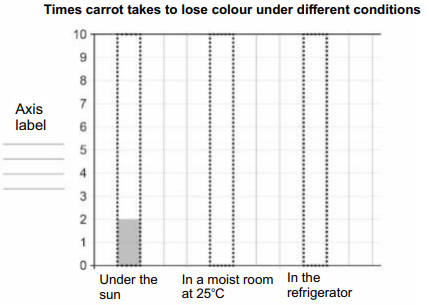
Time carrot slices take to change colour $2$ days $5$ days $8$ days
$3.$ What can Suman conclude from her activity$?$
$A.$ Carrots when kept under the sun do not rot easily.
$B.$ Carrots at room temperature lose colour more quickly.
$C.$ Carrots can be best preserved in hot and moist conditions.
$D.$ Carrots take more time to lose colour under cold conditions.
$4.$ Use the results of the activity to inish the graph below. The irst bar is drawn for you.
Put a label in the space provided for the axis on the left.
Image
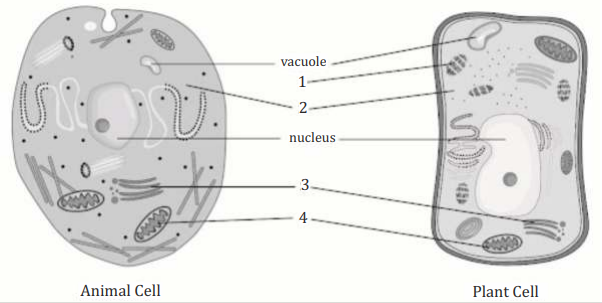
The picture shows some labelled parts of an animal cell and a plant cell.
$1, 2, 3$ and $4$ are different parts of the cells.
Image
$6.$ Which labelled part is a chloroplast$?$
$A. 1$
$B. 2$
$C. 3$
$D. 4$
$7.$ Which of these statements is supported by the picture$?$
$A.$ Vacuoles in animal cells are smaller than in plant cells.
$B.$ Nucleus of animal cells is much larger than that of plant cells.
$C.$ Animal cells have a ixed shape but plant cells have irregular shape.
$D. $ Animal cells have two outer layers but plant cells have only one outer layer.
$8.$ Rakesh has brown eyes.
Which labelled part contains the components responsible for this feature$?$
$9.$ Which of these is a feature found onlyin prokaryotic cells$?$
$A.$ Absence of cell wall
$B.$ Absence of nucleus
$C.$ Presence of vacuoles
$D.$ Presence of mitochondria
$10.$ Which of these correctly describes a protoplasm$?$
$A.$ Nucleus only
$B.$ Nucleus and cell membrane
$C.$ Nucleus and other cell organelles
$D.$ Nucleus, cytoplasm and cell membrane
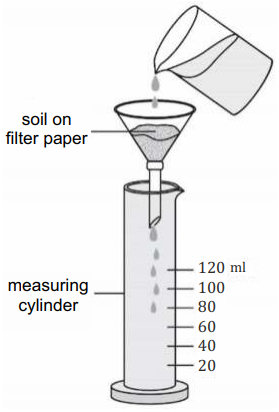
Soham investigates the water holding capacity of four different types of soils.
He sets up an experiment for each type of soil as shown in the diagram.
Soham records his observation in a table.
Image
  Soil type
Clay Loam Sand Silt
Amount of water added to the soil (ml) $150$ $150$ $150$ $150$
Amount of water collected in the measuring cylinder (ml) $30$ $60$ $105$ $50$
$8.$ Which type of soil absorbs the most water?
$A.$ Clay
$B.$ Loam
$C.$ Sand
$D.$ Silt
$9.$ Soham added the same amount of water to each type of soil.
State one more thing that Soham needs to keep the same in his experiment.