Question
The table shows the properties of four water samples.
Water Sample Smell Colour
Sample $1$ No smell Slightly muddy
Sample $2$ Strong bad smell Muddy and greenish
Sample $3$ Very light smell Colourless
Sample $4$ No smell Colourless
$6$. Which water sample is likely to be least polluted$?$
$A.$ Sample $1$
$B.$ Sample $2$
$C$. Sample $ 3$
$D$. Sample $4$
$7.$ In which water source will the survival of aquatic animals be the most dificult$?$
$A.$ Source of Sample $1$
$B.$ Source of Sample $2$
$C.$ Source of Sample $3$
$D.$ Source of Sample $4$
Answer

$6. D.$ Sample $4$
$7. B.$ Source of Sample $2$

Need a full question paper?

Generate a complete, print-ready paper with questions like this in minutes — across 16+ boards, with answer keys.

Start Generating Free

Similar questions

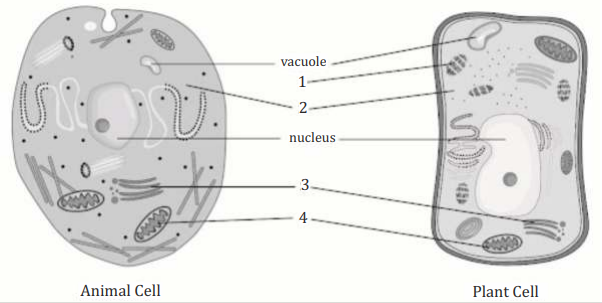
The picture shows some labelled parts of an animal cell and a plant cell.
$1, 2, 3$ and $4$ are different parts of the cells.
Image
$6.$ Which labelled part is a chloroplast$?$
$A. 1$
$B. 2$
$C. 3$
$D. 4$
$7.$ Which of these statements is supported by the picture$?$
$A.$ Vacuoles in animal cells are smaller than in plant cells.
$B.$ Nucleus of animal cells is much larger than that of plant cells.
$C.$ Animal cells have a ixed shape but plant cells have irregular shape.
$D. $ Animal cells have two outer layers but plant cells have only one outer layer.
$8.$ Rakesh has brown eyes.
Which labelled part contains the components responsible for this feature$?$
$9.$ Which of these is a feature found onlyin prokaryotic cells$?$
$A.$ Absence of cell wall
$B.$ Absence of nucleus
$C.$ Presence of vacuoles
$D.$ Presence of mitochondria
$10.$ Which of these correctly describes a protoplasm$?$
$A.$ Nucleus only
$B.$ Nucleus and cell membrane
$C.$ Nucleus and other cell organelles
$D.$ Nucleus, cytoplasm and cell membrane
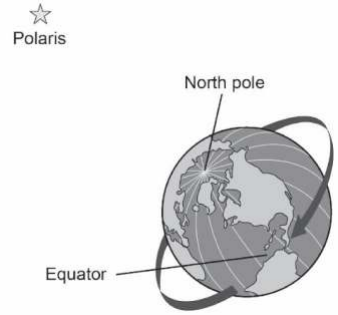
Polaris is a star that always appear at the same point in the night sky.
Image

$7.$ Why does Polaris appear at the same location over time$?$
$A.$ It is a part of our solar system
$B.$ It is too far away from the Earth
$C.$ It is situated along the Earth’s axis
$D.$ It is held in its position by the Earth’s gravity
$8.$ What is Polaris commonly known as$?$
The picture shows the relative size of different types of cells between $100\ nm$ and $100\ mm.$
Image
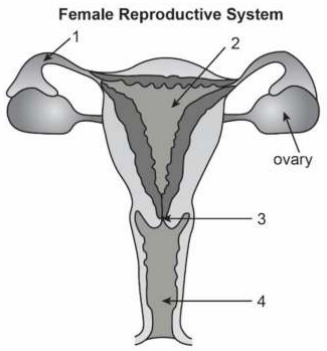
$1$. A mature egg and a sperm unite to form a zygote.
In which part of the female reproductive system does a zygote form$?$
$A. 1$
$B. 2$
$C. 3$
$D. 4$
$2.$ How many eggs are usually released each month by the ovary of a woman$?$
$A.$ One
$B.$ Two
$C.$ Fourteen
$D.$ Twenty-four
$3.$ In which part of the female reproductive system does an embryo implant$?$
$A. 1$
$B. 2$
$C. 3$
$D. 4$
$4.$ Which of these statements is true about a foetus$?$
Circle ‘Yes’ or ‘No’ for the correct response.
Is this statement true about a foetus? Yes or No
All body parts can be identiied properly Yes/No
It is covered by a hard shell of protective layers. Yes/No
It resembles a large ball made of millions of cells. Yes/No
$5.$ Where does the fertilisation of egg occur in the process of In Vitro Fertilisation $(IVF)?$
$A.$ Ovary
$B.$ Water
$C.$ Uterus
$D.$ Petri dish
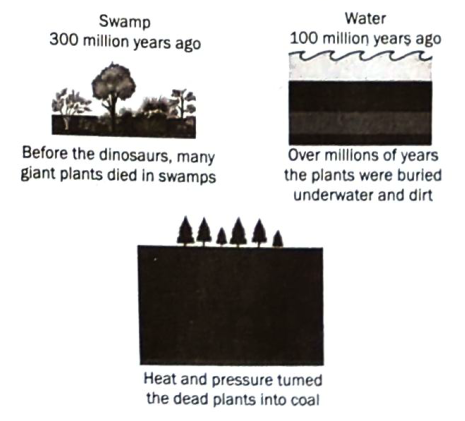
The table shows two groups of natural resources.
Image
(i) Which of these statements is true about coal ?
$\quad$Circle 'Yes' or 'No' for the correct response.
Is this true about coal ?Yes or No
(a) Dirt makes up a large part of coal.Yes/No
(b) Coal is produced from plant fossils.Yes/No
(c) Formation of coal requires heat and pressure.Yes/No

(ii) Where is a coal reserve most likely to be found ?
$\quad$(a) Inside volcanoes
$\quad$(b) Beneath glaciers
$\quad$(c) On ocean floors
$\quad$(d) Under land surfaces
(iii) Which gas is mainly emitted during the combustion of coal ?
(vi) Coke is a product obtained by the processing of coal.
$\quad~~~$Which of these is a byproduct of making coke ?
$\quad$(a) Coal tar
$\quad$(b) Bitumen
$\quad$(c) Coal gas
$\quad$(d) Kerosene
Erik dumped four types of domestic waste in separate land pits.
He covered the pits and left them undisturbed for a year.
The table below shows what he observed after a year.
Waste $1$ Waste $2$ Waste $3$ Waste $4$
Fully decomposed Not decomposed at all Fully decomposed Not decomposed at all
$9.$ Which type of waste(s) is most likely to cause soil pollution$?$
Heights of students of four different sections of Grade $8$ are measured. The table shows the
percentage of maximum height up to which the students in each section have grown
Section Girls Boys
$A$ $80\%$ $75\%$
$B$ $100\%$ $100\%$
$C$ $92\%$ $85\%$
$D$ $100\%$ $98\%$
$4.$ In which class have both the boys and the girls reached the end of puberty$?$
$A.$ Section $A$
$B.$ Section $B$
$C.$ Section $C$
$D.$ Section $D$
$5.$ What can be concluded from the table$?$
$A.$ Girls are taller than boys in all four classes.
$B.$ Girls attain their maximum height earlier than boys.
$C.$ Girls grow faster than boys throughout their childhood.
$D.$ Girls and boys attain their maximum height at the same age.
$6.$ What is the legal age for marriage in India$?$
$A. 16$ years for a girl and $18$ years for a boy
$B. 18$ years for a girl and $18$ years for a boy
$C. 18$ years for a girl and $21$ years for a boy
$D. 21$ years for a girl and $21$ years for a boy
$7.$ Why should syringes be disposed of carefully after use$?$
$8.$ Under which condition does metamorphosis take place$?$
$A.$ Females are twice the size of males.
$B.$ Young ones look different from adults.
$C.$ Young ones eat the same food as adults.
$D.$ Females are bright-coloured while males are dull.
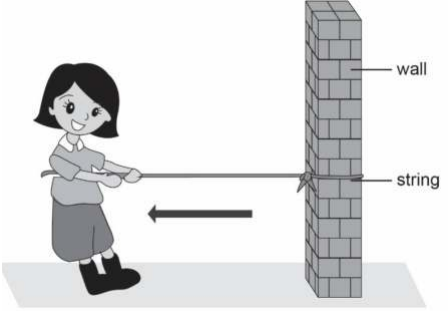
Ameeta ties four strings made of different materials to a wall.
She then pulls each string until it breaks.
The arrow shows the direction of the force.
Image

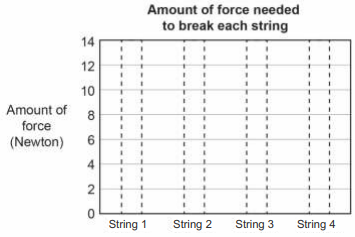
The table shows the amount of force needed to break each string.
String Amount of force needed to break the string (Newton)
String $1$ $10$
String $2$ $2$
String $3$ $14$
String $4$ $4$
$1.$ Draw the bars in the graph below to show the observations of Ameeta’s activity.
Fill in the dotted columns to show the correct values along the $Y- $axis.
Image
$2.$ Which string is made of the strongest ibre$?$
$A.$ String $1$
$B.$ String $2$
$C.$ String $3$
$D.$ String $4$
$3.$ What must Ameeta keep the same in her activity$?$
$A.$ Colour of the strings
$B.$ Length of the strings
$C.$ Thickness of the strings
$D.$ Height of the strings from ground
$4.$ Which of the following statements is/are true about polymers$?$
Circle ‘Yes’ or ‘No’ to mark your response.
Is the statement correct? Yes or No
All synthetic ibres are polymers. Yes/No
Some natural ibres are polymers. Yes/No
Polymers are made of multiple small chemical units. Yes/No
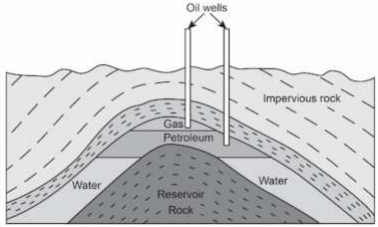
The picture shows how petroleum and natural gas are extracted through oil wellsImage
$7.$ Which of the following statements are supported by the picture$?$
Circle ‘Yes’ or ‘No’ for the correct response.
Is this statement supported by the picture? Yes or No
Petroleum is insoluble in water. Yes/No
Natural gas is denser than petroleum. Yes/No
Petroleum and natural gas deposits are found under rock layers. Yes/No
$8.$ Which of these conditions is required for the formation of natural gas$?$
$A.$ Low pressure
$B.$ Presence of air
$C.$ High temperature
$D.$ Presence of water
$9.$ Which of these petroleum products is used for heavy motor vehicles$?$
$A. LPG$
$B.$ Diesel
$C.$ Petrol
$D.$ Kerosene
$10.$ What is the advantage of using $CNG$ instead of petrol in light motor vehicles$?$
$A.$ It can be stored easily
$B.$ It can be extracted easily
$C.$ It causes less air pollution
$D.$ It releases more energy on combustion
The table shows the processes of external fertilisation and internal fertilisation.
External fertilisation Internal fertilisation
The female releases the eggs (ova) outside its body. The male releases the sperms on the eggs. Fertilisation takes place outside the female body. The male releases the sperms inside the body of the female. Fertilisation takes place inside the female body.
$6.$ Which of these is true about external fertilization and internal fertilization$?$
  External fertilization Internal fertilization
$A.$ Both parents are necessary Both parents are necessary
$B.$ Embryo is not formed Embryo is formed
$C.$ Involves development of eggshell Involves development of eggshell
$D.$ Takes place among invertebrates Takes place among vertebrates
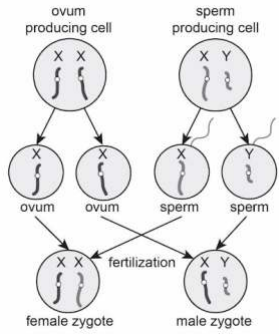
An ovum contains one $X$ chromosome.
A sperm contains an $X$ or a $Y$ chromosome.
A sperm can fertilize an ovum to produce two different zygotes.
Image
$1.$ Which chromosome does the female zygote receive from the mother and the father$?$
  Mother Father
$A.$ $X$ chromosome $Y$ chromosome
$B.$ $Y$ chromosome $X$ chromosome
$C.$ $X$ chromosome $X$ chromosome
$D.$ $Y$ chromosome $Y$ chromosome
$2.$ In which body part of a woman does a fertilized ovum get embedded$?$
$3.$ Which of these statements is supported by the picture$?$
Circle ‘Yes’ or ‘No’ for the correct response.
Is this Statement Supported by the Picture$?$ Yes or No
The father’s sperm decides the gender of the zygote. Yes/No
The $Y$ chromosome is shorter than the $X$ chromosome. Yes/No
An ovum unites with two sperms at a time Yes/No